Other Briefings
Reporting Obligations of Foreign Enterprises in Vietnam: 2026 Compliance Calendar
In March, foreign-invested enterprises (FIEs) in Vietnam face a busy period with multiple reporting obligations, which require a thorough understanding to avoid penalties and stay compliant.

March is the compliance-intensive period for foreign-invested enterprises (FIEs) in Vietnam, as multiple monthly, quarterly, and annual reporting obligations converge. These requirements span tax filings, investment reporting, foreign loan disclosures, and statistical submissions, each governed by separate authorities and deadlines.
Understanding the sequencing and documentation requirements is critical for avoiding penalties and ensuring regulatory compliance.
Reporting obligations in March 2026
Monthly foreign loan reports for FIEs – March 5
Foreign loan reporting obligations apply to enterprises with offshore borrowing arrangements, including deferred payment structures tied to import contracts.
As per Circular 12/2022/TT-NHNN, FIEs must submit monthly reports on the status of short-, medium-, and long-term foreign loans via the State Bank of Vietnam (SBV) online portal. These reports enable regulators to monitor foreign borrowing and repayment activities.
Key highlights:
- Deadline: No later than the 5th day of the following month
- Submission: Online via the SBV portal. If technical problems arise, the company can submit a written report to the SBV, using the form in Appendix 05 of Circular 12/2022
- Penalties apply for late or inaccurate reporting
Monthly tax submissions (VAT, FCT, and PIT) – March 20
Monthly tax declarations remain a core compliance obligation for FIEs with a monthly filing status. Enterprises must declare and pay value-added tax (VAT), foreign contractor tax (FCT), and personal income tax (PIT) withheld from employees.
Key highlights:
- Applies to companies registered for monthly tax filing
- Covers indirect taxes and payroll-related obligations
- Requires reconciliation with accounting records and invoices
- Increasing integration with Vietnam’s e-tax and e-invoice systems
Quarterly and annual investment implementation report – March 30
These reports are submitted to investment authorities and statistical offices. FIEs must report on project implementation, including capital contribution, operational progress, labor usage, and financial performance.
Key highlights:
- Submitted to the Department of Planning and Investment (DPI)
- Annual report deadline: Before March 31 of the following year
- Quarterly reports may also be required depending on project scope
Annual statistical reports – March 30
Enterprises must submit annual statistical data through the General Statistics Office (GSO) system.
Key highlights:
- Online submission only
- Content varies by locality and business sector
- Often overlaps with financial and labor reporting datasets
Annual PIT and CIT finalization – March 31
This is one of the most critical deadlines in Vietnam’s compliance calendar. Enterprises must finalize corporate income tax (CIT) and personal income tax (PIT), ensuring all liabilities are accurately calculated and declared.
Key highlights:
- Includes audited financial statements (for applicable entities)
- Transfer pricing documentation required for related-party transactions
- Reconciliation between provisional and final tax liabilities
- Increasing enforcement on e-identification and digital tax filing systems
What FIEs need to prepare for April 2026
In April, FIEs are also obliged to submit monthly reports including:
- Monthly foreign loan reports for FIEs – April 3; and
- Monthly tax submissions (VAT, FCT, and PIT) – April 20.
Additionally, April will be the final window for late or adjusted investment implementation reports, due by April 9. During this time, authorities may seek clarifications or request additional documents. Delays in submission could impact project compliance status and licensing.
Key compliance takeaways for FIEs
March is the most compliance-intensive period for FIEs in Vietnam, as tax finalization, investment reporting, and foreign loan disclosures all fall within a tight timeframe. At the same time, authorities are accelerating the shift toward digital reporting systems, particularly in tax and foreign loan management, requiring businesses to adapt to online platforms.
With stricter enforcement, late or inaccurate filings, especially for foreign loans, can lead to penalties and increased scrutiny. Ensuring consistency across tax, investment, and statistical reports is therefore essential to avoid audits.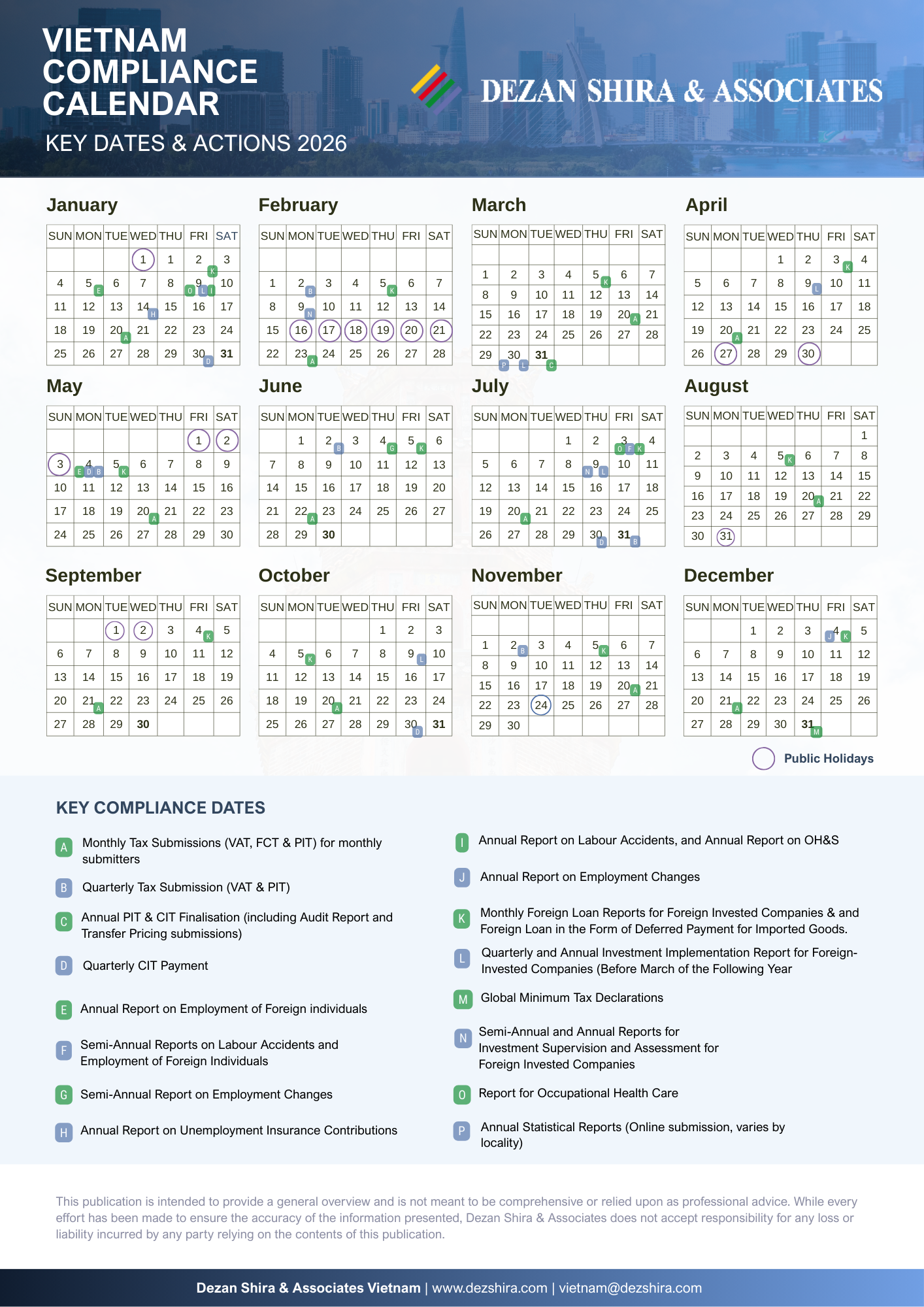



Navigating accounting and compliance requirements in Vietnam can be complex and time consuming. Engaging professional support helps businesses manage risks, stay compliant, and focus on growth with confidence.
About Us
Vietnam Briefing is one of five regional publications under the Asia Briefing brand. It is supported by Dezan Shira & Associates, a pan-Asia, multi-disciplinary professional services firm that assists foreign investors throughout Asia, including through offices in Hanoi, Ho Chi Minh City, and Da Nang in Vietnam. Dezan Shira & Associates also maintains offices or has alliance partners assisting foreign investors in China, Hong Kong SAR, Indonesia, Singapore, Malaysia, Mongolia, Dubai (UAE), Japan, South Korea, Nepal, The Philippines, Sri Lanka, Thailand, Italy, Germany, Bangladesh, Australia, United States, and United Kingdom and Ireland.
For a complimentary subscription to Vietnam Briefing’s content products, please click here. For support with establishing a business in Vietnam or for assistance in analyzing and entering markets, please contact the firm at vietnam@dezshira.com or visit us at www.dezshira.com
- Previous Article Vietnam’s Wood Industry in 2026: Navigating Challenges and Seizing New Opportunities
- Next Article Vietnam’s Amended Investment Law: Key Transitional Provisions for Existing and New Projects