Strip away the joint statements, and the Vietnam–China relationship today is being built in steel and concrete. From cross-border rail links and “smart” border gates to synchronized supply chains, the two economies are quietly engineering a level of operational integration that could define the next decade of Asian trade.
The Vietnam–China relationship is increasingly being operationalized through transport connectivity, customs modernization, maritime integration, investment flows, and deepening industrial cooperation, particularly across the northern corridor, where province-level engagement is intensifying. China remains indispensable to Vietnam’s manufacturing model and broader trade ecosystem, underpinning both upstream supply chains and export competitiveness.
Beyond diplomatic symbolism, the focus on Nanning in Guangxi and cross-border standard-gauge rail development reflects a strategic push to integrate northern Vietnam more closely with southern China’s logistics, customs, and production networks. During To Lam’s April 2026 visit, China signaled concrete support for Vietnam’s railway ambitions through financing, technology transfer, workforce training, and enterprise participation. Both sides characterized rail cooperation as a new “bright spot” in bilateral relations, highlighting its central role in shaping the next phase of economic integration.
Railways are becoming the hard infrastructure spine of the relationship
This is the most consequential area to watch. In April 2025, Vietnam and China signed multiple railway cooperation documents, including the establishment of a joint railway cooperation committee, Chinese technical support for the Lao Cai–Hanoi–Hai Phong line, and planning support for the Dong Dang–Hanoi and Mong Cai–Ha Long–Hai Phong standard-gauge routes. In March 2026, Hanoi and Beijing signed a further agreement to implement technical assistance for these lines, which Vietnam’s Ministry of Construction described as a practical basis for advancing strategic infrastructure connectivity, trade facilitation, and regional development.
That agenda is already moving from planning to construction. Vietnam broke ground in December 2025 on the Lao Cai–Hanoi–Hai Phong railway, a 419 km project connecting the Lao Cai international border gate to Lach Huyen seaport in Hai Phong, with operations expected by late 2030. A Reuters report notes the operational railway length at 391 km, with a total investment of VND 203.2 trillion (US$7.7 million) and partial financing expected from Chinese government loans. The broader point is clear: Hanoi is positioning rail connectivity with China as a core component of its growth and industrial logistics strategy, rather than a peripheral initiative.
This shift matters because rail alters the commercial logic of the relationship. Improved standard-gauge connectivity would reduce longstanding physical bottlenecks between Chinese and Vietnamese systems, lower logistics frictions in the north, and tighten the production loop between Chinese upstream suppliers and Vietnam-based manufacturers. China’s official messaging in 2025 explicitly linked bilateral ties to stronger railway, expressway, and port interconnectivity, as well as expanded cross-border train services. In practical terms, Vietnam’s role in “China+1” manufacturing is becoming less about separation from China and more about functional integration with it.
Border modernization is where the relationship becomes operational
A second layer of implementation is visible at the border, where modernization efforts are translating strategic alignment into operational efficiency. In January 2026, Vietnam approved a pilot “smart border gate” at the Mong Cai–Dongxing crossing. The initiative is designed to reduce customs clearance times from one to two days to four to six hours, lower logistics costs by 30 to 40 percent, and triple clearance capacity by 2030, supported by 24/7 operations enabled through intelligent systems and automated handling technologies. The project reflects a broader policy intent to convert high-level commitments into measurable trade facilitation outcomes.
Guangxi is advancing in parallel. Reporting from April 2026 indicates that the region is promoting smart border gate infrastructure to enable round-the-clock, automated customs clearance across its nine land crossings with Vietnam, including Dongxing and Youyiguan. For manufacturers and traders, this translates into greater predictability in cross-border logistics, reduced dwell times, smoother intermediate goods flows, and increased digitalization of customs procedures.
Taken together, these developments point to the growing importance of Guangxi – and specifically Nanning – as a strategic interface between China’s inland and coastal transport systems and northern Vietnam’s industrial base. As border systems, rail networks, and port infrastructure are upgraded in tandem, the bilateral relationship is developing into a corridor-based economic model rather than a purely state-led framework. Increasingly, the most consequential dynamics are unfolding at the subnational level, across border provinces, logistics hubs, and industrial zones, and reflected in the heightened emphasis on local government cooperation in recent joint statements.
Trade is booming, but structural imbalances persist
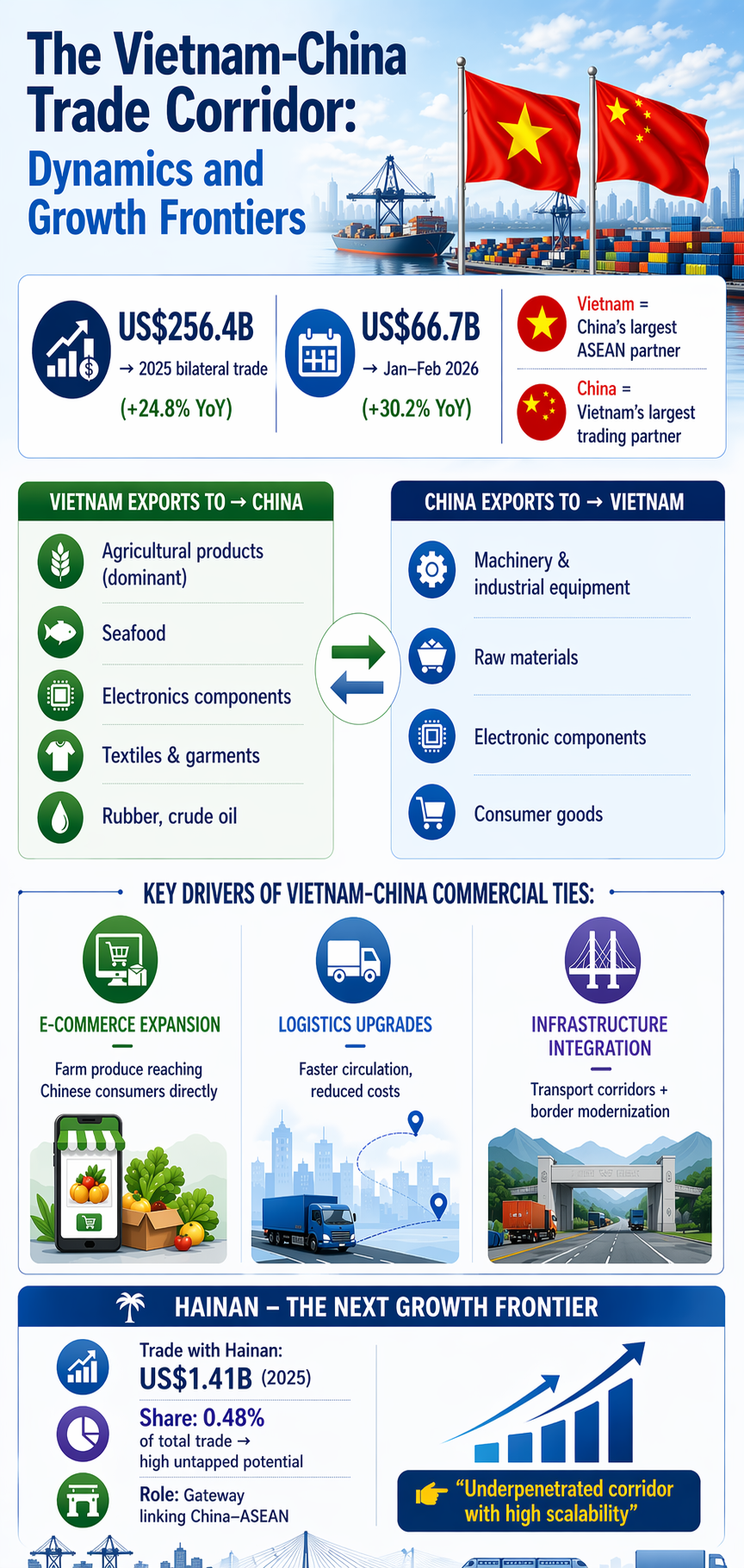
The bilateral trade relationship remains the economic backbone of Vietnam–China ties. Two-way trade reached approximately US$256 billion in 2025, reflecting strong year-on-year growth, with momentum continuing into early 2026. China remains Vietnam’s largest trading partner, while Vietnam is China’s largest trading partner within ASEAN.
However, this expansion is accompanied by a widening structural imbalance. Vietnam’s trade deficit with China has increased significantly, prompting Hanoi to prioritize more balanced trade outcomes. This includes efforts to expand market access for Vietnamese exports, particularly agricultural and aquatic products, alongside improvements in mutual recognition of standards and the development of cross-border e-commerce channels. The broader objective is to move beyond an assembly-led model toward greater domestic value capture within supply chains.
Imports from China are largely concentrated in intermediate goods, components, and raw materials that feed Vietnam’s manufacturing base, while exports are driven by agricultural products, seafood, electronic components, textiles and garments, rubber, and crude oil.
See also: China-Vietnam Trade Relationship: Key Trade Routes and Growth Drivers
“China+1” is reshaping the relationship
Chinese investment in Vietnam continues to expand as suppliers reposition to navigate global trade pressures, with a growing emphasis on joint ventures, technology transfer, and deeper industrial collaboration. This reflects a shift from simple relocation to a more embedded production model, characterized by the integration of Chinese capital, supplier ecosystems, and long-term manufacturing partnerships within Vietnam.
As a result, the relationship increasingly resembles a layered regional production system rather than a zero-sum competition between “China manufacturing” and “Vietnam manufacturing.” Vietnam benefits from job creation, export growth, and enhanced industrial capacity, while China maintains a central role in upstream inputs, machinery, technology, logistics, and, increasingly, infrastructure financing. Recent bilateral engagements clearly demonstrate this trajectory, with cooperation expanding beyond traditional trade into sectors, such as artificial intelligence, semiconductors, digital industries, new energy, critical minerals, customs coordination, and supply chain integration.
Maritime and local connectivity are also expanding
The relationship is not limited to land-based integration. Maritime connectivity is emerging as an important complementary pillar, reinforcing Vietnam-China cross-border trade flows and regional linkages. The launch of new container routes connecting southern China with northern Vietnam and onward to South Asia reflects a broader effort to establish integrated trade corridors spanning production and consumption hubs across the region. Guangxi, in particular, has expanded its shipping network with multiple routes linked to Vietnamese ports, including Hai Phong and Ho Chi Minh City.
This maritime dimension is significant for two reasons. First, it shows that bilateral integration is being pursued through a multimodal framework, combining rail, road, port, and shipping infrastructure. Second, it positions Hai Phong and the wider northern port-industrial cluster as central nodes in this evolving connectivity architecture. As these corridors converge, northern Vietnam is increasingly functioning as a key interface between China’s southern economic zones and broader regional and global trade networks.
People-to-people ties are being organized with more intention
Another notable feature is the effort to institutionalize local and social ties, especially in border areas. The April 2026 joint statement highlighted exchanges among localities, particularly border provinces, and the continuation of specific inter-provincial mechanisms involving Guangxi and Yunnan. Recent state coverage also points to a growing ecosystem of border festivals, resident exchanges, tourism cooperation, and defense diplomacy. Examples include the 2026 Vietnam–China Border People’s Festival in Nanning, the annual Border Defense Friendship Exchange in Quang Ninh and Guangxi, and the cross-border tourism cooperation site at Ban Gioc–Detian.
For business, these events are not just ceremonial. They help to create a softer operating environment around customs coordination, local administrative trust, transport planning, and investment promotion. They also show that border management is not being treated simply as a security issue; it is being tied to trade, tourism, and local development.
But the Vietnam–China relationship still has hard limits
The bilateral relationship is not frictionless. Recent engagements continue to address maritime differences, particularly in the East Sea, alongside commitments to manage disputes, avoid escalation, and maintain dialogue under international law. There is also sustained emphasis on border control, anti-smuggling, anti-fraud measures, and information sharing – highlighting the managed and security-conscious nature of the relationship.
At the operational level, tighter scrutiny around rules of origin and transshipment has increased compliance requirements. As supply chain integration deepens, exporters using Vietnam as a production base face greater pressure to ensure robust documentation, local value addition, and adherence to trade regulations.
Vietnam–China relations are moving towards deep operational and physical integration rather than just diplomatic rhetoric. Both nations are investing heavily in hard infrastructure, such as standard-gauge railways and “smart” border gates, to streamline the movement of goods and reduce logistics costs. This connectivity reinforces Vietnam’s role in the “China+1” manufacturing strategy, making its industrial base more functionally dependent on Chinese supply chains and technical expertise. While trade imbalances and maritime disputes remain points of friction, the focus has moved to creating permanent economic corridors through provincial and regional cooperation and aligned customs systems. Ultimately, Vietnam’s economic growth is becoming increasingly anchored to its industrial and digital ties with China’s southern provinces.
Bottom line
The Vietnam–China relationship is working on the ground, not because political rhetoric has become warmer, but because both sides are building systems that make interdependence harder to reverse. Rail planning is being institutionalized. The Lao Cai–Hanoi–Hai Phong line is underway. Smart border gates are being rolled out. Guangxi is integrating more deeply with northern Vietnam. Port routes are multiplying. Chinese investment and technology partnerships are becoming more embedded in Vietnam’s manufacturing landscape.
For foreign investors, the practical takeaway is straightforward: Vietnam’s attractiveness as a manufacturing and export platform increasingly rests on its ability to stay plugged into China, not outside it. The country’s strategic balancing will continue, and maritime tensions will remain real. But at the operational level, the Vietnam–China relationship is moving from diplomatic alignment to physical, digital, and industrial connectivity. That is the story playing out in Guangxi, Mong Cai, Hai Phong, Lao Cai, and the northern production belt – and it is likely to shape the next phase of Vietnam’s trade and investment model.