Other Briefings
Why Vietnam is the Top China+1 Destination for Australian Firms
For Australian companies pursuing a China+1 strategy, Vietnam is a prime option, offering competitive production costs, robust industrial networks, and extensive trade agreements.

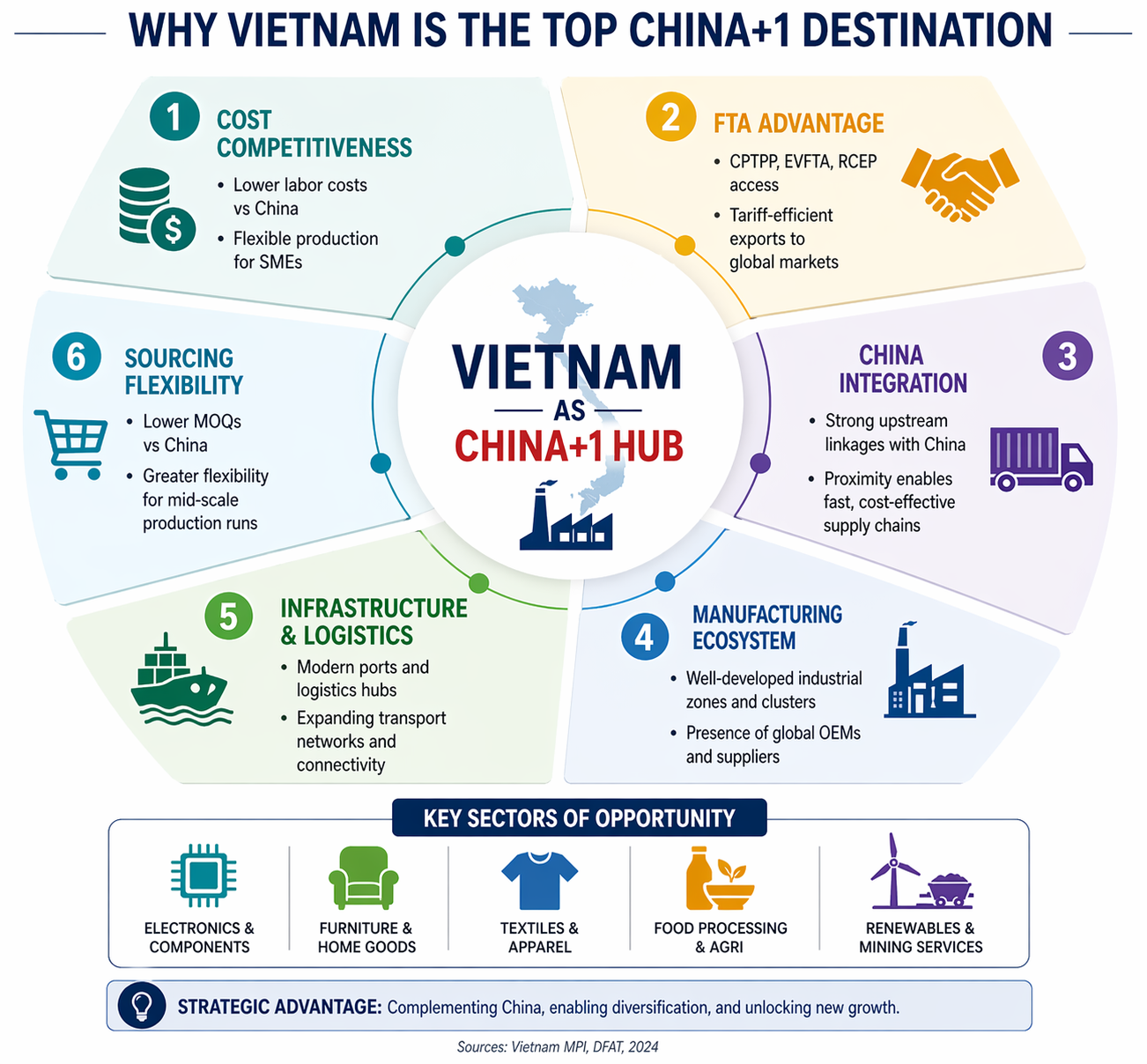
Vietnam has emerged as a primary China+1 destination for Australian firms seeking manufacturing diversification, cost optimization, and supply chain resilience. Its appeal is not based on replacing China but on complementing it, leveraging deep industrial linkages, competitive production costs, and extensive trade agreements.
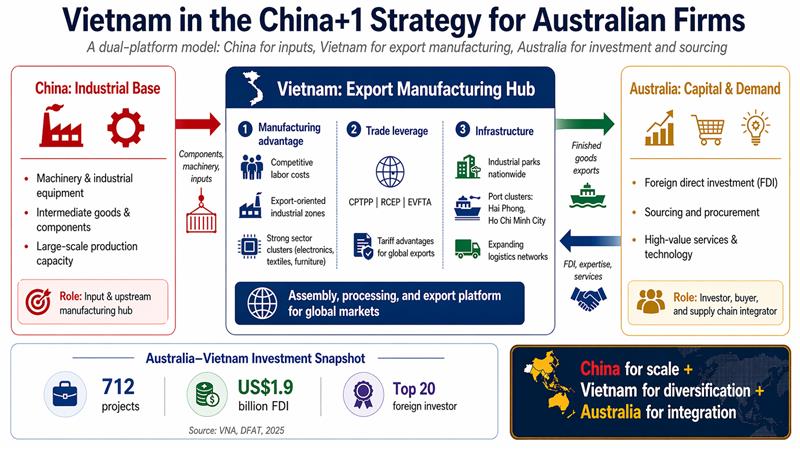
For Australian investors, Vietnam represents a dual-platform strategy:
- A production base for global exports
- A sourcing hub integrated with Chinese supply chains
Australia–Vietnam investment landscape
Australia’s investment footprint is broad but relatively shallow, indicating strong headroom for expansion, especially in manufacturing and supply chain-linked sectors. Data from 2024 confirms steady – though still underpenetrated – Australian investment in Vietnam:
- 712 Australian FDI projects with total registered capital of ~US$1.9 billion
- Australia ranks among the top 20 foreign investors in Vietnam in 2025
- Investment spans manufacturing, agriculture, services, and infrastructure
- Projects are distributed across the country, including major hubs like Ho Chi Minh City, Hanoi, and Ba Ria–Vung Tau
 Why Vietnam is outperforming as a China+1 destination
Manufacturing scale + cost competitiveness
Vietnam’s manufacturing sector is the backbone of its FDI-led growth, supported by:
- Competitive labor costs relative to China
- Export-oriented industrial zones (north–south corridor)
- Strong sector clusters: electronics, textiles, furniture, footwear
Vietnam has become a global manufacturing node, with major multinational supply chains already anchored in-country.
Trade agreements favor Australian firms
Vietnam offers one of the most extensive FTA networks globally, including:
- Comprehensive and Progressive Agreement for Trans-Pacific Partnership (CPTPP)
- EU–Vietnam FTA (EVFTA)
- Regional Comprehensive Economic Partnership (RCEP)
For Australian firms, CPTPP alone enables:
- Reduced tariffs on Vietnam-manufactured goods
- Improved cost competitiveness vs China imports
Deep supply chain linkages with China
Vietnam’s advantage is not decoupling but integration with China’s industrial ecosystem:
- High dependence on Chinese machinery, inputs, and components
- Geographic proximity enabling fast cross-border logistics
- Increasing infrastructure integration (ports, rail, border gates)
Implication: Australian firms can maintain Chinese supplier relationships while shifting final assembly or export production to Vietnam.
Infrastructure and industrial ecosystem maturity
Vietnam’s infrastructure upgrades underpin its manufacturing rise:
- Industrial parks and export processing zones across key regions
- Port clusters (Hai Phong, Ho Chi Minh City)
- Expanding logistics and e-commerce networks
These factors enable scalable, export-ready production ecosystems, which are critical for Australian SMEs and sourcing firms.
Sector opportunities for Australian firms
Vietnam’s alignment with Australian import demand is particularly strong in consumer goods, agri-processing, and light manufacturing.
|
Sector |
Opportunity rationale |
|
Electronics & components |
Growing assembly base tied to global OEMs |
|
Furniture & home goods |
Strong export capabilities and craftsmanship |
|
Textiles & apparel |
Competitive pricing + scalable production |
|
Food processing & agri |
Alignment with Australian agri exports |
|
Renewables & mining services |
Strong policy push + Australian expertise |
Australian companies operating in Vietnam
Vietnam has attracted a growing base of Australian firms across sectors:
- Telstra
- RMIT University
- ANZ
- BlueScope Steel
- BHP
- Austal
- SunRice
- Mavin Group
These firms operate across manufacturing, education, finance, infrastructure, and agribusiness, reflecting Vietnam’s multi-sector appeal.
Vietnam as a sourcing hub for Australian SMEs
For Australian importers and SMEs, Vietnam offers distinct sourcing advantages:
Key benefits
- Lower MOQs (minimum order quantities) vs China
- Greater flexibility for mid-sized production runs
- Increasing compliance with ethical and sustainability standards
- Strong export-oriented supplier base
Key sourcing sectors
- Furniture and home décor
- Apparel and footwear
- Consumer electronics assembly
- Processed food and agri-products
Strategic considerations for Australian investors
|
Vietnam Entry Strategy Options |
||
|
Model |
Best for |
Key considerations |
|
Representative office |
Market testing |
No revenue generation |
|
Trading company |
Sourcing & distribution |
Limited manufacturing |
|
Wholly foreign-owned enterprise (WFOE) |
Manufacturing |
Licensing, compliance |
|
JV with local partner |
Market access |
Partner due diligence |
|
Vietnam Site Selection Strategy |
|
|
Region |
Strength |
|
Northern Vietnam (Hanoi, Hai Phong) |
Electronics, proximity to China |
|
Southern Vietnam (HCMC, Binh Duong) |
Consumer goods, logistics |
|
Central Vietnam (Da Nang) |
Emerging manufacturing hub |
|
Vietnam Market Entry: Key Risks and Mitigation |
|
|
Risk |
Mitigation strategy |
|
Supply chain dependency on China |
Dual sourcing strategy |
|
Infrastructure bottlenecks |
Locate near industrial clusters |
|
Regulatory complexity |
Engage local advisory support |
|
Skills gaps in high-tech sectors |
Invest in training partnerships |
Vietnam vs China: Complement, not substitute
Vietnam’s role is best understood as “China+1 – not China replacement”:
- China remains dominant in inputs and advanced manufacturing
- Vietnam specializes in assembly, export manufacturing, and diversification
For Australian firms, the optimal model is: China for scale and inputs + Vietnam for diversification and export optimization.
Australia’s Southeast Asia Economic Strategy to 2040: How Vietnam can play a key role
“Invested: Australia’s Southeast Asia Economic Strategy to 2040” was launched in September 2023 by the Anthony Albanese Government. The strategy positions Southeast Asia as central to Australia’s long-term prosperity and security, aiming to substantially grow two-way trade and unlock much higher Australian investment in the region by 2040.
The strategy identifies Vietnam as a high-growth, manufacturing-driven economy where Australian businesses can scale commercial engagement across multiple sectors. Key drivers include:
- Rapid industrialization and export growth, positioning Vietnam as a core production base in global value chains
- Strong participation in regional trade frameworks such as the RCEP and CPTPP
- Increasing demand for high-quality inputs, services, and technology, areas where Australian firms have competitive strengths
The strategy outlines several sectors where Vietnam offers immediate and scalable opportunities for Australian firms – as shown in the table below.
|
Australia’s Southeast Asia Economic Strategy to 2040: Vietnam Market Prospects |
|
|
Sector |
Commercial opportunity in Vietnam |
|
Clean energy & renewables |
Vietnam’s energy transition creates demand for Australian expertise in grid, storage, and project financing |
|
Agribusiness & food processing |
Strong complementarities with Australia’s export strengths and Vietnam’s processing capacity |
|
Education & skills development |
Workforce upskilling for manufacturing and digital sectors |
|
Digital economy & technology |
Rapid digital adoption across manufacturing and services |
|
Infrastructure & logistics |
Expansion of ports, industrial parks, and transport corridors |
Final advisory
For Australian firms, Vietnam is no longer an “alternative” market – it is a core node in Asia’s supply chains.
Winning strategies will focus on:
- Leveraging Vietnam’s FTA-driven export advantage
- Maintaining China-linked supply chain integration
- Building localized production and sourcing ecosystems
- Aligning with industrial clusters and sector strengths
In practical terms, Vietnam offers Australian businesses a cost-effective, trade-advantaged, and strategically connected manufacturing base – positioning it as the most viable China+1 destination in Southeast Asia today.
For international investors, Vietnam's different localities offer favorable conditions across almost every sector, particularly as the country shifts toward higher value-chain manufacturing, high-tech industries, and innovation. Taking a closer look at Vietnam's provinces and investment destinations before committing capital can provide a decisive competitive advantage. A tailored market study, dedicated location selection, or business matchmaking can uncover factors that are often hard to assess—such as special incentives, skilled labor availability, and tax breaks. About Us Vietnam Briefing is one of five regional publications under the Asia Briefing brand. It is supported by Dezan Shira & Associates, a pan-Asia, multi-disciplinary professional services firm that assists foreign investors throughout Asia, including through offices in Hanoi, Ho Chi Minh City, and Da Nang in Vietnam. Dezan Shira & Associates also maintains offices or has alliance partners assisting foreign investors in China, Hong Kong SAR, Indonesia, Singapore, Malaysia, Mongolia, Dubai (UAE), Japan, South Korea, Nepal, The Philippines, Sri Lanka, Thailand, Italy, Germany, Bangladesh, Australia, United States, and United Kingdom and Ireland. For a complimentary subscription to Vietnam Briefing’s content products, please click here. For support with establishing a business in Vietnam or for assistance in analyzing and entering markets, please contact the firm at vietnam@dezshira.com or visit us at www.dezshira.com


- Previous Article Mapping Adidas’ Supply Chain in Vietnam: Clusters, Logistics, and Labor Dynamics
- Next Article