Vietnam’s coffee market is experiencing significant growth and evolving consumer preferences, driven by positive export performance and demand. With a notable surge in coffee prices and a potential tariff exemption from the US, Vietnam’s coffee industry is poised for promising opportunities.
On 27 October, US President Donald Trump indicated that coffee would be part of a new trade agreement with Vietnam, which would exclude it from the 20 percent headline tariff. The news, along with optimistic performance in the first 10 months of 2025, has revitalised business confidence in Vietnam’s future coffee export growth.
Vietnam’s coffee industry holds promising opportunities for domestic and foreign firms in both manufacturing and retail.
Nevertheless, navigating the Vietnamese coffee market can be demanding, especially when competing with hundreds of local and foreign coffee brands already present in Vietnam’s market.
Refine Market Positioning
Use Vietnam's coffee industry insights to refine product positioning, distribution, and expansion strategy.Vietnam’s coffee export turnover surges as prices climb
By the end of October 2025, Vietnam recorded a US$7.41 billion turnover in coffee exports, increasing by more than 60 percent compared to the same period last year – the highest growth among the country’s key agricultural exports. Notably, Vietnam’s coffee prices also reached a record high in recent years, averaging US$5,653 per tonne.
The impressive performance has led to optimistic forecasts for product sales in the final months of 2025, as global markets enter the year-end peak demand season in Europe and North America.
|
Province |
Purchase price on 4 November 2025 (VND/kg) |
Purchase Price on 4 November 2025 (US$/kg) |
Change vs. 3 November 2025 (US$/kg) |
|
Dak Lak |
119,000 |
4.52 |
+0.08 |
|
Lam Dong |
118,200 – 119,500 |
4.49 – 4.54 |
+0.10 |
|
Gia Lai |
118,500 |
4.50 |
+0.08 |
Key trends in the global coffee market today
Supply shortages from key exporters
Supply shortages from key exporters like Brazil, Vietnam, and Indonesia are causing the price rise in coffee. Climate change has negatively affected harvests in many regions, significantly reducing global output so far this year.
US importers show growing interest in Vietnam’s Robusta coffee
With a potential tariff exemption on the horizon, new opportunities for Vietnam’s coffee in the US market are set to open up. According to the Vietnam Coffee and Cocoa Association (Vicofa), US importers are looking to increase imports of Vietnamese speciality coffee, as American roasters’ interest in Vietnam’s Robusta coffee continues to grow.
Over the past two years, indicators have pointed to a gradual shift in US coffee consumption, with consumers seeking new taste profiles beyond conventional Arabica. This growing appreciation for speciality Robusta offers Vietnam an opportunity to strengthen its position in one of the world’s largest coffee-consuming markets.
However, despite being the world’s largest producer and exporter of Robusta coffee, Vietnam’s speciality-grade Robusta output remains limited. This represents a market gap that Vietnam could strategically address in the coming years by improving processing, differentiating on quality, and promoting speciality Robusta exports.
Domestic market emerging as Vietnam’s second growth engine
Beyond exports, Vietnam’s domestic market is increasingly regarded as a major driver for the coffee industry. With a population of over 100 million, per capita coffee consumption reaches 2.5-3 kilograms annually – still well below Europe’s 6-8 kilograms, but growing quickly.
The domestic market offers firms a testing ground to refine products and build brand value before expanding abroad. The rapid rise of major chains such as Highlands, Phuc Long, Starbucks, and The Coffee House reflects strong and steady demand, helping enterprises reduce reliance on volatile export markets.
Looking ahead, experts forecast a surge in global coffee consumption during the year-end festive seasons, particularly in the US and Europe. With favourable prices, Vietnam’s coffee export turnover in 2025 is likely to surpass US$5 billion, despite lower output.
Vietnam’s coffee export performance in 2024
According to the Ministry of Agriculture and Rural Development (MARD), coffee exports reached 1.32 million tonnes in 2024, an 18.8 percent decrease in volume but a 29.11 percent increase in value compared to 2023. Vietnam’s average coffee export in 2024 was US$4,151 per tonne, surging 56.9 percent year-on-year. The country’s coffee export turnover has consistently risen in the past five years, from US$2.66 billion in 2020 to US$5.48 billion in 2024.
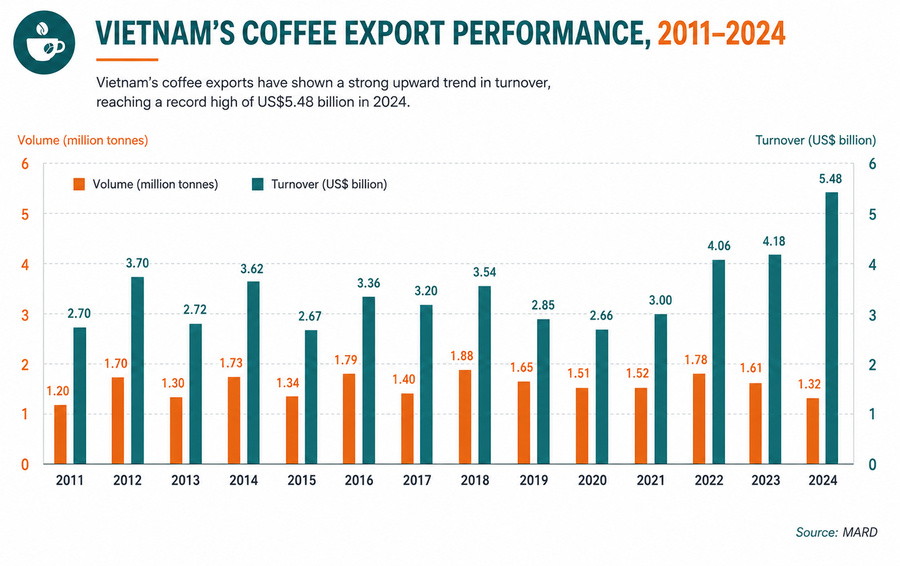 Vietnam has experienced export growth in all of its top 15 export markets. Malaysia saw the highest growth at 2.2 times, followed by the Philippines at 2.1 times. However, the European Union (EU) remained the largest market for Vietnamese coffee in 2024, with Germany, Italy, and Spain being the three largest coffee-consuming markets for Vietnam, holding market shares of 11 percent, 8.1 percent, and 8 percent, respectively.
The Vietnam Coffee and Cocoa Association reported that in the 2023-2024 crop year (from October 2023 to September 2024), Vietnam exported approximately 1.46 million tonnes of coffee valued at US$5.43 billion, the highest export turnover in a coffee crop year.
Spikes in global coffee prices contribute to Vietnam’s success
In the first 11 months of 2024, Vietnam exported over 1.2 million tonnes of coffee, a 14 percent decline from 2023. Conversely, coffee export revenue increased by over 35 percent, due to record-high export prices.
In October 2024, Vietnam’s average coffee export price reached US$5,720 per tonne, the highest on record, reflecting a 59 percent rise from the previous year. Although the price dipped slightly in the following month to US$5,581 per tonne, it stayed relatively high. Thus, Vietnam’s average coffee export price for the first 11 months was US$4,052 per tonne, up 57 percent from 2023. Vietnam’s Import-Export Department reported that in 2024, coffee experienced the largest price increase among key agricultural exports.
The Vietnam Coffee and Cocoa Association (VICOFA) noted that 2024 was unprecedented in both Vietnamese and global coffee history regarding price increases. Vietnamese coffee prices are now the highest worldwide, with Robusta surpassing Arabica prices. Robusta prices on the London Stock Exchange exceeded US$5,000 per tonne for the first time.
Key players in the Vietnam coffee market
Vietnam is known for its wide range of coffee products and types, with Arabica, Robusta, Liberica, Peaberry, and Weasel coffee being some of its most famous varieties.
Vietnam’s leading raw coffee exporters
According to Statista, the top 10 raw coffee exporters in Vietnam during the 2022/2023 crop year include:
- Intimex Group JSC: 148.53 thousand tonnes
- Vinh Hiep Co. LTD: 120.51 thousand tonnes
- Simexco Daklak: 102.58 thousand tonnes
- Intimex My Phuoc JSC: 91.82 thousand tonnes
- Louis Dreyfus Vietnam: 90.39 thousand tonnes
- NKG Vietnam Co. LTD: 75.69 thousand tonnes
- Phuc Sinh Corporation: 65.49 thousand tonnes
- Tuan Loc Commodities: 62.08 thousand tonnes
- Highlands Coffee: 58.53 thousand tonnes
- Olam Group: 57.43 thousand tonnes
Vietnam’s top coffee brands
The Vietnamese coffee market is a tough arena for both local and foreign brands. A Mordor Intelligence assessment lists five leading brands in Vietnam’s coffee market. These are noted below.
Nestlé
Nestlé is a well-known brand in the Vietnamese fast-moving consumer goods (FMCG) industry. The company has leading instant coffee products under the brand name ‘Nescafé’, which had the highest brand recognition of instant coffee products in Vietnam in 2018. Currently, Nestlé has six plants in Vietnam with roughly 2,300 employees.
Bien Hoa Vinacafé Joint Stock Company
Bien Hoa Vinacafé is the leading coffee manufacturing company in Vietnam with two signature coffee instant products: Vinacafé and Wake-up. The company has exported its coffee products to more than 20 countries, including major markets in ASEAN and Europe.
Starbucks Coffee Company
In Vietnam, the global coffee giant Starbucks owns 87 stores, mainly in Hanoi and Ho Chi Minh City. As of February 2025, Starbucks has around 125 stores in Vietnam.
Len’s Coffee LLC
Len’s Coffee is a family-run coffee-exporting company. The company exports different varieties of coffee to the U.S. from Vietnam, including Arabica, Robusta, Excelsa, and Liberica. Len’s Coffee works with four famous local coffee brands in Vietnam: Trung Nguyen Coffee, Highlands Coffee, Truong Lam Coffee, and Bach Coffee.
Phuc Long Trading Production Company Limited
Phuc Long Trading Production Company is a pioneer in the Vietnamese coffee and tea industry. The company had a total of 176 stores in 2024 and aims to expand into the global market and be the largest coffee and tea chain in Vietnam. In addition to offering food and beverage services at stores, Phuc Long also sells packaged coffee and tea products.
Challenges for foreign coffee brands in Vietnam’s market
Different customer preferences
Vietnamese people prefer the strong, bitter Robusta coffee. For Vietnamese consumers, a delicious cup of coffee must be rich in natural flavour, have the right amount of bitterness, and have the soft aroma of wood. Most foreign coffee brands use milder Arabica beans with the aroma of nuts and fruit.
Furthermore, coffee in Vietnam is not a ‘quick drink’ to get a buzz like it often is in Western cultures. Vietnamese people go for coffee for leisure; they like to sit and sip and think. These differences in coffee culture can make foreign brands less attractive than local brands.
Vietnamese are price-sensitive
Vietnam is one of the most price-sensitive regions in Southeast Asia. According to the H1 2024 Vietnam Food & Beverage Market Report released by iPOS, most Vietnamese consumers are willing to pay between VND 41,000 and VND 71,000 (US$1.60 to US$2.78) for coffee. While the percentage of surveyed consumers willing to pay this price range has risen by 11.5 percent compared to six months ago, the higher-end segment continues to face challenges, including popular brands like Starbucks, %Arabica, and The Coffee Bean & Tea Leaf. The percentage of consumers paying more than VND 100,000 (US$3.91) per cup has dropped from 6 percent to 1.7 percent.
Consumers have also been inclined to reduce their frequency of travelling to coffee shops, citing high pressure at work as the main reason. Accordingly, in the first half of 2024, a notable 41.7 percent went to a cafe only one or two times per month, while 32.3 percent visited these places once or twice every week.
Tough competition
Foreign brands entering the Vietnamese coffee market will experience tough competition from local brands and other foreign brands, from coffee store chains to sidewalk cafes. With approximately 500,000 cafes by 2023, varying from large to small, according to a Mibrand report, Vietnam boasts an abundance of delicious and reasonably priced cafes. Trung Nguyen Coffee was the most recognisable coffee chain among Vietnamese consumers, according to a Statista survey in 2022.
High business operation cost
According to CBRE Vietnam, the rental price in commercial shopping centres in 2024 was roughly US$178 per square meter per month in Hanoi and US$273 in Ho Chi Minh City. Coupled with Vietnam’s price-sensitive consumers, these costs can challenge foreign brands to scale back or withdraw.
Market prospects for foreign firms
Changing consumer preferences
According to the Food and Beverage Business Market Report 2022, younger consumers (aged 23 to 30) are more receptive to foreign coffee products, including Arabica beans, and are not averse to seeing coffee culture in Vietnam evolve.
Rising demand for instant coffee
Busy lifestyles and longer working hours are making the instant coffee market in Vietnam increasingly vibrant and competitive. Knowledge Sourcing Intelligence has projected that Vietnam’s instant coffee market is projected to grow at a compound annual growth rate (CAGR) of 12.26 percent, reaching a value of US$731.443 million by 2028.
In 2021, the Louis Dreyfus Company (LDC) and private-label coffee company Instanta signed a joint venture agreement to build an instant coffee factory. A year later, Nestlé and Starbucks launched a new instant coffee product covering the signature flavours of Starbucks coffee: Dark Roast, Caffè Mocha, Caffè Latte, and Caramel Latte.
Investment opportunities
Coffee manufacturing and processing facilities
With abundant natural resources, a growing skilled workforce, and a low-cost labor force, Vietnam is an attractive destination for foreign enterprises in the coffee processing sector. Nestlé, a leading company in the F&B sector, purchases 20 to 25 percent of Vietnamese coffee each year for processing.
Foreign enterprises may also benefit from supportive government policies. According to Decree No. 57/2018/ND-CP, the Vietnamese government will support up to 60 percent of the investment budget, capped at US$625,000, for enterprises investing in Vietnam’s agriculture sector. Projects linking enterprises and farmers in production and agriculture could also be subsidised under Decree No. 98/2018/ND-CP.
Online coffee stores
Vietnamese consumers are avid patrons of online retail channels. Datareportal’s Digital 2022: Vietnam report found rising internet penetration and online beverage demand. Vietnam’s e-commerce value is expected to reach US$39 billion in 2025, ranking the country second in Southeast Asia in e-commerce growth. However, online retail has not been able to completely displace traditional channels. Businesses may need a good business model combining both online and offline channels to expand and develop sustainably in Vietnam.
Conclusion
The Vietnamese coffee market is an attractive option for international investors; however, they should make sure they understand the market well in advance and be prepared to cater to local tastes. This means looking at the types of coffee Vietnamese consumers enjoy, the way they enjoy their coffee, and learning from the experiences of foreign coffee brands that have decided to exit the market.
If you’re considering expanding into the Vietnamese consumer market, get in touch with our Business Intelligence experts for competitor benchmarking and a tailored market entry strategy for your product or service.
This article was originally published on 15 September 2023. It was last updated on 5 November 2025.
Unlock the Full Article
Share a few details to continue reading