Other Briefings
US Designates Vietnam a Priority Foreign Country on IP: What Foreign Businesses Should Review

On Aptil 30, 2026, the US Office of the Trade Representative (USTR) released its Special 301 Report, designating Vietnam as a Priority Foreign Country (PFC).
The category sits at the top of the Special 301 framework, above the Watch List and Priority Watch List, and is reserved by statute for trading partners that USTR considers to have the most egregious IP-related practices.
What happened?
Vietnam is the only country to receive the designation in 2026, and the first since 2013. USTR now has 30 days to decide whether to open a formal Section 301 investigation, with a determination usually reached within six months.
Vietnam’s Ministry of Foreign Affairs (MOFA) has requested that the United States conduct an “objective assessment” of the country’s enforcement record, citing the IP law amendments passed in December 2025 and ongoing actions against piracy platforms. The diplomatic exchange will continue, but for foreign businesses with operations or supply chain exposure in Vietnam, the more useful questions are narrower.
In this article, we examine what the PFC designation actually triggers, where the amended IP framework has changed, and how the practical enforcement landscape is likely to develop over the coming year.
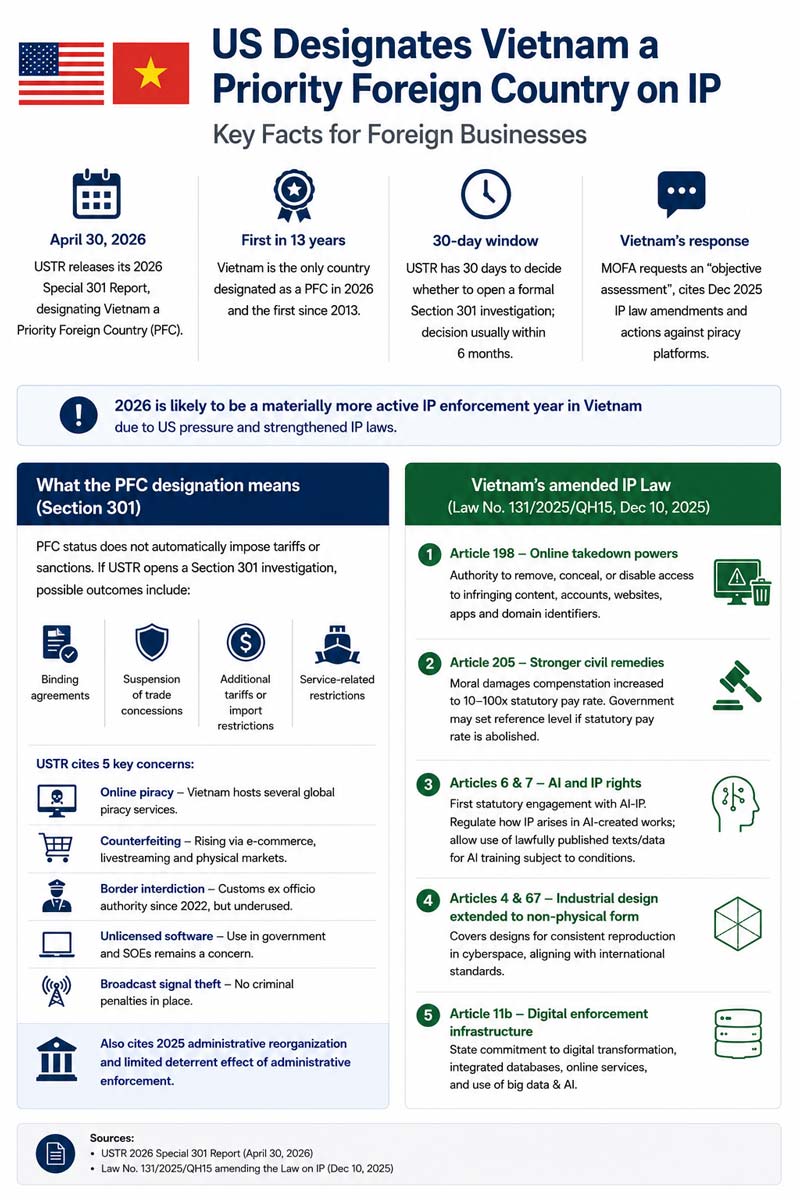
What the PFC designation means: Section 301 investigation timeline and possible trade measures
PFC status does not automatically impose tariffs or sanctions. The Special 301 Report is a unilateral US policy instrument, not a judicial ruling, and the framework is designed to escalate bilateral pressure rather than to impose direct measures. The operational consequences begin only if USTR opens a Section 301 investigation within the 30-day window.
An investigation would require formal consultations with Vietnam and could ultimately lead to the following outcomes if a determination of unfair practice is reached:
- Binding agreements;
- Suspension of trade concessions;
- Additional tariffs;
- Import restrictions; or
- Service-related restrictions.
USTR’s report sets out five grounds for the elevation:
- Online piracy: Vietnam is identified as a host jurisdiction for several global piracy services.
- Counterfeiting: Counterfeit goods are increasingly distributed through e-commerce and livestreaming alongside long-established physical markets.
- Border interdiction: Customs has held ex officio authority since 2022, but USTR considers the authority underused.
- Unlicensed software: Use within government and state-owned enterprises remains a recurring concern.
- Broadcast signal theft: Vietnam still lacks criminal penalties for the offence.
The report additionally cites enforcement disruption linked to Vietnam’s 2025 administrative reorganization, alongside a continued reliance on administrative measures that, in USTR’s assessment, lack deterrent effect.
See also: Vietnam’s E-Commerce Sector: Current Landscape and 2026 Outlook
Vietnam’s amended IP Law: Key changes for foreign rights holders
Law No. 131/2025/QH15, passed by the National Assembly on December 10, 2025, amends the Law on Intellectual Property in a targeted way rather than rewriting it. Several of the changes bear directly on the gaps that USTR has now elevated.
See also: Vietnam Tightens Intellectual Property Registration Framework from April 1, 2026
The five amendments most relevant to foreign businesses:
- Article 198: Online takedown powers. New authority for mandatory removal or blocking of infringing information, content, accounts, websites, applications, or IP addresses. This provides the statutory basis for platform intervention that USTR has flagged as missing, and the most direct response to the online piracy.
- Article 205: Stronger civil remedies. Plaintiffs claiming moral damages can now seek compensation from 10 to 100 times the statutory pay rate. The government can set a reference level if the statutory pay rate is abolished. Whether courts apply the upper range remains uncertain, but the ceiling has shifted.
- Articles 6 and 7: Artificial Intelligence (AI) and IP rights. The first formal statutory engagement with AI-IP questions in Vietnamese law. Article 6 authorizes the government to regulate how IP rights arise in subject matter created using AI systems, while Article 7 permits the use of lawfully published texts and data for AI training, subject to conditions protecting rights holders.
- Article 4 and Article 67: Industrial design extended to non-physical form. Industrial design now expressly covers designs in non-physical form, with Article 67 recognizing industrial applicability for designs intended for consistent reproduction in cyberspace. The change brings the framework closer to international standards for digital and virtual product design, particularly relevant for technology, gaming, and virtual product companies.
- Article 11b: Digital enforcement infrastructure. A state commitment to comprehensive digital transformation of IP activities, including integrated databases on protection and transaction prices, online public services, and the use of big data and AI in operational processes. This is the legislative basis for the digital tooling whose absence USTR has repeatedly identified.
The legal toolkit is materially stronger than it was a year ago. Whether the gap between statutory authority and operational enforcement closes in line with the legislative direction is the question USTR is now testing, and the answer will be visible across the implementing decrees expected through 2026.
How Vietnam manages IP infringement in practice
Vietnam’s enforcement framework runs across three parallel tracks:

- Administrative measures: Handled by inspectors at the Ministry of Science and Technology, the Ministry of Culture, Sports and Tourism, market management authorities, and Customs. These account for the bulk of enforcement activity in Vietnam.
- Civil remedies: Pursued through the courts, though case volumes remain low relative to administrative actions.
- Criminal prosecution: Conducted under the Penal Code, and reserved for the most serious cases.
The amended law clarifies the competence of each track, but does not alter the underlying balance. That balance is itself part of USTR’s critique. Administrative fines have been increased under recent decrees, yet remain widely considered insufficient to deter commercial-scale repeat infringement.
The expansion of Article 198 to include online takedown powers, combined with the digital infrastructure commitments in Article 11b, provides authorities with a basis for more rapid and visible intervention against online infringement. Whether they use it at scale will depend on three variables:
- The content of the implementing decrees expected through 2026;
- Agency capacity following the 2025 administrative reorganization; and
- Which authorities take the lead on online takedowns in practice.
Customs ex officio enforcement exemplifies the gap between formal authority and practice. Since 2022, the power exists, but USTR’s view that it is rarely used aligns with foreign rights holders’ experiences in Vietnam.
What foreign rights holders in Vietnam should review now
The combination of an expanded statutory toolkit and direct US pressure makes 2026 likely to be a more active enforcement year than 2025. Foreign rights holders with meaningful IP exposure in Vietnam should be reviewing several areas now, rather than once the implementing decrees are issued:
- Trademark and patent coverage: Confirm registrations are current, and that the protected goods and services categories reflect actual commercial activity rather than the position at the time of original filing. Old or narrowly drafted registrations are a recurring source of weak enforcement positions.
- Customs recordal: Submit or refresh recordal with Vietnam Customs so that ex officio interventions are operationally possible. The power has existed since 2022 but rights holders cannot benefit from it without an active recordal in place.
- Online monitoring: Establish takedown-ready evidence on e-commerce platforms, livestream channels, and host providers. Article 198 now provides the statutory basis for platform-level intervention, but rights holders need documentation that meets evidentiary standards before authorities can act.
- Industrial design and digital product coverage: Companies in technology, gaming, virtual products, and software should review whether their existing portfolio captures the new non-physical design protection introduced by amended Articles 4 and 67.
- Graduated enforcement strategy: Map administrative, civil, and criminal pathways in sequence rather than treating them as separate options. Cases that begin as administrative actions may escalate; preparation in advance shortens the path to escalation.
- Group-level IP structure: For multinationals, consider whether existing licensing, holding, and royalty arrangements still align with the amended framework, and whether group-level changes are warranted given the strengthened civil damages regime under Article 205.
The window is real, but it is also competitive. The rights holders best positioned to use the new framework will be those who have done the underlying portfolio and evidentiary work in advance.
How Dezan Shira & Associates can help
We support foreign businesses navigating Vietnam’s evolving IP framework across the full enforcement cycle. Our Vietnam-based advisors work with rights holders to register trademarks, patents, industrial designs, and copyright with the relevant Vietnamese authorities, and to maintain portfolio coverage that reflects actual commercial activity rather than the position at the time of original filing.
Contact our IP and legal advisory team to discuss your portfolio, enforcement strategy, or regional IP structure.



Setting up a business in Vietnam requires navigating company registration, local approvals, and work permit processes. We help FDI companies by preparing and submitting documentation, coordinating with authorities, and ensuring compliance, so they can start operations smoothly and focus on growth.
About Us
Vietnam Briefing is one of five regional publications under the Asia Briefing brand. It is supported by Dezan Shira & Associates, a pan-Asia, multi-disciplinary professional services firm that assists foreign investors throughout Asia, including through offices in Hanoi, Ho Chi Minh City, and Da Nang in Vietnam. Dezan Shira & Associates also maintains offices or has alliance partners assisting foreign investors in China, Hong Kong SAR, Indonesia, Singapore, Malaysia, Mongolia, Dubai (UAE), Japan, South Korea, Nepal, The Philippines, Sri Lanka, Thailand, Italy, Germany, Bangladesh, Australia, United States, and United Kingdom and Ireland.
For a complimentary subscription to Vietnam Briefing’s content products, please click here. For support with establishing a business in Vietnam or for assistance in analyzing and entering markets, please contact the firm at vietnam@dezshira.com or visit us at www.dezshira.com
- Previous Article La crescita del settore privato in Vietnam: principali incentivi introdotti dal Decreto 20/2026
- Next Article