Other Briefings
Vietnam’s Manufacturing Ecosystem and Global Supply Chain Positioning
Amid a rapidly evolving global trade environment, Vietnam has emerged as a key manufacturing hub in Asia, positioning itself to move further up the global value chain and strengthen its role in regional and international supply networks.
Vietnam in the global supply chain

The trend toward supply chain diversification is accelerating amid rising global trade uncertainties, driven by the US’s unpredictable tariff policies and geopolitical crises across various regions. Against this backdrop, Vietnam’s position as one of the most preferred relocation destinations continues to strengthen, as it boasts a fast-growing, dynamic manufacturing sector in Asia.
Ranked third in the 2026 Asia Manufacturing Index, the country is recognized for its bold efforts to transition from a low-cost assembly hub to a more advanced industrial economy. Vietnam’s achievements are underpinned by its strategic trade integration, robust support for foreign direct investment (FDI), and policy reforms to aid key sectors.
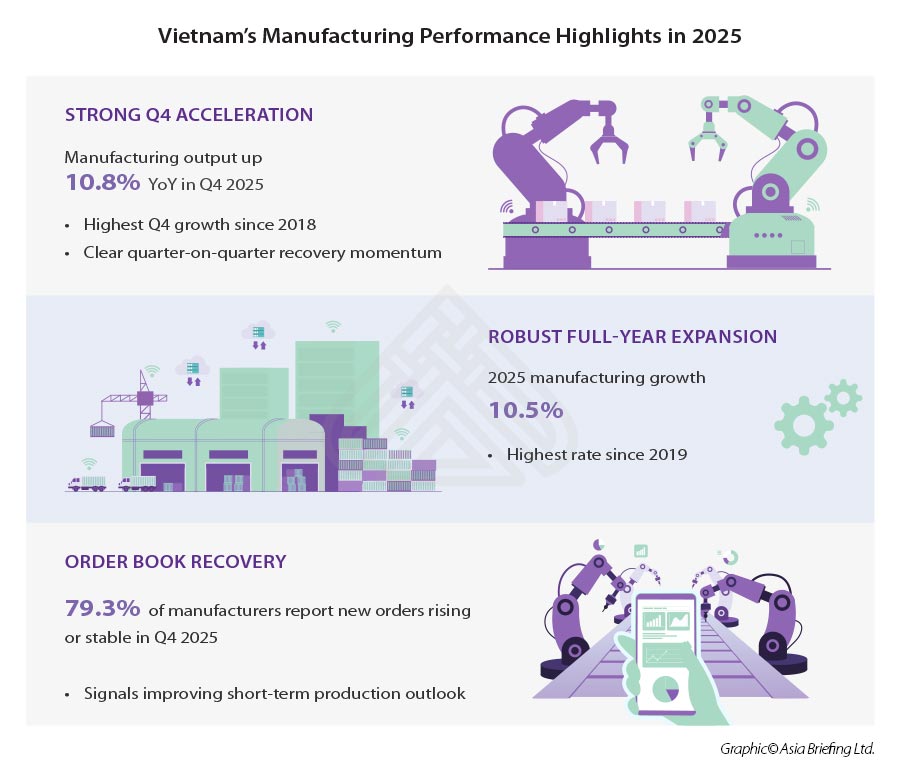
Vietnam’s economic performance in 2025 highlights the central role of manufacturing in its development trajectory. GDP expanded by 8.02 percent, driven largely by a 9.97 percent increase in manufacturing and processing, marking the sector’s strongest performance since 2019. Manufacturing continues to anchor Vietnam’s industrialization and global economic integration. The sector remains the country’s largest FDI recipient and contributes substantially to GDP, export turnover, and state budget revenues. In 2025, Vietnam’s total industrial added value rose 8.80 percent year-on-year, accounting for 35.15 percent of the economy’s total value-added growth.
Within this, manufacturing and processing alone contributed 31.49 percent, reaffirming its position as the primary growth engine. Beyond its direct output, manufacturing generates significant spillover effects across logistics, construction, and labor markets, reinforcing its multiplier impact on the broader economy.
See also: Vietnam Manufacturing Tracker: As of April 2026
Manufacturing: Vietnam’s primary FDI recipient
FDI into Vietnam reached approximately US$38.42 billion in 2025, reinforcing the country’s position as a regional manufacturing hub. Beyond capital expansion, these inflows continue to support export growth, industrial upgrading, technology transfer, improvements in management capacity, labor standards, and deeper participation in global value chains.
Sustained FDI inflows from major partners, including the US, South Korea, Japan, China, Taiwan, and European economies, have boosted the expansion of Vietnam’s manufacturing sector. Core manufacturing segments include electronics and smartphones, textiles and garments, footwear, furniture, automotive components, and renewable energy equipment – industries that increasingly position Vietnam as a critical node in regional and global supply chains.
FDI concentration in manufacturing
FDI flows remain heavily concentrated in the manufacturing and processing sector, which has long been regarded as the backbone of Vietnam’s industrialization strategy. In 2025, Vietnam’s manufacturing sector attracted US$21.01 billion in FDI, representing 54.7 percent of the country’s total FDI inflows. This included:
- 1,381 new investment projects with nearly US$9.8 billion in registered capital;
- 843 projects with capital adjustments adding approximately US$8.79 billion; and
- 602 capital contribution and share acquisition deals valued at US$2.43 billion.
This confirms manufacturing as the country’s largest FDI recipient by a significant margin.
Expansion from scale to depth
The high proportion of capital adjustments reflects more than new entry: it signals expansion by existing investors. Multinational corporations are:
- Increasing existing production capacity
- Upgrading technology and production lines
- Extending operational timelines
- Deepening supply chain integration
This trend suggests growing investor confidence and long-term commitment to Vietnam as a manufacturing base.
Sectoral composition
Within manufacturing, FDI remains focused on globally integrated industries, such as electronics, machinery, textiles, footwear, and food processing. At the same time, investment is gradually shifting toward higher value-added and technology-intensive segments, aligned with Vietnam’s strategy to transition from labor-cost competitiveness to productivity- and innovation-led growth.
Macroeconomic impact
Manufacturing FDI remains central to Vietnam’s trade and industrial performance:
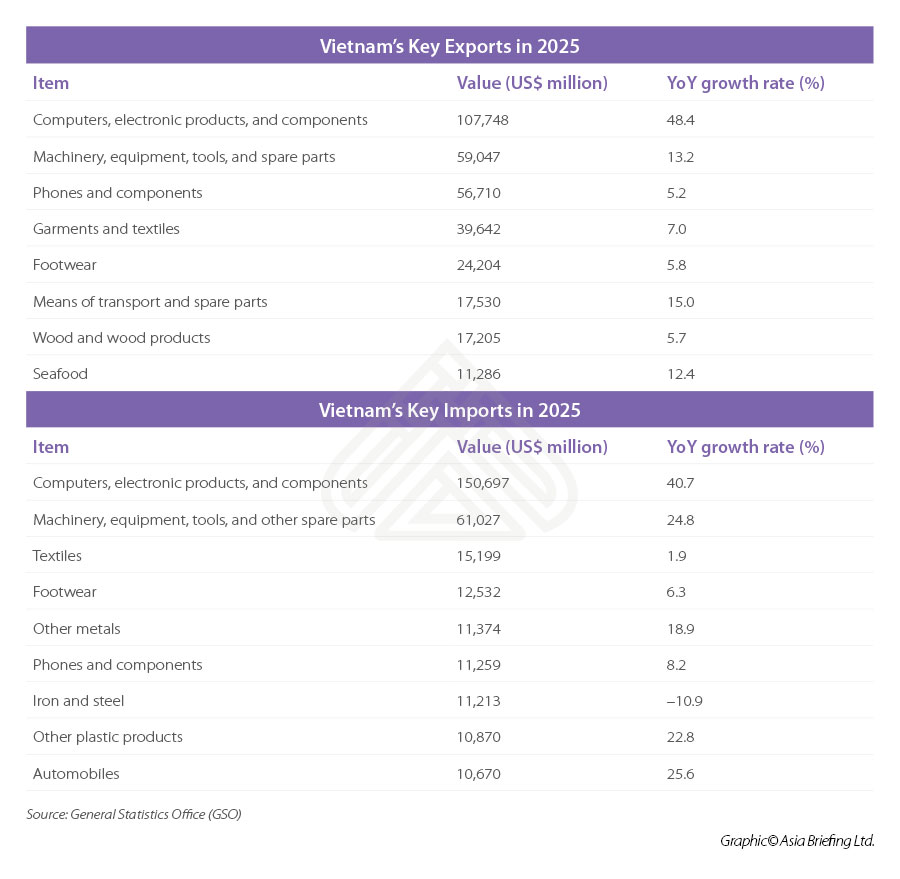
- Processed industrial exports reached US$421.47 billion in 2025
- Accounting for 88.7 percent of total merchandise exports
As a result, manufacturing-led FDI continues to drive industrial output, export expansion, employment creation, and trade balance stability, reinforcing its structural role in Vietnam’s economic model.
Expanded free trade agreement network
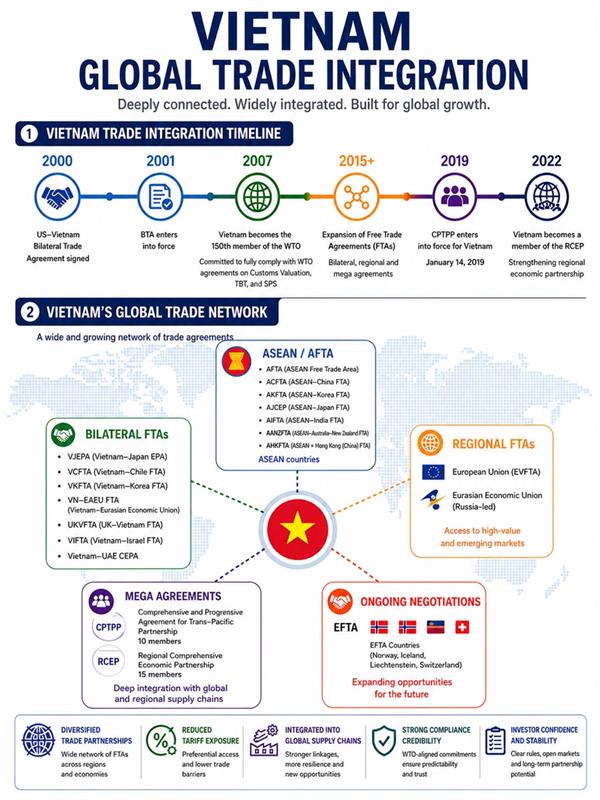
Vietnam has signed and implemented several free trade agreements (FTAs), both independently and as part of the Association of Southeast Asian Nations (ASEAN). These agreements provide unmatched preferential access to major markets and significantly enhance Vietnam’s attractiveness for export-oriented manufacturers. Customs modernization and trade facilitation improvements incentivized by these FTAs continue to reduce lead times and lower compliance costs for doing business in Vietnam.
Vietnam’s push to move up the global value chain
Under the policy direction set out in the Resolution of the 14th National Party Congress and the Government’s 2026 socio-economic development agenda, Vietnam is sharpening its focus on upgrading its industrial base and advancing within global value chains. In line with these strategic orientations, the Ministry of Industry and Trade (MOIT) has outlined a target for the processing and manufacturing sector to account for approximately 28 to 30 percent of GDP by 2030.
The strategy prioritizes the development of high-tech industries, green and low-carbon manufacturing, and a gradual shift away from low value-added assembly toward higher value-added stages of production. This transition is designed not only to enhance the competitiveness of Vietnamese industrial products but also to enable the country to participate in international markets with technologically sophisticated goods rather than primarily exporting raw materials or contract-manufactured products.
A central pillar of this shift is digital transformation and innovation in manufacturing. MOIT is encouraging enterprises to increase investment in research and development (R&D), adopt new technologies, and invest in core technologies. At the same time, the ministry is working to refine the policy framework and streamline administrative procedures to improve businesses’ access to financial and technological resources.
Looking ahead, two major policy initiatives stand out: developing an industrial supporting industry program for 2026–2030 and operating modern technical centers. The inauguration of the technical center supporting industrial development at Hoa Lac Hi-Tech Park represents a concrete step toward building a more robust innovation ecosystem and strengthening Vietnam’s position in higher segments of the global value chain.
Vietnam’s special incentives for manufacturers
Vietnam offers a comprehensive set of incentives to attract domestic and foreign manufacturers, particularly in high-value, export-oriented sectors. These incentives include tax relief, land-use benefits, customs exemptions, and emerging preferential policies within Free Trade Zones (FTZs), creating a competitive investment environment for industrial and manufacturing projects.
Tax incentives
Investment incentives in Vietnam are determined by location, industry, and other priorities, such as project scale or engagement in support industries. Projects in socio-economically disadvantaged areas, priority sectors (e.g., high technology), or those with significant capital may receive enhanced tax benefits.
Corporate income tax (CIT)
CIT is levied on profits of companies and organizations operating in Vietnam. Under the current tax framework, the standard rate is 20 percent, with reduced rates (15-17 percent) available for qualifying SMEs. New investment projects in encouraged sectors and locations may benefit from preferential CIT rates or exemptions depending on eligibility conditions.
Value added tax (VAT)
VAT applies to most goods and services at standard, reduced, or zero rates. A temporary government reduction lowered the standard VAT rate to 8 percent to support economic activity through 2026 under Decree 174/2025/ND-CP, effectively reducing the VAT burden on production and consumption.
Land rental and land use tax
Vietnam provides land rental and land use tax exemptions and reductions based on project type and location:
- 3-year exemption: Projects in investment encouragement sectors and new business development bases.
- 7-year exemption: Projects in difficult socioeconomic areas.
- 11-year exemption: Projects in especially difficult areas or encouraged sectors in difficult areas.
- 15-year exemption: Projects in specially encouraged sectors in especially difficult areas.
In certain cases, projects in specially encouraged sectors located in especially difficult socioeconomic areas may receive full project land rent exemptions.
Import duty exemption
Manufacturers can qualify for import duty exemptions on:
- Machinery and equipment imported to form fixed assets of a project.
- Materials and semi-finished goods imported to fulfill export processing contracts.
- Machinery, equipment, and supplies used for scientific research and technological development not yet domestically producible.
These exemptions reduce upfront input costs and support investment in technology and infrastructure.
New incentives in free trade zones
Vietnam is accelerating the development of free trade zones (FTZs) nationwide, with the government planning multiple FTZs in major cities such as Da Nang, Haiphong, and Ho Chi Minh City by 2026–2030 to enhance competitiveness and integrate deeper into global supply chains.
These new FTZ incentives are aimed at attracting export-oriented manufacturers, high-tech enterprises, and integrated logistics and supply chain operations, supporting Vietnam’s broader industrial strategy.
See also: Vietnam: A Rising Manufacturing Hub in Asia in 2026



For international investors, Vietnam's different localities offer favorable conditions across almost every sector, particularly as the country shifts toward higher value-chain manufacturing, high-tech industries, and innovation. Taking a closer look at Vietnam's provinces and investment destinations before committing capital can provide a decisive competitive advantage. A tailored market study, dedicated location selection, or business matchmaking can uncover factors that are often hard to assess—such as special incentives, skilled labor availability, and tax breaks.
About Us
Vietnam Briefing is one of five regional publications under the Asia Briefing brand. It is supported by Dezan Shira & Associates, a pan-Asia, multi-disciplinary professional services firm that assists foreign investors throughout Asia, including through offices in Hanoi, Ho Chi Minh City, and Da Nang in Vietnam. Dezan Shira & Associates also maintains offices or has alliance partners assisting foreign investors in China, Hong Kong SAR, Indonesia, Singapore, Malaysia, Mongolia, Dubai (UAE), Japan, South Korea, Nepal, The Philippines, Sri Lanka, Thailand, Italy, Germany, Bangladesh, Australia, United States, and United Kingdom and Ireland.
For a complimentary subscription to Vietnam Briefing’s content products, please click here. For support with establishing a business in Vietnam or for assistance in analyzing and entering markets, please contact the firm at vietnam@dezshira.com or visit us at www.dezshira.com
- Previous Article Vietnam’s Electronics Industry 2026: A Guide to Emerging Opportunities
- Next Article