Vietnam’s government has launched a sweeping administrative reform package through the issuance of eight resolutions aimed at reducing regulatory burdens, decentralizing authority, and improving the business environment. The move signals a shift toward a more facilitative, service-oriented governance model, with direct implications for investors and businesses operating in the country.
Under the new resolutions, the government has launched one of its most extensive administrative reforms. It plans to eliminate 184 procedures, simplify around 350–394 procedures, and decentralize 134 procedures to local authorities.
On the business side, 890 business conditions have been eliminated, alongside the simplification of a small number of remaining requirements. These reforms are expected to reduce compliance time and costs by more than 50 percent compared to 2024 levels, easing operational burdens for enterprises.
The resolutions cover a wide range of sectors overseen by the State Bank of Vietnam and 14 ministries and agencies, including industry and trade, education, healthcare, construction, and finance.
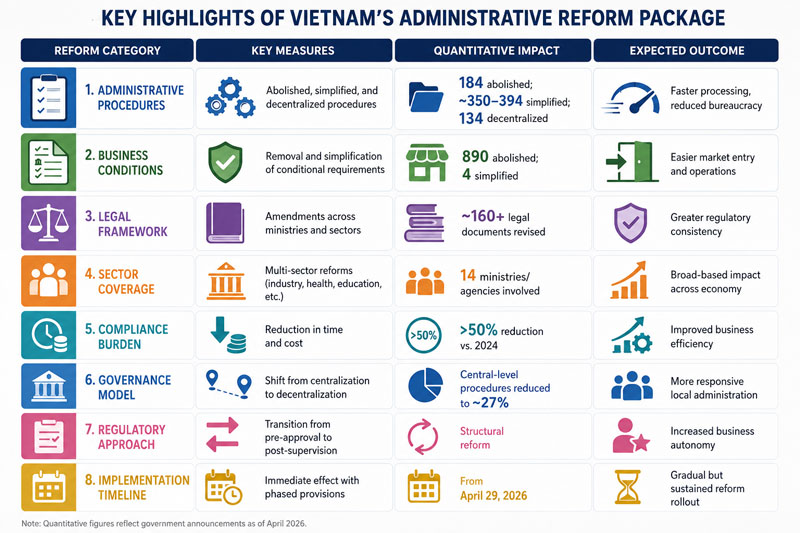
Sector-wide impact of Vietnam’s administrative reform
The reforms are wide-ranging and sector-specific:
- Industry and trade: Simplified licensing procedures, particularly in petroleum distribution and retail operations.
- Agriculture and environment: Removal of business conditions related to land surveys, evaluation, and planning consultancy.
- Education and training: Reduced conditions across all levels, including foreign-invested institutions and study-abroad consultancy services.
- Healthcare: Decentralization of licensing authority and removal of conditions related to biosafety and medical services.
- Culture, sports, and tourism: Elimination of conditions tied to artistic performances, competitions, and beauty contests.
In addition, certain administrative requirements, such as biometric data collection for identity systems, have been scrapped, reflecting a broader push toward efficiency and digital governance.
|
Resolution |
Governing areas |
Key reform focus |
|
Agriculture, environment, land, water resources, climate change |
Cuts and simplifies procedures and business conditions across 15 sub-sectors; removes selected conditions in land and fisheries; decentralizes aquaculture certification to local authorities |
|
|
Culture, sports, tourism, digital content, advertising |
Decentralizes 16 procedures, simplifies 10, and removes 4 business conditions, including in performing arts, social media, gaming, and advertising |
|
|
Industry, trade, petroleum, distribution and retail |
Reduces and simplifies procedures and business conditions, notably removing licensing requirements and easing conditions in petroleum distribution and retail |
|
|
Science, technology, innovation management |
Cuts and simplifies procedures across six areas; expands decentralization in licensing and regulatory oversight to local authorities |
|
|
Healthcare, biosafety, vaccination, medical services |
Decentralizes procedures to provincial level; removes and simplifies conditions related to biosafety, immunization, and healthcare services |
|
|
Public security, ID systems, e-identification, seals, public order |
Abolishes and simplifies procedures related to ID, e-ID, seals, and security; decentralizes selected procedures to provincial and commune levels |
|
|
Education, training, academic services |
Cuts and simplifies procedures and business conditions while maintaining education quality and student safety standards |
|
|
Multi-sector: defense, home affairs, finance, construction, foreign affairs, justice, banking |
Introduces cross-sector cuts, decentralization, and simplification of procedures and business conditions across seven key regulatory areas |
Structural shift: Decentralization and governance reform
Beyond numerical reductions, the resolutions reflect broader institutional changes. The government is moving away from a pre-approval model toward post-supervision, allowing businesses greater operational autonomy while strengthening oversight mechanisms.
At the same time, decentralization reduces the share of procedures handled at the central level to roughly 27 percent, empowering provincial authorities to take on a larger implementation role.
This shift is intended to accelerate decision-making, improve administrative efficiency, and foster a more responsive regulatory environment.
Implications for foreign investors
For foreign investors, the reforms offer three key takeaways:
- Lower compliance costs: Fewer procedures and conditions reduce both time and administrative expenses.
- Faster market entry and operations: Streamlined approvals and decentralized processes enable quicker execution.
- Improved regulatory transparency: Simplification and standardization reduce ambiguity in licensing and compliance.
Collectively, these changes are expected to enhance Vietnam’s competitiveness as an investment destination, particularly in manufacturing, services, and high-tech sectors.
What businesses should do in response?
As the eight resolutions introduce simultaneous, cross-sector reforms, businesses should move beyond passive compliance and actively recalibrate their regulatory strategy:
- Review and streamline internal compliance processes
Reassess licensing workflows, documentation, and approval timelines in light of abolished or simplified procedures, particularly for permits, sub-licenses, and conditional business lines. - Leverage decentralization at the local level
As authority shifts to provincial and commune authorities, businesses should proactively engage with local regulators to expedite approvals and clarify implementation practices. - Monitor implementing regulations and guidance
Ministries and agencies are required to issue detailed implementing documents before March 1, 2027. Businesses should track these updates closely, as practical changes will depend on subordinate legislation. - Engage advisors for regulatory interpretation
Where reforms overlap or remain ambiguous, especially in multi-sector Resolution 24, professional advisory support can help interpret changes and avoid compliance gaps.
How we can help
Vietnam’s latest reform package introduces wide-ranging changes to licensing, business conditions, and administrative procedures across multiple sectors. Our Business Advisory team helps companies assess how these eight resolutions impact their operations, identify newly simplified or abolished requirements, and adjust compliance strategies accordingly.
To discuss how these reforms may impact your business, feel free to reach out to us at Vietnam@dezshira.com.