Learn how businesses can meet EVFTA rules of origin, documentation requirements, and compliance steps to access preferential tariffs when exporting from Vietnam to the EU.
The EU–Vietnam Free Trade Agreement gives companies operating in Vietnam a clear pathway to reduce export costs into the European Union. Preferential tariffs under the agreement directly improve margins, strengthen pricing competitiveness, and support long-term supply chain positioning.
To access these benefits, companies must align their product classification, sourcing strategy, manufacturing processes, and documentation systems with EVFTA requirements. Businesses that structure their operations around compliance from the outset consistently secure tariff advantages and avoid disruption during customs clearance.
EVFTA tariff benefits: A measurable cost advantage
The EVFTA eliminates duties on the majority of goods traded between Vietnam and the EU. Around 65 percent of EU tariffs on Vietnamese exports were removed at entry into force, with most of the remaining tariffs phased out over a defined schedule.
For exporters, the impact is immediate and measurable:
- Reduced landed costs in EU markets
- Increased pricing flexibility in competitive sectors
- Improved positioning against suppliers from non-FTA countries
Sectors with strong tariff leverage
- Electronics and electrical equipment
- Textiles and garments
- Footwear
- Furniture and wood products
- Agro-processing and seafood
In sectors such as textiles and footwear, tariff reductions typically range between 8 and 17 percent. For higher-value manufacturing segments, even smaller percentage reductions translate into significant margin gains at scale.
Commercial insight: Companies that integrate EVFTA eligibility into their production model can treat Vietnam as a cost-optimized export platform for Europe, not just a manufacturing base.
Rules of origin: The foundation of eligibility
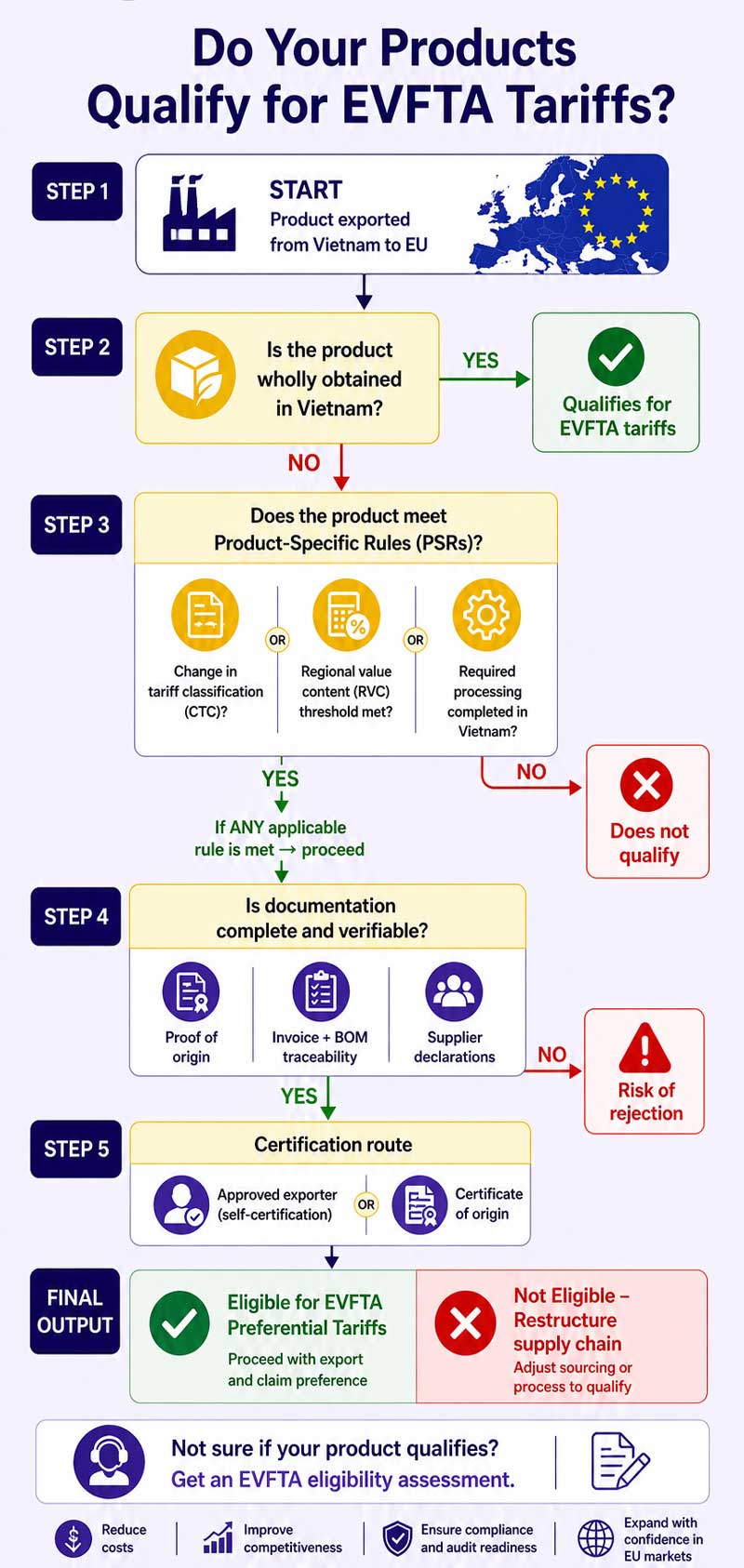
Preferential tariffs under the EVFTA are granted to products that meet defined rules of origin (RoO). These rules determine whether a product qualifies as originating in Vietnam.
Companies qualify under three primary pathways:
- Wholly obtained goods
Products produced entirely within Vietnam, including:
- Agricultural products grown domestically
- Minerals extracted locally
- Aquaculture and fisheries products
This category applies mainly to natural resources and agricultural exports.
- Substantial transformation
Most manufactured goods fall under this category. Imported inputs can be used, but the production process in Vietnam must result in a defined level of transformation.
- Product-specific rules (PSRs)
Each product category, identified by its HS code, has a specific rule that determines eligibility.
These rules typically require one or more of the following:
- Change in tariff classification (CTC)
- Regional value content (RVC) thresholds
- Specific processing requirements
See also: An Introduction to Rules of Origin for Vietnamese Exports
Commercial insight: Rules of origin are best addressed at the supply chain design stage, not after production begins. Companies that map origin requirements early reduce compliance costs and accelerate export readiness.
Applying product-specific rules: Sector-level considerations
Product-specific rules vary across industries and directly influence sourcing and manufacturing decisions.
Textiles and garments
Many textile products must meet “yarn-forward” or “fabric-forward” requirements. This means:
- Yarn or fabric must originate from Vietnam or an eligible partner
- Heavy reliance on imported fabric can disqualify the product
Strategic response: Companies localize upstream sourcing or develop regional supplier networks aligned with EVFTA requirements.
Electronics and machinery
Electronics products typically require:
- A change in tariff classification
- Or a minimum level of value addition in Vietnam
Strategic response: Manufacturers increase assembly, testing, or component integration activities locally to meet transformation thresholds.
Food and agro-processing
Processed food products often require:
- Local sourcing of primary inputs
- Or defined processing steps within Vietnam
Strategic response: Companies secure domestic supply chains or adjust processing stages to meet origin criteria.
Commercial insight: Meeting PSRs depends on bill of materials (BOM) mapping, supplier alignment, and production planning. Companies that treat origin compliance as a technical function gain faster market access.
Documentation and certification: Enabling tariff access
To claim EVFTA tariff preferences, exporters must provide proof of origin supported by accurate and verifiable documentation.
Core documentation requirements
- Commercial invoice
- Packing list
- Transport documentation
- Production and sourcing records
- Proof of origin declaration
Certification options
Companies can use:
- Certificates of origin issued by authorized bodies
- Self-certification under the approved exporter system
The EVFTA promotes self-certification for qualified exporters, allowing greater flexibility and faster processing.
See also: How to Apply for a Certificate of Origin in Vietnam
Commercial insight: A strong documentation system reduces clearance delays and supports audit readiness. Companies that digitize compliance processes improve both speed and accuracy.
Step-by-step approach to EVFTA qualification
Companies that consistently qualify for EVFTA tariffs follow a structured workflow:
Step 1: Confirm product classification
Assign the correct HS code to determine applicable rules.
Step 2: Identify applicable origin rule
Review the product-specific rule under EVFTA.
Step 3: Map supply chain inputs
Identify origin of raw materials, components, and intermediate goods.
Step 4: Validate compliance
Confirm that transformation or value thresholds are met.
Step 5: Prepare documentation
Ensure all records support origin claims.
Step 6: Issue proof of origin
Use certification or self-declaration mechanisms.
Step 7: Maintain audit records
Retain documentation for verification by customs authorities.
Commercial insight: Companies that embed this workflow into ERP or compliance systems reduce manual errors and improve scalability.
Structuring operations for EVFTA advantage
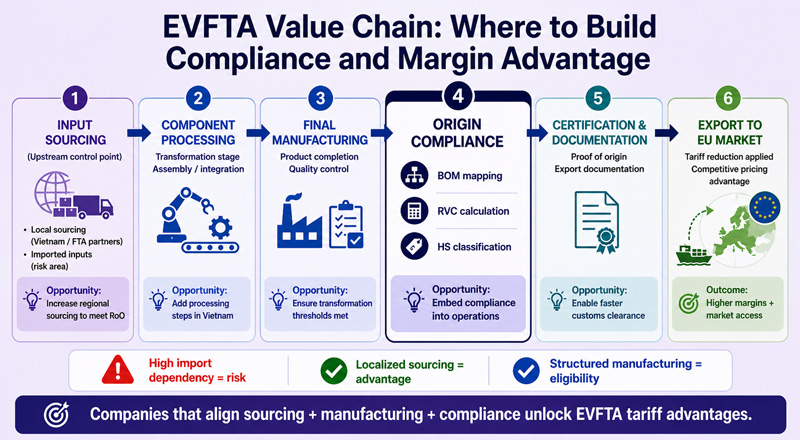
Companies use EVFTA as a lever to optimize both cost and supply chain resilience.
Key structuring strategies
Local sourcing expansion
Increasing local or regional procurement helps meet value content requirements.
Supplier realignment
Companies shift toward EVFTA-compliant suppliers to ensure consistent eligibility.
Manufacturing upgrades
Adding processing stages in Vietnam increases transformation levels.
Dual production models
Some companies operate separate EVFTA-compliant and non-compliant production lines to maintain flexibility.
Commercial insight: EVFTA compliance supports a long-term operating model, not just a transactional export decision. Companies that align procurement, manufacturing, and trade strategy gain sustained competitive advantage.
Common risks and how companies address them
Frequent compliance gaps
- Incorrect HS classification
- Incomplete origin calculations
- Insufficient supporting documentation
- Supplier origin misalignment
Operational consequences
- Denial of preferential tariffs
- Retroactive duties
- Delays in customs clearance
- Increased compliance costs
Risk mitigation strategies
- Conduct origin audits before exporting
- Implement supplier verification processes
- Maintain standardized documentation templates
- Align tax, customs, and operational teams
Commercial insight: Proactive compliance reduces both financial exposure and operational disruption.
Vietnam’s role in EU supply chains
The EVFTA strengthens Vietnam’s position as a strategic export base for Europe. Companies increasingly use Vietnam to:
- Diversify supply chains beyond China
- Access EU markets with preferential tariffs
- Build cost-efficient manufacturing platforms
- Align with sustainability and trade compliance standards
At the same time, successful execution depends on:
- Early-stage planning
- Cross-functional coordination
- Ongoing compliance monitoring
What this means for foreign investors
Foreign companies entering Vietnam can integrate EVFTA advantages into their business model from the outset.
Key actions:
- Assess product eligibility during market entry planning
- Structure supply chains to meet origin requirements
- Align manufacturing processes with transformation thresholds
- Implement compliance systems before scaling exports
Companies that act early convert EVFTA from a regulatory requirement into a margin-enhancing strategy.
Advisory: Unlocking EVFTA benefits
Ensuring EVFTA eligibility requires coordination across trade compliance, tax structuring, and supply chain design.
Businesses can benefit from:
- Product-level eligibility assessments
- Rules of origin mapping
- Supply chain restructuring strategies
- Documentation and audit readiness support
Companies that integrate these elements early achieve faster EU market access and stronger cost positioning.
Assess your EVFTA eligibility before you export.
→ Get a product-level rules of origin (RoO) assessment and identify how to structure your supply chain to qualify for preferential tariffs under the EU–Vietnam Free Trade Agreement. Access our Supply Chain and Tariff Advisory by emailing: Vietnam@dezshira.com