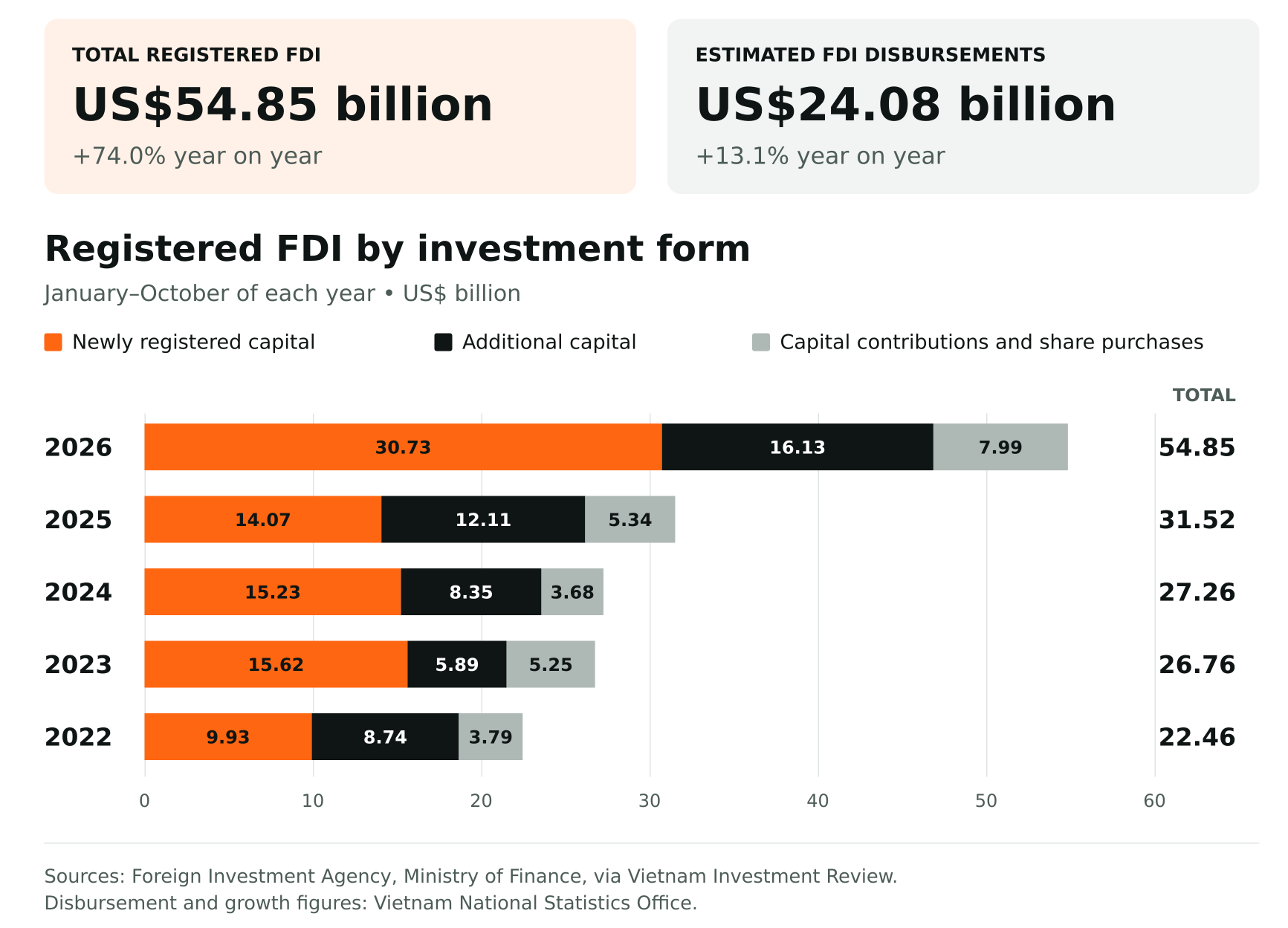
Vietnam recorded US$54.85 billion in registered foreign direct investment (FDI) in the first 10 months of 2026, the highest for the period since 2009. Estimated disbursements rose 13.1 percent to US$24.08 billion, with manufacturing accounting for nearly 83 percent of capital deployed.
Newly licensed projects accounted for more than half of Vietnam’s registered FDI through 31 October. Capital increases at existing projects and investments through capital contributions and share purchases also grew. The figures show where investors are committing capital and, separately, where projects are putting it to work.
Plan Market Entry
Assess opportunities, locations, structures, tax benefits, and regulatory requirements in Vietnam.What drove Vietnam’s FDI growth in the first 10 months of 2026?
Capital registered for new projects reached US$30.73 billion, or 2.2 times the amount recorded a year earlier. The number of newly licensed projects rose 4.7 percent to 3,478. With capital growing much faster than project numbers, the average capital commitment per newly licensed project increased sharply.
|
Vietnam’s Registered and Disbursed FDI, January–October 2026 |
||
|
Investment category |
Capital (US$ billion) |
Year-on-year change |
|
Newly licensed projects |
30.73 |
2.2 times the 2025 level |
|
Capital increases at existing projects |
16.13 |
+33.2% |
|
Capital contributions and share purchases |
7.99 |
+49.6% |
|
Total registered FDI |
54.85 |
+74.0% |
|
Estimated FDI disbursements |
24.08 |
+13.1% |
|
Source: Foreign Investment Agency |
||
Disbursements are reported separately and can include spending on projects approved in earlier periods.
Investors registered capital increases across 1,079 existing projects. Separately, they recorded 2,616 capital contribution and share purchase transactions, worth a combined US$7.99 billion. These two channels together accounted for 44 percent of total registered FDI.
Which sectors led new investment and disbursements?
Processing and manufacturing attracted US$14.61 billion, or 47.5 percent of capital registered for newly licensed projects. Transport and warehousing followed with US$5.15 billion, or 16.7 percent. Including increases at existing projects, manufacturing accounted for US$24.19 billion, or 51.6 percent of combined new and additional project capital.
The processing and manufacturing sector was even more prominent in disbursements. It accounted for US$19.96 billion, or 82.9 percent of the estimated US$24.08 billion deployed. Real estate followed at US$1.76 billion (7.3 percent), with electricity, gas, and related utility supply at US$785.2 million (3.3 percent). For industrial suppliers, manufacturing disbursements provide a starting point for assessing where factory projects are progressing. For logistics operators, transport and warehousing registrations signal future capacity to track as projects reach construction and opening milestones.
Plan your market entry
Ascentium Vietnam helps foreign investors assess entry structures and navigate company set-up and licensing. Discuss your investment plans with our experts.
Where did newly registered FDI come from?
Singapore led the 80 economies with newly licensed projects, accounting for nearly a third of newly registered project capital in Vietnam in the first 10 months of 2026. The five largest sources together accounted for approximately 87 percent. The ranking reflects the jurisdiction recorded for the direct investor, which can differ from the location of the ultimate owner.
|
Top Investor Economies by Newly Registered FDI in Vietnam, January–October 2026 |
|||
|
Rank |
Investor economy |
Newly registered capital (US$ billion) |
Share of newly registered capital |
|
1 |
Singapore |
9.52 |
31.0% |
|
2 |
South Korea |
5.81 |
18.9% |
|
3 |
Luxembourg |
4.99 |
16.2% |
|
4 |
Hong Kong |
3.57 |
11.6% |
|
5 |
China |
2.77 |
9.0% |
|
6 |
Japan |
1.58 |
5.1% |
|
7 |
The Netherlands |
0.44 |
1.4% |
|
Source: Foreign Investment Agency |
|||
What does Vietnam’s FDI action plan mean for investors?
On 22 September 2026, the government issued Resolution No. 280/NQ-CP to implement the Politburo’s Resolution No. 10-NQ/TW on developing the foreign-invested sector. Vietnam aims to attract US$200–300 billion in registered FDI and US$150–200 billion in disbursed FDI by 2030. The action plan directs provinces to identify priority projects and asks the Ministry of Finance to study support for strategic investments, with potential incentives linked to commitments such as technology transfer, workforce training, research and development, and local supplier development.
For investors planning a new factory, warehouse or expansion, provincial priority lists can help shape an initial shortlist. Site-level checks should establish when land or factory space will be available, whether power and transport infrastructure can support the planned operation, and how quickly the business can recruit staff and qualify local suppliers. Where the investment case depends on incentives, confirm the rules and eligibility for the specific project before factoring the benefits into financial projections.