Factory audit services help buyers assess whether a factory can meet the requirements of a specific order. This article explains when an audit is useful, what it should cover, common gaps, indicative costs, and how businesses should choose an audit provider.
When should businesses conduct a factory audit?
A factory audit is an on-site review of a supplier’s identity, facilities, production capacity, management systems, records, and working conditions against set criteria. Depending on the buyer’s needs, it may focus on specific aspects, such as supplier capability, quality control, labour and social compliance, environmental management, or several of these areas.
Foreign buyers normally commission a factory audit after screening potential suppliers and before making a substantial commercial commitment. At this point, the buyer has the greatest leverage to request access, negotiate changes, or select another supplier.
A new or follow-up audit may also be appropriate when:
- Production volume increases substantially, or a new product or process is introduced;
- The supplier changes its ownership, facility location, production line, or subcontractors;
- Complaints, delivery failures, accidents, inconsistent records, or whistleblower reports raise concerns; or
- A previous corrective action requires on-site verification.
Audit frequency varies by supplier. Higher-risk products, complex processes, poor past performance, and serious past issues warrant more frequent inspections.
Assess Supplier Risks
We help businesses evaluate factories, identify sourcing risks, and verify corrective actions across their Vietnam supply chain.What should a factory audit cover?
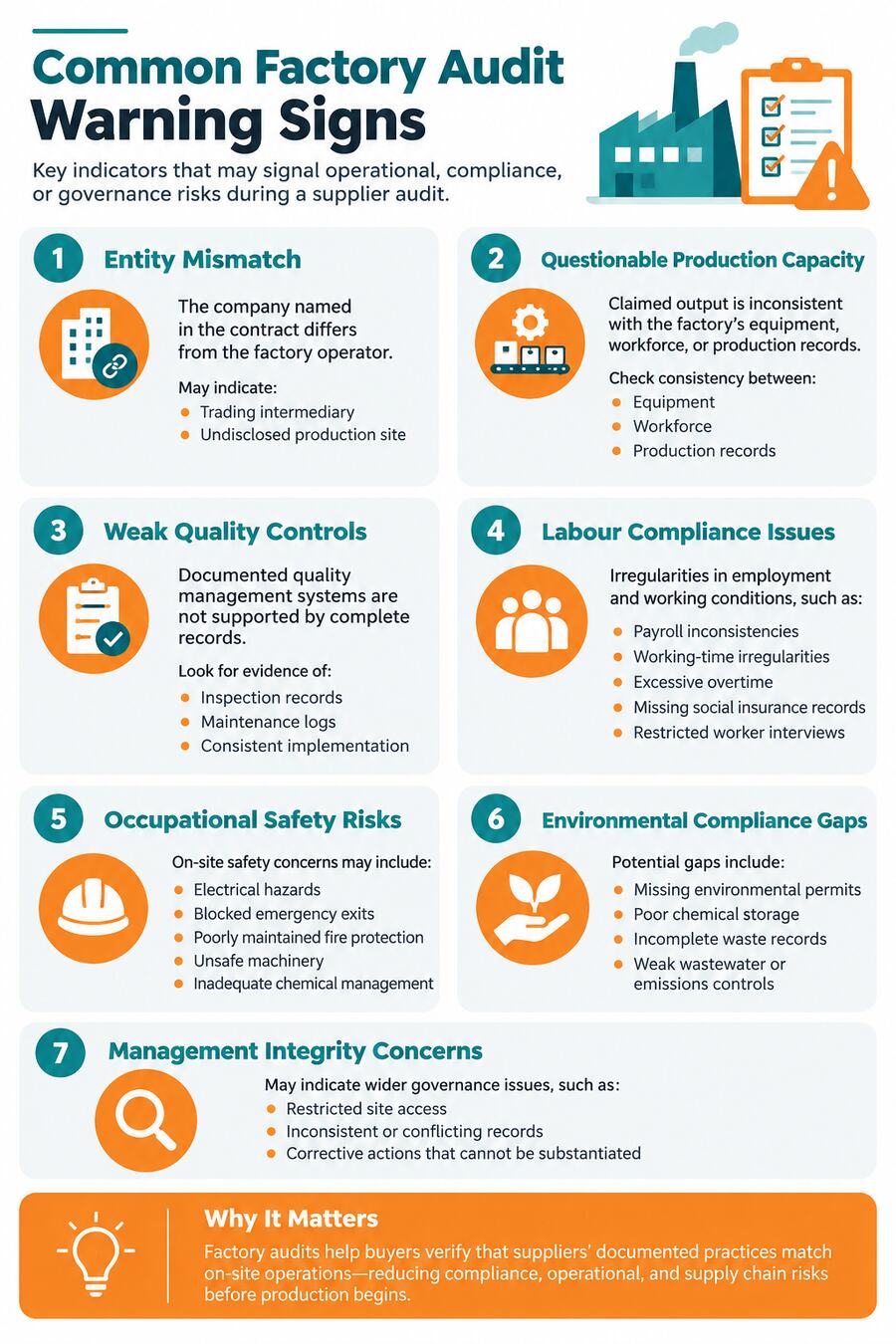
The buyer and audit provider should agree on the criteria before the audit visit. The scope should reflect the contract and buyer code, destination-market requirements, and applicable Vietnamese rules. It should also identify every factory building and outsourced process covered by the review.
|
Audit area |
What the auditor should verify |
Main business risk |
|
Legal identity, site, and subcontracting |
Enterprise registration, factory address, relationship between the contracting party and manufacturer, site occupancy, and outsourced processes |
Fraud, weak contractual recourse, or production at an undisclosed site |
|
Production capacity |
Equipment, workforce, current orders, production records, bottlenecks, and realistic monthly output |
Delays, overcommitment, and uncontrolled subcontracting |
|
Quality and traceability |
Incoming, in-process, and final controls; testing; calibration; defect records; complaints; and lot traceability |
Rejected shipments, recalls, rework, and chargebacks |
|
Labor and social compliance |
Contracts, age verification, wages, working hours, overtime, leave, social insurance, grievances, and worker interviews |
Enforcement, back-pay claims, work stoppages, and reputational damage |
|
Occupational safety and fire |
Machine and electrical safety, protective equipment, chemical handling, alarms, exits, firefighting equipment, incidents, and drills |
Injury, fire, suspension, liability, and production interruption |
|
Environmental management |
Required approvals, wastewater, emissions, waste handling, chemicals, monitoring records, and emergency plans |
Penalties, remediation costs, disruption, and buyer rejection |
A factory may perform well in a basic capability audit but fail a buyer-specific social, technical, or environmental requirement. The scope must therefore support the commercial decision the buyer needs to make.
Why factory audits are becoming more important
Vietnam’s expanding role in global manufacturing and supply chains gives foreign buyers more sourcing options, but it also introduces new onboarding risks. A prospective supplier may:
- Be a trading company rather than the actual manufacturer;
- Overstate its production capacity; or
- Outsource specialised processes without the buyer’s knowledge or approval.
At the same time, buyers are placing greater emphasis on environmental, social, and governance (ESG) performance and supply chain transparency. Supplier questionnaires and codes of conduct are increasingly reinforced by:
Strengthen ESG compliance
We help businesses identify supplier compliance gaps, verify corrective actions, and improve supply chain transparency.- Audit rights;
- Traceability requirements;
- Corrective action plans with defined deadlines; and
- Escalation clauses for non-compliance.
Regulatory developments are also driving this trend. The amended EU Corporate Sustainability Due Diligence Directive (CSDDD) will apply to a limited group of very large companies from July 2029. While Vietnamese suppliers are not automatically subject to the directive, many may still receive proportionate information requests and remediation requirements from customers that fall within its scope.
As a result, suppliers that can readily provide permits, payroll records, production data, and evidence of corrective actions gain a competitive advantage. For buyers, factory audits provide an effective way to verify this information before compliance issues disrupt production or damage customer relationships.
Choosing a factory audit service in Vietnam
1. Define the audit objective
Clearly identify the audit’s purpose, such as verifying supplier legitimacy, production capacity, labour practices, or ESG compliance. The scope should specify:
- Sites and subcontractors to be assessed
- Applicable buyer standards
- Worker access and record-sampling requirements
- Audit format, reporting, and follow-up arrangements
2. Assess the audit provider
Choose an independent provider with local auditors who understand the industry and production process. Request:
- Relevant sector experience
- Sample audit reports and methodology
- Quality assurance process and turnaround time
- Disclosure of any conflicts of interest or supplier relationships
3. Compare like-for-like quotations
Audit fees typically depend on factory size, audit scope, location, and reporting requirements. When comparing quotations, ensure they cover the same:
- Number of auditor-days
- Travel and translation costs
- Reporting and testing fees
- Re-audit charges
A lower price may simply reflect a narrower audit scope.
4. Ensure corrective action and follow-up
Audit reports should prioritise findings by severity and include clear corrective actions, deadlines, and evidence requirements. High-risk findings, such as fraud, forced labour, child labour, or serious safety risks, should be resolved before supplier approval or production begins.
Key takeaways
- Conduct the audit after shortlisting a supplier but before paying a deposit, transferring tooling, or placing a significant order.
- Match the audit scope to the product, production process, destination market, and main supplier risks.
- Treat the audit report as a starting point: critical findings and corrective actions should be verified and acted upon before production proceeds.