Other Briefings
Vietnam Immigration: Permanent Residence Eligibility and Application Guide
Vietnam’s immigration regime does not provide a pathway to permanent residence based solely on long-term residence, unlike those of many neighboring countries. Instead, permanent residence is available only to foreign nationals who fall within one of four statutory categories, excluding the vast majority of expatriates, investors, and professionals living and working in Vietnam.
Key takeaways
- Vietnam grants permanent residence only under limited statutory categories, including individuals with meritorious service, close family ties to Vietnamese citizens, and certain foreign experts or scientists, subject to strict legal conditions.
- Permanent residence is granted indefinitely, although the Permanent Residence Card (PRC) must be renewed every 10 years.
- Most foreign investors, professionals, and expatriates will continue to rely on temporary residence cards (TRCs) and long-term visas, as these do not automatically lead to permanent residence.
Vietnam’s immigration framework offers several pathways for foreign nationals seeking to live and work in the country, including visas, temporary residence cards, work permits, and, in limited circumstances, permanent residence.

While most expatriates and foreign investors rely on temporary residence arrangements, Vietnam’s permanent residence regime provides an indefinite right to reside in the country for a small group of eligible applicants who satisfy specific legal criteria.
Understanding who qualifies, the application process, and the available alternatives is essential for businesses and individuals planning a long-term presence in Vietnam.
See also: Vietnam Visa Costs: What You Need to Know
Vietnam’s immigration framework: Who is eligible for permanent residence?
Vietnam’s Law on Entry, Exit, Transit and Residence of Foreigners provides only four pathways to permanent residence for foreign nationals, including:
- Individuals recognized for meritorious service to Vietnam, including those awarded State orders or honorary titles for contributions to the country’s development or national defense;
- Foreign scientists and experts residing in Vietnam on a temporary residence card;
- Sponsored family members of Vietnamese citizens, who are foreign nationals sponsored by a Vietnamese parent, spouse, or child permanently residing in Vietnam; and
- Stateless persons who have continuously resided in Vietnam since 2000 or earlier.
In practice, permanent residence is granted only in limited circumstances. Family-sponsored applications account for a significant share of approvals, while the meritorious service category is reserved for exceptional cases. The scientist and expert pathway is narrowly interpreted and discretionary, and the provision for long-resident stateless persons applies only to a small historical group.
Conditions applicants must satisfy
For all four of these categories, those wishing to apply for permanent residency in Vietnam also need to satisfy another set of conditions in order to be eligible. Vietnamese law requires that the applicant have a stable income and lawful accommodation within Vietnam. Beyond this general requirement, two categories carry a specific further condition:
- Scientists and experts must be formally proposed by a relevant minister or the head of a ministerial-level agency.
- Family members sponsored by a Vietnamese citizen must have temporarily resided in Vietnam for at least three consecutive years before applying.
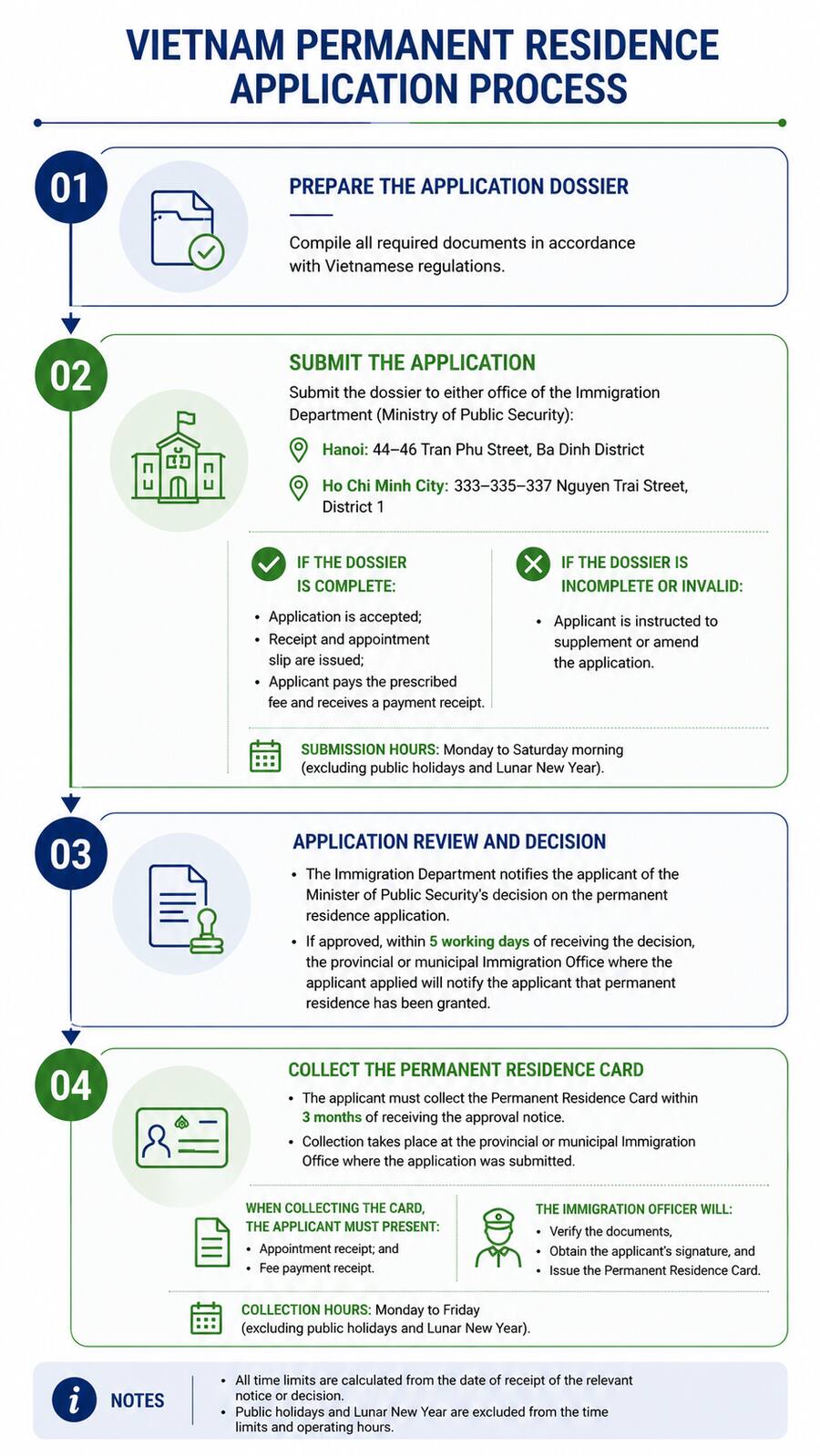
How to apply for permanent residence in Vietnam
If these conditions are met, applications are submitted to the Vietnam Immigration Department, which is within the Ministry of Public Security. The fee for the application is US$100, and the authorities have up to four months to decide on an application, extendable by a further two months where additional verification is required.
The documents issued in a foreign country must be translated into Vietnamese and legalized. Applicants in the scientist-and-expert category will also need the supporting ministerial recommendation noted above.
|
Required Documents for Permanent Residence Applications in Vietnam |
|
|
Required document |
Description |
|
Application for permanent residence (Form NA12) |
Completed Form NA12 issued together with Circular No. 04/2015/TT-BCA dated January 5, 2015, of the Ministry of Public Security. |
|
Criminal record certificate |
Criminal record certificate issued by the competent authority of the applicant’s country of nationality. |
|
Diplomatic note |
Diplomatic note from the diplomatic mission of the applicant’s country requesting the Vietnamese authorities to grant the applicant permanent residence. |
|
Certified copy of passport |
Certified true copy of the applicant’s valid passport. |
|
Documents proving eligibility for permanent residence |
Documents demonstrating that the applicant satisfies the conditions for permanent residence under Article 40 of the Law on Entry, Exit, Transit and Residence of Foreigners in Vietnam (Law No. 47/2014/QH13 dated June 16, 2014). |
|
Letter of guarantee (if applicable) |
Guarantee letter for foreign nationals falling under Clauses 1 and 2, Article 39 of the Law on Entry, Exit, Transit and Residence of Foreigners in Vietnam. |
|
Source: Ministry of Public Security |
|
Renewal of a Permanent Residence Card
Permanent residence status in Vietnam is granted indefinitely and does not expire. However, the PRC must be renewed every 10 years in accordance with Article 43 of the Law on Entry, Exit, Transit, and Residence of Foreigners in Vietnam.
Card renewal is an administrative procedure handled by the provincial-level public security authority where the permanent resident is registered. It does not require the applicant to undergo a new eligibility assessment for permanent residence.
The renewal dossier is relatively simple and generally includes:
- An application for PRC renewal;
- The existing PRC; and
- The applicant’s valid passport.
Alternatives under Vietnam’s immigration system
For most foreign nationals, obtaining permanent residence in Vietnam is not a viable option, as eligibility is limited to the four categories prescribed under Vietnamese law.
Those who do not qualify must generally maintain lawful residence by periodically renewing their temporary residence status.
Temporary residence may be granted on the basis of:
- Employment;
- Investment; or
- Family relationships.
Depending on the applicable visa or TRC category, the validity period typically ranges from two to 10 years, with the longest terms generally available to qualifying foreign investors.
Vietnam also offers several long-term residence options for foreign nationals, including:
- Investor (DT) visas and TRCs for eligible foreign investors; and
- A five-year visa for highly skilled professionals introduced under Decree No. 221/2025/ND-CP.
However, these immigration pathways do not provide a direct route to permanent residence.
For individuals seeking Vietnamese nationality, permanent residence remains an important milestone. Under the Law on Vietnamese Nationality, permanent residence is one of the conditions that may apply when applying for naturalization, alongside other statutory requirements, including a qualifying period of residence in Vietnam.
See also: Vietnam Investor Visa Guide: Pathways for Long-Term Residency
Conclusion
Vietnam’s permanent residence regime remains one of the most restrictive in the region, with eligibility limited to a small number of foreign nationals who meet specific statutory criteria. For the vast majority of expatriates, investors, and foreign professionals, long-term residence in Vietnam will continue to rely on temporary residence cards and other visa-based immigration pathways rather than permanent residency.
For those who do qualify, however, permanent residence offers greater stability by removing the need for periodic visa or temporary residence renewals. Given the stringent eligibility requirements and documentation standards, applicants should carefully assess their eligibility, prepare comprehensive supporting documents, and ensure compliance with the applicable immigration procedures before submitting an application.



Setting up a business in Vietnam requires navigating company registration, local approvals, and work permit processes. We help FDI companies by preparing and submitting documentation, coordinating with authorities, and ensuring compliance, so they can start operations smoothly and focus on growth.
About Us
Vietnam Briefing is one of five regional publications under the Asia Briefing brand. It is supported by Dezan Shira & Associates, a pan-Asia, multi-disciplinary professional services firm that assists foreign investors throughout Asia, including through offices in Hanoi, Ho Chi Minh City, and Da Nang in Vietnam. Dezan Shira & Associates also maintains offices or has alliance partners assisting foreign investors in China, Hong Kong SAR, Indonesia, Singapore, Malaysia, Mongolia, Dubai (UAE), Japan, South Korea, Nepal, The Philippines, Sri Lanka, Thailand, Italy, Germany, Bangladesh, Australia, United States, and United Kingdom and Ireland.
For a complimentary subscription to Vietnam Briefing’s content products, please click here. For support with establishing a business in Vietnam or for assistance in analyzing and entering markets, please contact the firm at vietnam@dezshira.com or visit us at www.dezshira.com
- Previous Article EFTA–Vietnam FTA Concluded: Business Implications for Trade, Investment, and Market Access
- Next Article