Vietnam has become a leading manufacturing destination in Asia, supported by competitive labor costs, an extensive network of free trade agreements, and a steadily improving regulatory framework. For foreign investors, the country offers strong export potential and integration into global supply chains.
With the introduction of the Law on Investment (LOI) 2025, effective from March 1, 2026, Vietnam is further streamlining procedures and improving market access conditions. This guide outlines the key manufacturing sectors and provides a practical, step-by-step roadmap for setting up operations in the country.
Vietnam’s key manufacturing sectors
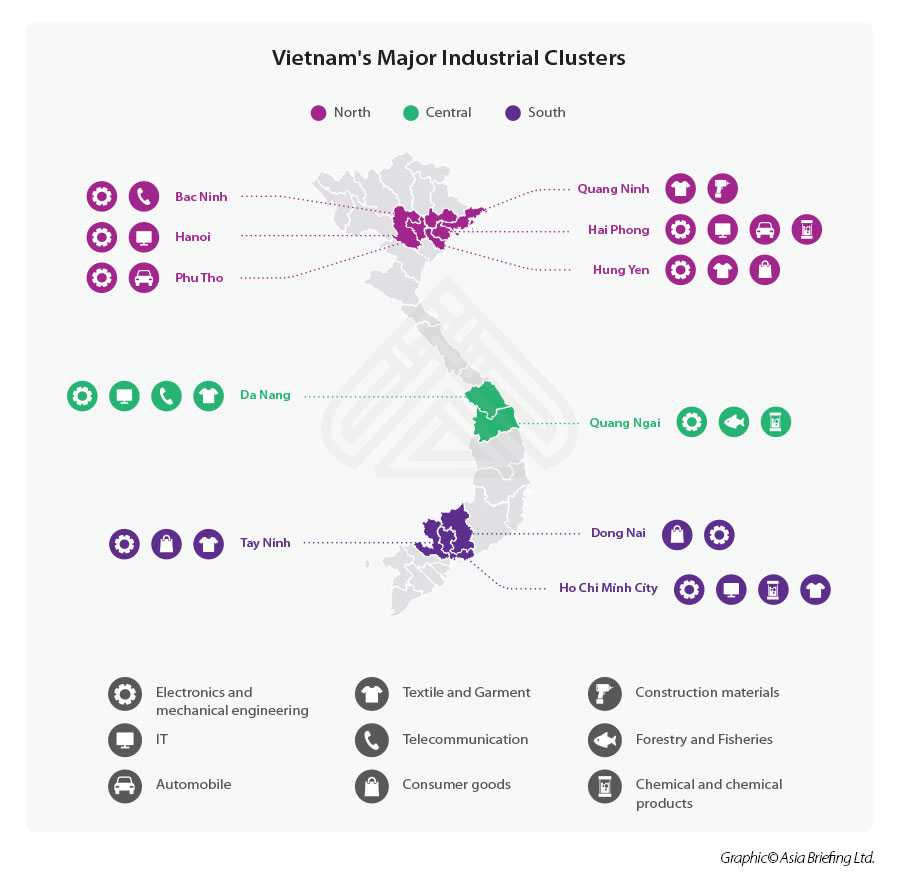
Vietnam’s manufacturing landscape is diverse, but several sectors stand out for foreign investors:
- Electronics and semiconductors: The country’s largest export sector, driven by firms such as Samsung Electronics and Intel, with exports exceeding US$100 billion annually.
- Textiles and footwear: A mature textile export industry with strong global demand, though increasingly constrained by labor shortages. In 2025, textile and garment exports reached approximately US$46 billion, maintaining Vietnam’s position among the world’s top three exporters.
- Furniture and wood products: A fast-growing export segment exceeding US$17 billion, with rising sustainability compliance requirements.
- Automotive and EVs: A high-growth market led by VinFast and supported by policy incentives. In 2025, Vietnam’s automotive market recorded 20.3 percent sales growth, making it the second-fastest growing market in the ASEAN-6.
- Agro-processing: A key pillar of value-added production, driven by modernization and export expansion. Vietnam’s agro-processing industry currently employs around 1.6 million direct workers, while supporting tens of millions of upstream jobs in raw material production and related services
These sectors illustrate Vietnam’s strengths in both labor-intensive manufacturing and higher-value industrial production.
Step-by-step guide to setting up a manufacturing company
Step 1: Choose the appropriate business structure
Selecting the right business structure is the first critical decision, as it determines ownership, control, and regulatory obligations.
Foreign investors typically consider three options:
- Wholly foreign-owned enterprise (WFOE): This structure offers full ownership and control, making it suitable for investors seeking operational independence. It is widely used in electronics, machinery, and export-oriented manufacturing.
- Joint venture (JV): A partnership with a local entity, often preferred in sectors where local knowledge, licensing, or distribution networks are important, such as textiles or consumer goods.
- Business cooperation contract (BCC): A contract-based arrangement without establishing a legal entity. This is less common for manufacturing but may be suitable for limited or pilot projects.
Choosing the right structure depends on factors such as market access conditions, capital requirements, and long-term strategy.
|
Business Structure Options for Manufacturing in Vietnam |
|||
|
Criteria |
Wholly Foreign-Owned Enterprise (WFOE) |
Joint Venture (JV) |
Business Cooperation Contract (BCC) |
|
Legal status |
Separate legal entity |
Separate legal entity |
No legal entity (contract-based) |
|
Ownership |
100% foreign ownership |
Shared between foreign and local partners |
No ownership structure |
|
Control |
Full control by investor |
Shared control (depends on agreement) |
Shared operational control via contract |
|
Market access |
Subject to foreign ownership restrictions in certain sectors |
Easier access in restricted or conditional sectors |
Flexible access depending on agreement |
|
Setup complexity |
Moderate |
Higher (partner selection, negotiation) |
Lower (no entity formation required) |
|
Capital contribution |
Required (registered capital) |
Required (shared capital contribution) |
Not required in the same way (contractual contributions) |
|
Profit sharing |
Fully retained by investor |
Shared based on equity ratio |
Shared based on contractual terms |
|
Liability |
Limited to company capital |
Limited to company capital |
Depends on contract terms |
|
Suitable for |
Long-term, large-scale manufacturing |
Sectors needing local expertise or networks |
Short-term, pilot, or cooperation projects |
|
Common industries |
Electronics, machinery, export manufacturing |
Textiles, consumer goods, regulated sectors |
Oil & gas, telecom, pilot manufacturing |
|
Risk level |
Lower (full control) |
Medium (partner dependency) |
Higher (no legal entity protection) |
Step 2: Secure a suitable location
Location selection is a pivotal step that directly impacts costs, logistics, and regulatory compliance.
There is no one-size-fits-all solution. Investors should assess:
- Proximity to suppliers and export markets
- Infrastructure quality (ports, roads, utilities)
- Labor availability and cost
- Local incentives and industrial policies
- Taxation and regulatory environment
It must be noted that foreign investors cannot own land in Vietnam. However, they can lease land through government approval. According to the 2024 Land Law (amended by Decree No. 151/2025/-CP), the provincial People’s Committee has the authority to lease land to foreign-invested economic organizations.
There are two main approaches to leasing land in Vietnam:
1. Leasing industrial land:
Provides full control over factory design and operations but requires higher upfront investment and longer setup timelines (typically 12–18 months).
2. Renting ready-built factories (RBFs):
Offers a faster and more flexible entry option. These facilities are pre-constructed within industrial parks, allowing operations to begin within 6–9 months. This model is increasingly popular among foreign manufacturers.
|
Comparison: Industrial Land vs Ready-Built Factory (RBF) in Vietnam |
||
|
Criteria |
Industrial Land (Build-to-Suit) |
Ready-Built Factory (RBF) |
|
Initial investment |
High (land lease + construction costs) |
Lower (rental-based, minimal upfront CAPEX) |
|
Setup timeline |
12–18 months |
6–9 months |
|
Flexibility in design |
Full control over factory layout and specifications |
Limited to existing design and infrastructure |
|
Speed to market |
Slower due to construction and approvals |
Faster, suitable for quick market entry |
|
Scalability |
Easier to expand on owned/leased land |
Depends on availability within industrial park |
|
Regulatory complexity |
Higher (construction permits, design approvals) |
Lower (pre-approved facilities) |
|
Operational control |
Full control over operations and facilities |
Shared infrastructure, managed by developer |
|
Suitable for |
Large-scale, long-term manufacturing projects |
SMEs, pilot projects, or rapid expansion |
|
Cost predictability |
Variable (construction, delays, inflation risks) |
More predictable monthly rental costs |
|
Maintenance responsibility |
Investor-managed |
Often partially managed by industrial park operator |
Step 3: Prepare and submit registration documents
Establishing a manufacturing entity requires two key registration certificates:
1. Investment Registration Certificate (IRC):
Required for most foreign-invested projects, outlining project scope, capital, and location.
2. Enterprise Registration Certificate (ERC):
Establishes the legal entity and defines its corporate structure.
Under recent guidance, investors may follow two approaches:
- Apply for the IRC first, then establish the company; or
- Establish the company first, then complete investment procedures
This flexibility reflects Vietnam’s ongoing efforts to simplify market entry.
Step 4: Obtain licenses and permits
Manufacturing operations require multiple approvals to ensure regulatory compliance.
Key permits include:
- Environmental Impact Assessment (EIA):
Mandatory for most manufacturing projects; approval typically takes 30–60 days. - Construction permits:
Required for building or modifying factory facilities; usually processed within 20–30 days. - Sector-specific licenses:
Applicable to conditional industries (e.g., chemicals, electronics), issued by relevant ministries such as the Ministry of Industry and Trade. - Operational permits:
Including fire safety and factory operation approvals before commencing production.
Regulatory update: Simplifying conditional business lines
A key reform in the 2025 Investment Law is the reduction of conditional business lines, i.e., categories of commercial activities or sectors in which companies are permitted to operate, from 234 to 196, with 38 business lines removed entirely from the conditional list. These business lines span multiple sectors, from finance, accounting, and commerce to transportation, agriculture, forestry, and fisheries.
In practice, this means many manufacturing activities no longer require pre-licensing, reducing administrative burden and accelerating project timelines. Remaining conditions are concentrated in sensitive sectors such as finance, construction, and transportation.
Step 5: Capital contribution and bank account setup
Capital contribution is a mandatory requirement following company registration.
Key considerations include:
- Investors must contribute registered capital within 90 days of ERC issuance (as prescribed under Law on Enterprises, 2020)
- Capital contributions may be made in the form of cash, machinery, equipment, technology, intellectual property, or other assets permitted under applicable law. Funds must be transferred through a direct investment capital account (DICA) opened at a licensed Vietnamese bank
This account is essential for complying with foreign exchange regulations and ensuring smooth profit repatriation.
Step 6: Recruitment and staffing
A strong workforce is key to success. Vietnam has a young, abundant labor pool ideal for manufacturing, but skill gaps may need training programs.
Employers must comply with the Labor Code, including:
- Signing labor contracts
- Ensuring minimum wage and working conditions
- Registering employees for social insurance
For foreign employees:
- Work permits are required
- Processing typically takes around 10 working days after submission
- Applications can be submitted online or through authorized service providers
Compliance risks and common challenges
While Vietnam offers strong opportunities, investors should be aware of key risks:
- Licensing delays at local levels
- Land clearance and construction bottlenecks
- Labor shortages in certain industries
- Environmental compliance requirements
- Tax and transfer pricing scrutiny
Early planning and local expertise can help mitigate these risks.
Conclusion
Setting up a manufacturing company in Vietnam is a structured but increasingly streamlined process. Beyond legal procedures, investors must carefully evaluate costs, location, incentives, and workforce dynamics to ensure successful market entry. With continued reforms and strong industrial growth, Vietnam remains a leading destination for global manufacturing investment.