In the first half of 2025, Vietnam’s labour market maintained strong momentum, supported by a workforce of approximately 53 million people. Although labour costs remain relatively competitive, wages have continued to rise steadily. This article examines Vietnam’s key workforce indicators, wage growth trends, and sector-specific earnings to help businesses assess the country’s evolving labour market.
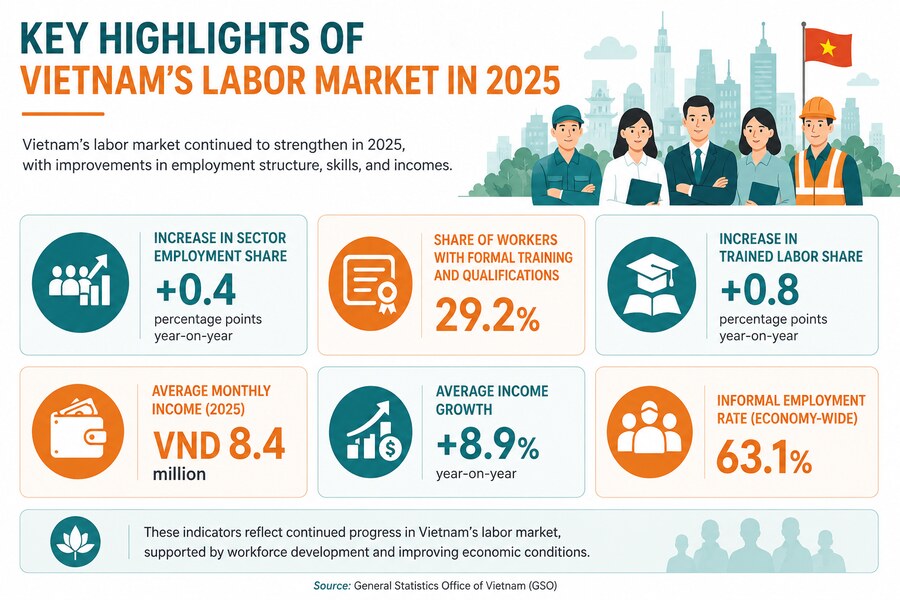
Known for its cost-competitive labour force in the past, Vietnam has experienced a steady rise in wages in recent years. The national average monthly income reached about VND 7.7 million (US$305) in 2024, an 8.6 percent year-on-year increase, and grew to roughly VND 8.3 million (US$317) by mid-2025.
Structure Employee Compensation
Plan competitive salaries, payroll, and workforce costs in Vietnam.Vietnam’s wages show consistent growth
Vietnamese wages have grown by about 8-10 percent annually in recent years. Official data indicate that the average monthly income was approximately VND 8.3 million (US$317) in Q1 2025 and VND 8.2 million (US$314) in Q2 2025, showing a roughly 10 percent rise from the same periods in 2024.
Meanwhile, the 6 percent minimum wage increase, effective from July 2024, directly raised incomes, although no additional hike was announced for 2025. Since 2020, average pay is estimated to have increased by about 5-6 percent. Major cities experienced similar growth, while smaller provinces, especially in the North-Central and Central regions, outpaced this growth with an increase of about 11.7 percent.
Overall, wage growth in Vietnam remains robust. Investors should anticipate annual increases in labour costs of around 10 percent in their budgets unless productivity improvements or automation technologies offset these costs.
Wage trends by sector in Vietnam
Vietnam’s wage structure reflects a sharp divide between knowledge-based roles and labour-intensive sectors, with considerable variations depending on industry type.
Services
The services sector offers the highest average wages at approximately VND 9.9 million (US$378) per month, driven by demand for skilled labour in areas such as finance, information technology, and professional services. Within this sector, jobs requiring specialised expertise offer significant wage premiums. For instance, a software developer typically earns around VND 20 million (US$763) per month, while a mid-level financial analyst may receive VND 18 million (US$687).
Executive-level compensation is substantially higher. According to a report by FiinRatings, private sector company directors earn about VND 2.5 billion (US$95,420) in 2023, compared to VND 1.4 billion (US$53,430) for their state-owned enterprise (SOE) counterparts. This reflects the private sector’s flexibility in rewarding performance and attracting talent.
Wages in retail, logistics, and other general services typically range from VND 6-10 million (US$229-382), placing them around or slightly below the national average. In contrast, positions requiring technical skills, such as those in IT, engineering, or finance, can easily command wages double the average. This wage premium illustrates Vietnam’s growing skills gap and increasing demand for qualified professionals across sectors.
Industry and construction
Wages in the industry and construction sectors, which includes manufacturing, average around VND 9.1 million (US$347.5) per month. However, within manufacturing, pay levels vary widely. In 2024, factory workers earned between VND 7.7 million and 8.4 million (US$294-321) per month, depending on industry segment. Workers in electronics and high-tech manufacturing are typically paid at the higher end, while those in textiles and garments remain near the lower end.
Notably, foreign-invested enterprises (FIEs) tend to offer wages roughly 20 percent higher than those of their local counterparts, partly due to differing compensation structures and additional benefits. This wage differential gives FIEs a competitive edge in recruitment, though cost pressures remain a factor in labour-intensive industries.
Agriculture and forestry
The agriculture and forestry sector continues to lag behind in compensation, with average monthly wages of just VND 4.9 million (US$187). The lower pay levels reflect the sector’s limited value addition and dependence on seasonal, low-skilled labour. Although this keeps operational costs low, it also poses challenges for workforce stability and rural labour retention.
Wages vary across different enterprise types
Wage disparities are also evident across enterprise types. In 2024, state-owned enterprises (SOEs) reported the highest average formal-sector wage at VND 10.91 million (US$417) per month, followed by FIEs at VND 9.28 million (US$355), and private domestic firms at VND 8.10 million (US$310).
These differences have implications for recruitment and retention strategies, particularly in higher-skilled roles. Foreign investors often find themselves competing with public-sector wage levels when hiring managerial or technical staff, even though compensation for rank-and-file employees in FIEs generally aligns with private sector benchmarks.
Regional wage disparities
Wage levels vary considerably across Vietnam. According to Talentnet, the Red River Delta, home to Hanoi, and the southeastern region, including Ho Chi Minh City (HCMC), have the highest average monthly salaries – around VND 9.8 million (US$374) and VND 9.7 million (US$370), respectively. These figures are roughly 18 percent above the national average.
By contrast, rural provinces and smaller localities continue to lag behind. In 2025, urban workers earned an average of VND 10.4 million (US$397) per month, compared to just VND 8.4 million (US$321) in rural areas, resulting in a wage gap of roughly 24 percent.
Many industrial parks are located in mid-tier provinces, where wages typically sit between those of major urban centers and rural regions. For instance, the broader Southeast region, including HCMC, recorded an average wage of VND 9.3 million (approximately US$355).
Notably, North-Central and Central Highlands provinces experienced the fastest wage growth from 2024 to 2025, at approximately 11.7 percent. However, their absolute wage levels still remain below those seen in Vietnam’s top-tier cities. In other words, the same job may pay 10–15 percent less in a secondary city than in Hanoi or HCMC, reflecting differences in living costs, labour supply, and regional competitiveness.
Implications for investors
Steady wage growth
Wages in Vietnam have continued their upward trajectory, rising by approximately 8-10 percent annually. Average monthly pay increased from VND 7.1 million (US$271) in 2023 to around VND 7.7 million (US$294) in 2024. Employers should anticipate similar adjustments in 2025, as salary growth remains driven by labour market competition and moderate inflationary pressure.
Regional differences
Labour costs remain significantly higher in southern and urban provinces compared to rural areas. FIEs operating in industrial hubs such as HCMC, Binh Duong, and Dong Nai typically pay average monthly wages of around VND 9-10 million (US$344-383). In contrast, workers in northern and midland provinces earn lower wages, approximately VND 6-8 million (US$229-306), though wage expectations in these areas are gradually rising in line with overall economic growth.
FDI wage edge
FIEs in Vietnam typically offer wages that are approximately 10–15 percent higher than those of local private companies, allowing them to attract and retain more skilled employees. However, as domestic firms gradually increase their compensation levels, FIEs are facing intensified competition for talent. Survey data indicate that while many FDI firms report a sufficient local labour supply, they continue to differentiate themselves through performance-based bonuses and expanded employee benefits.
Policy environment
As of 2025, statutory labour costs remain fixed, with the regional minimum wage ranging from VND 3.45 million to VND 4.96 million (US$132-190), and the national base salary set at VND 2.34 million (US$90). Looking ahead, policy shifts are expected to prioritize vocational training and social insurance reforms over direct wage increases. Investors should note the government’s continued emphasis on workforce upskilling, as currently, only around 28 percent of workers have received formal training, as well as the rising regulatory compliance requirements affecting employment practices.
See also: Vietnam’s Regional Minimum Wage Effective from July 1, 2025
(US$1 = VND 26,100)
Unlock the Full Article
Share a few details to continue reading