Vietnam’s e-commerce market has grown rapidly in recent years. Rising internet penetration, a young population, and increasing smartphone adoption have all contributed to this expansion. However, the logistics infrastructure that supports e-commerce has not kept pace. Warehousing, last-mile delivery, rural coverage, and cold-chain systems remain underdeveloped compared to more mature markets.
Logistics costs account for about 16 to 17 per cent of Vietnam’s GDP, higher than Thailand at about 14 per cent and Malaysia at about 13 per cent. More strikingly, last-mile delivery alone represents 53 per cent of total logistics costs. For businesses operating in Vietnam, these figures represent not only a cost burden but also a competitive disadvantage. This article provides an overview of the market, examines key fulfilment models, outlines practical steps for building a logistics network, and discusses regulatory considerations and future trends.
Build Your Business
Explore how professional advisory support can help your business navigate Vietnam’s evolving retail, consumer, and e-commerce landscape.Vietnam’s e-commerce logistics market
Vietnam’s cross-border e-commerce logistics market was valued at approximately US$1.2 billion in 2025. It is projected to grow at a compound annual growth rate of about 11.5 per cent from 2026 to 2030, reaching approximately US$2.06 billion by 2030.
The cold-chain logistics market was valued at approximately US$850 million in 2025 and is projected to grow at about 14 per cent, reaching approximately US$1.64 billion by 2030.
The market is served by a mix of local and international players. Key local providers include Viettel Post, VNPost, GHN, and GHTK. Regional and international players include Ninja Van, Shopee Express, Lazada Logistics, DHL, and FedEx. Local logistics companies hold about 65 per cent of the market share, with foreign-invested enterprises accounting for the remaining 35 per cent. Foreign ownership in logistics enterprises is generally capped at 49 per cent, which limits the ability of international players to fully control their operations in Vietnam.
The key challenge facing the sector is that logistics costs remain high. At 16 to 17 per cent of GDP, Vietnam’s logistics cost ratio is significantly above the regional average. This affects the competitiveness of Vietnamese businesses and increases the final price paid by consumers.
Key logistics models and fulfilment options
Businesses in Vietnam have several logistics models to choose from. Each model has its own trade-offs in terms of control, cost, and scalability:
- Self-operated logistics: Companies such as Shopee Express and Lazada Logistics operate their own delivery networks. This model offers greater control over service quality and delivery speed. However, it requires substantial capital investment and is best suited for large platforms with high order volumes.
- Third-party logistics (3PL): Providers such as Viettel Post, GHN, GHTK, and Ninja Van offer logistics services on a contract basis. This model provides flexibility and scalability without large upfront investment. It is ideal for smaller businesses or those testing the market.
- Hybrid models: Many businesses combine self-operated logistics for high-volume urban areas with third-party providers for rural or remote regions. This approach balances control with cost efficiency.
- Warehouse space: Current warehouse space in Vietnam is approximately 7 million square meters. The projected requirement by 2030 is 12 million square meters, indicating a significant supply gap that presents opportunities for investment.
How to build an efficient logistics network
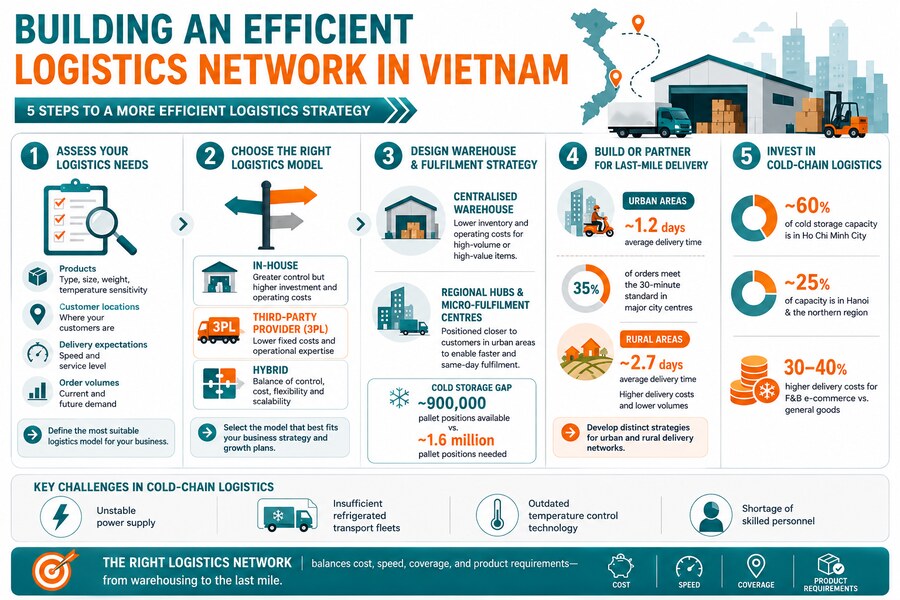
Building an efficient logistics network in Vietnam requires a systematic approach. The following steps provide a practical framework.
Step 1 – Assess your logistics needs
Consider the type of products you sell, including their size, weight, and temperature sensitivity. Identify your customer locations, delivery speed expectations, and order volumes. This assessment will determine the most suitable logistics model for your business.
Step 2 – Choose the right logistics model
Based on your assessment, decide whether to operate your own logistics, use third-party providers, or adopt a hybrid approach.
Step 3 – Design warehouse and fulfilment strategy
For high-volume or high-value items, a centralised warehouse can reduce costs. For faster delivery, regional hubs and micro-fulfilment centres in urban areas can enable same-day fulfilment. Current cold storage capacity stands at about 900,000 pallet positions against actual demand of about 1.6 million pallet positions, so businesses handling perishable goods must prioritise cold storage investment.
Step 4 – Build or partner for last-mile delivery
In urban areas, average delivery time is about 1.2 days, but only about 35 per cent of orders meet the “30-minute standard” in major city centres. In rural areas, average delivery time increases to about 2.7 days, with higher costs and lower volumes. Businesses should develop distinct strategies for urban and rural delivery.
Step 5 – Invest in cold-chain logistics
For businesses handling fresh or frozen products, cold-chain logistics is essential. Current cold storage capacity is concentrated in Ho Chi Minh City, accounting for about 60 per cent of total capacity, with about 25 per cent in Hanoi and the northern region. Food and beverage e-commerce delivery costs are 30 to 40 per cent higher than for general goods due to cold-chain requirements.
Key challenges include unstable power supply, insufficient refrigerated transport fleets, outdated temperature control technology, and a shortage of skilled personnel.
Regulatory and operational considerations
Foreign investors should be aware of several regulatory constraints. Foreign ownership in logistics enterprises is generally capped at 49 per cent, meaning international companies must typically enter the Vietnamese market through joint ventures with local partners.
The Vietnamese government approved a new logistics strategy for 2026 to 2030 in July 2026. The strategy aims to reduce logistics costs to 13 to 15 per cent of GDP by 2030 and raise Vietnam’s ranking in the Logistics Performance Index to the top 40 globally. Under this strategy, logistics projects may qualify for corporate income tax incentives, including a four-year exemption and a nine-year 50 per cent reduction, as well as land use tax reductions.
Businesses must also comply with customs regulations for cross-border e-commerce, labour laws governing delivery personnel, environmental standards including emissions requirements and delivery vehicle restrictions, and data protection regulations.
Future trends and recommendations
Several trends are shaping the future of Vietnam’s e-commerce logistics sector. Technology adoption is accelerating, with AI-driven route optimisation, automated warehouses, and real-time tracking systems improving efficiency. Cold-chain expansion is being driven by fresh food and pharmaceutical e-commerce, with online fresh food sales growing by about 35 to 40 per cent year-on-year in the first quarter of 2026.
Rural logistics is another area of growth, supported by government initiatives and private sector investment. Sustainable logistics practices, including electric delivery vehicles and packaging reduction, are also gaining traction.
For businesses operating in Vietnam, the following recommendations are offered.
- Align logistics strategy with your e-commerce model: Your logistics approach should reflect your product range, target customers, and growth ambitions.
- Partner with established local logistics players: Local providers have the market knowledge, infrastructure, and regulatory experience that international businesses often lack.
- Invest in technology to improve visibility and operational efficiency: Real-time tracking and data analytics can reduce costs and improve customer satisfaction.
- Prioritise cold-chain and rural coverage as competitive factors: These are areas where Vietnam currently has significant gaps, and businesses that address them effectively can gain a meaningful advantage over competitors.
See also: Vietnam E-Commerce Sector Outlook: Key Growth Trends