Other Briefings
Vietnam Revises High-Tech Park Rules: What Investors Need to Know
Effective 1 July 2026, Decree No. 260/2026/ND-CP has introduced a new framework for Vietnam’s high-tech park regulations, strengthening the country’s strategy for attracting high-value investment by raising eligibility standards for projects while expanding incentives and administrative support for investors.
Key takeaways
- Under Decree No. 260/2026/ND-CP, qualified projects continue to receive preferential investment incentives and one-stop administrative support, while new eligibility criteria place greater emphasis on R&D, strategic technologies, environmental performance and workforce quality.
- Manufacturing and R&D projects in high-tech parks face stricter operational and innovation requirements.
- Investors should review project plans early to ensure compliance and maximise available incentives.
Decree No. 260/2026/ND-CP (“Decree 260”), provides further clarifications and implementation measures to several provisions of Vietnam’s Law on High Technology. It places greater emphasis on research and development (R&D), strategic technologies, advanced manufacturing, and workforce development.
Rather than offering incentives based primarily on investment size, Vietnam is increasingly rewarding projects that demonstrate innovation, technology transfer, and long-term value creation.
For foreign investors, the changes create new opportunities but also require more careful planning to ensure projects meet the revised qualification criteria and remain compliant throughout their investment lifecycle.
See also: Vietnam Passes First-Ever Law on Digital Technology Industry
Investors in Vietnam’s high-tech parks continue to enjoy preferential incentives
As per Article 22 of Decree 260, projects located in high-tech parks will continue to receive investment incentives equivalent to those available in areas with especially difficult socio-economic conditions under Vietnam’s Investment Law.
While the incentive framework itself remains familiar, the decree expands the range of support available to investors. Accordingly, businesses operating within Vietnam’s high-tech parks can benefit from:

- Investment incentives and tax preferences available under existing investment regulations;
- One-stop administrative support for investment, enterprise registration, land, construction, environmental, labour, taxation and customs procedures;
- Government support for workforce recruitment and related employment matters; and
- Priority access to national programmes supporting high technology, strategic technologies, innovation, skills development and enterprise support.
The decree also authorises provincial governments to introduce additional support measures based on local development priorities and available budgets. This could create differences in investment packages across provinces, making location selection an increasingly strategic consideration for investors.
Investment projects face stricter qualification criteria
The new framework raises the bar for projects seeking approval in high-tech parks by introducing clearer eligibility requirements across multiple project categories.
According to Article 26 of Decree 260, all investment projects must demonstrate that they:
- Align with the development objectives of the relevant high-tech park;
- Apply environmentally friendly and energy-efficient technologies;
- Match the park’s infrastructure planning and capacity;
- Demonstrate sufficient financial resources and technological capability to implement projects on schedule; and
- Deliver relatively high investment intensity compared with other projects within the same functional zone.
These baseline requirements are supplemented by sector-specific criteria depending on whether the project involves R&D, advanced manufacturing, incubation services, technology services or education and training.
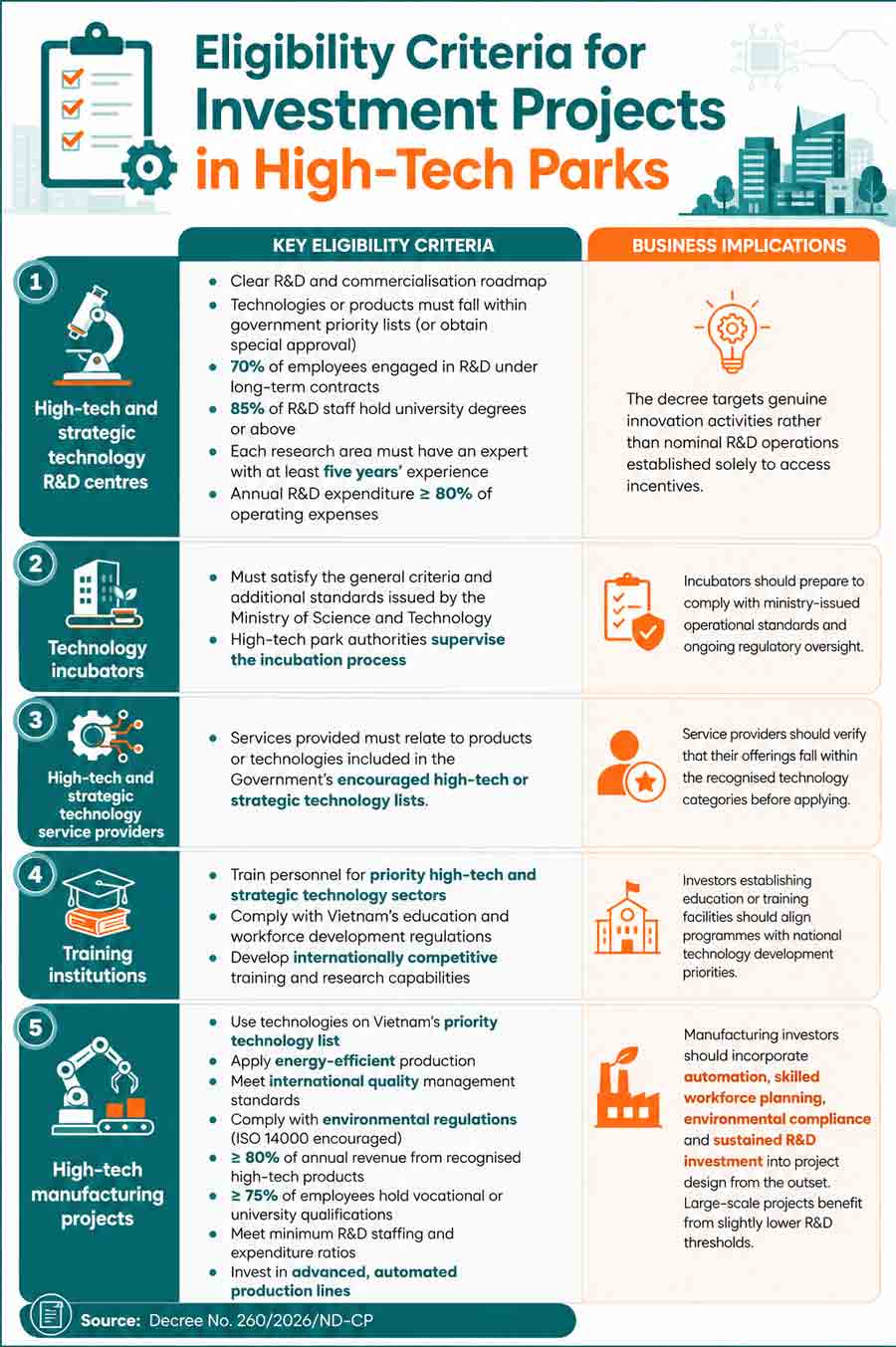
R&D and strategic technology projects receive priority
The decree places particular emphasis on attracting research-intensive investments and strategic technology development.
Projects establishing high-tech or strategic technology R&D centres must demonstrate clear commercialisation pathways rather than focusing solely on research, and their operational requirements are considerably more demanding.
These requirements indicate Vietnam’s intention to attract substantive research activities rather than projects established primarily to access investment incentives.
Advanced manufacturing projects must demonstrate technology leadership
Manufacturing projects applying high technologies are also subject to enhanced qualification standards. In addition to using technologies included on Vietnam’s priority technology lists, projects are expected to demonstrate advanced production capabilities through:
- International quality management standards;
- Environmental compliance and energy-efficient production; and
- Advanced automation and modern production lines.
Some requirements vary by project scale. Large projects meeting specified investment or revenue thresholds benefit from lower R&D expenditure and staffing ratios, recognising economies of scale while maintaining innovation requirements.
For manufacturers considering Vietnam as a regional production base, investment planning should incorporate:
- Workforce development and skills training;
- Technology deployment and automation; and
- Long-term R&D investment to maintain compliance and qualify for incentives.
Streamlined certification process with greater investor accountability
Decree 260 also introduces a clearer certification mechanism for projects that are not otherwise required to obtain investment policy approval or an Investment Registration Certificate (IRC).
Under the new procedure, investors must submit a project dossier explaining how the proposed investment satisfies the applicable eligibility criteria. The application includes commitments regarding:
- Project implementation;
- Technology standards;
- Labour requirements; and
- Environmental considerations.
The management board of the relevant high-tech park must coordinate consultation with provincial authorities before completing its assessment within prescribed timelines.
Importantly, investor commitments will become part of the regulatory basis for future supervision and inspections. Therefore, if projects fail to fulfil the commitments made during certification, investors may face compliance actions under Vietnam’s investment legislation.
Businesses should ensure that technical, operational and financial assumptions included in project applications are realistic and fully supported by implementation plans.
Effectiveness and transitional provisions
Effective 1 July 2026, Decree 260 replaces Decree No. 10/2024/ND-CP, which governed high-tech parks in Vietnam. The new directive introduces transitional provisions that protect existing investments while aligning future project changes with the new regulatory framework.
Existing investment licences, investment registration certificates and high-tech enterprise certifications generally remain valid until their expiry. However, businesses should note that:
- Modifications involving high-tech or strategic technology activities must comply with the new eligibility criteria;
- Existing land lease arrangements remain valid in certain circumstances; and
- Annual land rental incentives may transition to the new framework after the decree takes effect.
These transitional measures provide regulatory continuity while encouraging existing investors to gradually align their operations with Vietnam’s updated high-tech and innovation strategy.
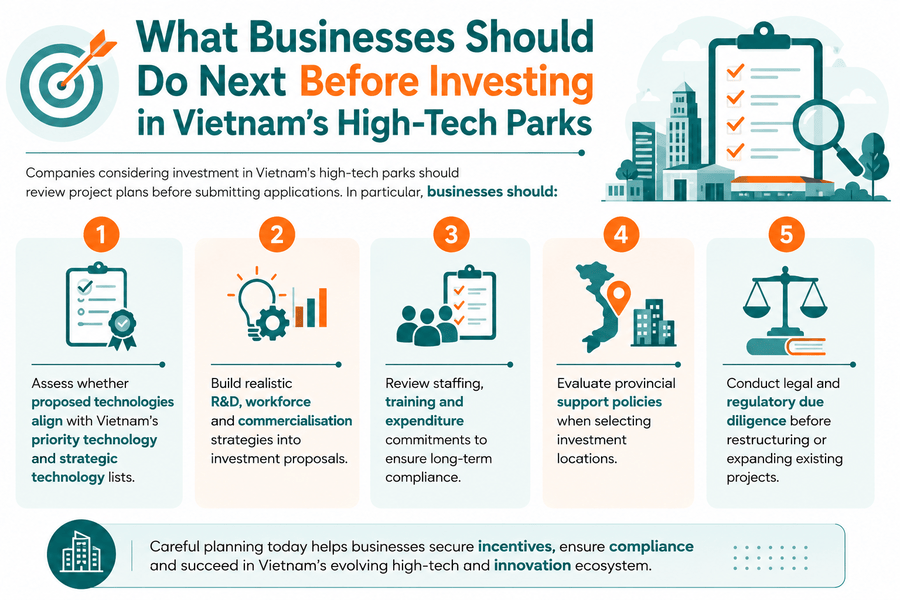
What businesses should do next?
The new high-tech park framework reflects Vietnam’s shift from attracting investment based primarily on capital commitments towards rewarding projects that generate technological capability, innovation and skilled employment.
For multinational manufacturers, technology companies and innovation-focused investors, the revised framework presents an opportunity to secure preferential treatment while supporting Vietnam’s ambition to move further up the global value chain. However, accessing these benefits will increasingly depend on demonstrating genuine technological capability and maintaining compliance throughout the life of the investment.
See also: Vietnam Manufacturing Tracker: A First-Half 2026 Review



Setting up a business in Vietnam requires navigating company registration, local approvals, and work permit processes. We help FDI companies by preparing and submitting documentation, coordinating with authorities, and ensuring compliance, so they can start operations smoothly and focus on growth.
About Us
Vietnam Briefing is one of five regional publications under the Asia Briefing brand. It is supported by Dezan Shira & Associates, a pan-Asia, multi-disciplinary professional services firm that assists foreign investors throughout Asia, including through offices in Hanoi, Ho Chi Minh City, and Da Nang in Vietnam. Dezan Shira & Associates also maintains offices or has alliance partners assisting foreign investors in China, Hong Kong SAR, Indonesia, Singapore, Malaysia, Mongolia, Dubai (UAE), Japan, South Korea, Nepal, The Philippines, Sri Lanka, Thailand, Italy, Germany, Bangladesh, Australia, United States, and United Kingdom and Ireland.
For a complimentary subscription to Vietnam Briefing’s content products, please click here. For support with establishing a business in Vietnam or for assistance in analyzing and entering markets, please contact the firm at vietnam@dezshira.com or visit us at www.dezshira.com
- Previous Article Vietnam Economy H1 2026: GDP, FDI, Trade and Manufacturing Review
- Next Article