Other Briefings
From July 1, Here Are the 10 Tax Practices Prohibited in Vietnam
Vietnam’s new Tax Administration Law, effective July 1, 2025, introduces 10 prohibited tax practices that businesses must avoid. Coupled with intensified enforcement against illegal invoice trading and tax fraud, the law underscores Vietnam’s stronger compliance regime.
Key takeaways
- Vietnam’s 2025 Tax Administration Law identifies 10 categories of prohibited acts applicable to taxpayers, tax officials, and related organizations.
- Illegal invoice trading and tax fraud remain among the country’s top tax enforcement priorities, with authorities strengthening investigations and digital monitoring.
- Businesses should strengthen internal tax controls, conduct supplier due diligence, and ensure the authenticity of electronic invoices to mitigate compliance risks.
Vietnam steps up tax compliance enforcement

Vietnam continues to modernize its tax administration as part of broader efforts to improve fiscal transparency, digital governance, and the business environment. Law No. 108/2025/QH15 on Tax Administration, effective from October 1, 2025, reinforces this objective by consolidating prohibited acts in tax administration while granting tax authorities stronger legal tools to detect and address tax violations.
The updated framework comes alongside increasingly sophisticated enforcement measures. Authorities are leveraging electronic invoice databases, inter-agency information sharing, and data analytics to identify suspicious transactions, particularly those involving value-added tax (VAT) fraud and illegal invoice trading.
For foreign-invested enterprises (FIEs) operating in Vietnam, understanding these prohibited acts is no longer merely a legal compliance exercise: It has become an important component of financial governance and risk management.
The 10 prohibited acts under Vietnam’s 2025 Tax Administration Law
The law identifies 10 categories of prohibited conduct that apply to taxpayers, tax authorities, public officials, and organizations participating in tax administration.
1. Collusion between taxpayers and tax officials
The law prohibits any agreement or collusion intended to reduce tax liabilities, conceal tax obligations, or otherwise circumvent tax regulations.
This includes situations where taxpayers cooperate with tax officials to falsify records, manipulate tax assessments, or interfere with tax inspections.
2. Failure to fulfill tax obligations through fraudulent means
Taxpayers are prohibited from deliberately avoiding tax obligations through fraudulent declarations, concealment of taxable income, or other deceptive practices.
Examples include:
- deliberately underreporting revenue;
- concealing taxable transactions;
- failing to declare taxable income; and
- submitting misleading financial information.
Such conduct may constitute tax evasion depending on its severity.
3. Filing false tax declarations or providing inaccurate information
Businesses must ensure that tax declarations accurately reflect their commercial activities.
Violations include:
- submitting inaccurate tax returns;
- falsifying accounting records;
- providing incorrect supporting documents;
- intentionally overstating deductible expenses or VAT credits.
Errors arising from negligence may result in administrative penalties, while intentional misrepresentation may trigger more serious enforcement measures.
4. Tax evasion and tax fraud
The law expressly prohibits tax evasion and fraudulent activities designed to reduce tax liabilities or obtain unlawful tax benefits.
Common forms include:
- concealing revenue;
- maintaining dual accounting systems;
- fabricating transactions; and
- improperly claiming tax incentives or refunds.
Depending on the circumstances, violations may result in administrative sanctions or criminal prosecution.
5. Illegal purchase, sale, or use of invoices and tax documents
Illegal invoice trading remains one of Vietnam’s highest enforcement priorities.
The law prohibits:
- buying or selling invoices without genuine commercial transactions;
- issuing invoices for fictitious transactions;
- using forged invoices;
- trading tax-related documents for unlawful financial gain.
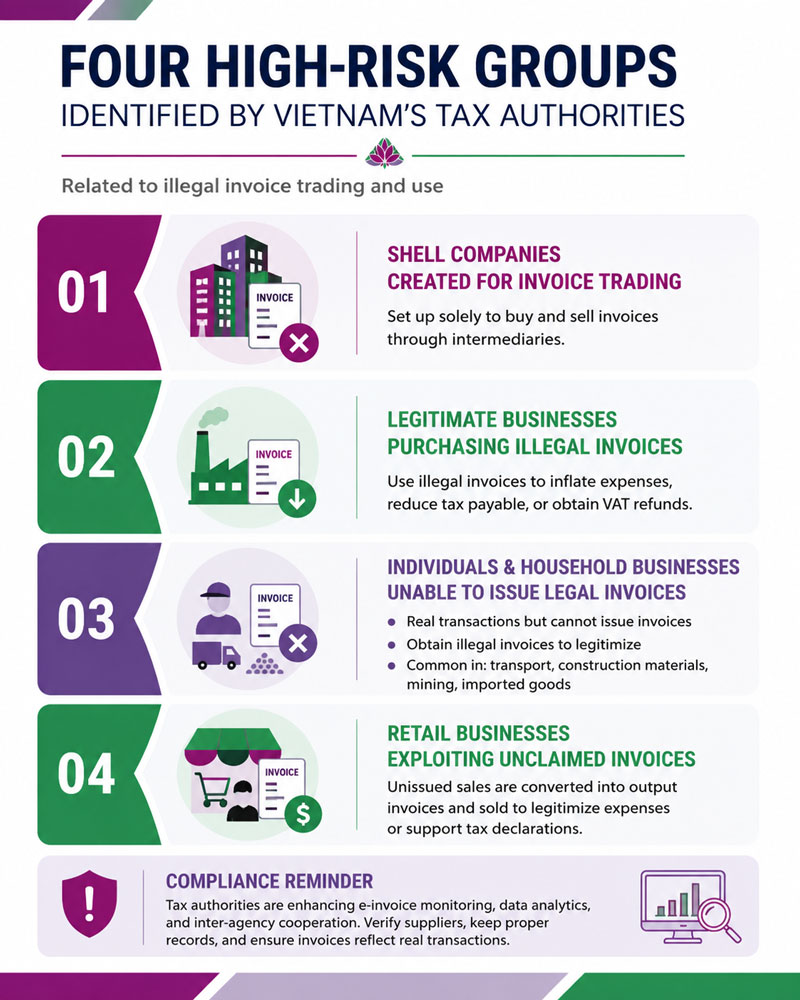
Electronic invoices have significantly improved transparency, but authorities continue to identify sophisticated schemes involving shell companies established solely to issue VAT invoices.
6. Obstructing tax administration activities
Organizations and individuals must cooperate with tax authorities during inspections, audits, and investigations.
Prohibited conduct includes:
- refusing to provide required documents;
- destroying accounting records;
- delaying inspections without legitimate grounds; and
- interfering with tax enforcement activities.
7. Abuse of authority by tax officials
The law also regulates the conduct of tax officials.
Officials are prohibited from:
- abusing their authority;
- harassing taxpayers;
- deliberately delaying administrative procedures;
- demanding unofficial payments; and
- disclosing confidential taxpayer information without authorization.
These provisions are intended to strengthen transparency and accountability within tax administration.
8. Misuse or disclosure of confidential taxpayer information
Taxpayer information collected during tax administration must be protected.
Unauthorized disclosure, commercial exploitation, or misuse of confidential tax information is prohibited unless permitted by law.
9. Bribery and corruption in tax administration
Offering, giving, requesting, or accepting bribes in relation to tax administration is strictly prohibited.
The prohibition applies to both taxpayers and public officials and complements Vietnam’s broader anti-corruption framework.
10. Other acts prohibited under tax administration regulations
The law includes a broad provision covering other activities that interfere with lawful tax administration or violate tax regulations.
This allows authorities to address emerging forms of tax misconduct that may not be explicitly listed elsewhere in the legislation.
Recent enforcement signals: Intensified scrutiny against invoice fraud
Recent enforcement actions demonstrate that illegal invoice trading remains one of the primary focuses of Vietnam’s tax authorities.
In June 2026, the Investigation Security Agency under the Hai Phong City Police announced the dismantling of an alleged network engaged in the illegal purchase and sale of VAT invoices. According to investigators, the operation involved more than 4,700 VAT invoices with a total recorded transaction value reaching hundreds of billions of Vietnamese dong.
Authorities alleged that the suspects established multiple “shell” enterprises with little or no genuine business activity for the primary purpose of issuing VAT invoices to other businesses seeking to legitimize fictitious expenses or improperly claim VAT deductions.
The investigation also highlighted increasingly sophisticated methods used by invoice trading networks, including frequent changes in legal representatives, nominee directors, and the rapid establishment and dissolution of companies to evade regulatory scrutiny.
Separately, the Ministry of Finance has warned that illegal trading of invoices and accounting documents continues to undermine tax administration and distort market competition. Tax authorities are strengthening cooperation with public security agencies while expanding the use of electronic invoice databases and risk-based analytics to detect suspicious transactions earlier.
These developments suggest that enforcement efforts are increasingly targeting not only organized invoice trading networks but also businesses that knowingly, or through inadequate due diligence, use fraudulent invoices in their accounting records.
Practical implications for foreign-invested enterprises
Although large-scale criminal investigations often involve organized fraud networks, legitimate businesses may also face significant tax risks if they fail to verify the authenticity of suppliers or supporting documentation.
Businesses should therefore consider strengthening their tax governance by:
- conducting due diligence on new suppliers before engaging in transactions;
- verifying the validity of electronic invoices through official tax systems;
- ensuring that invoices correspond to genuine commercial activities and supporting documentation;
- maintaining complete accounting records for tax inspections;
- periodically reviewing VAT claims and deductible expenses through internal compliance audits; and
- providing regular tax compliance training to finance and accounting personnel.
As Vietnam continues to digitalize tax administration, authorities are expected to rely increasingly on data-driven risk analysis rather than traditional manual inspections. Businesses with robust internal controls will therefore be better positioned to manage compliance risks and respond efficiently to tax audits.
Looking ahead
Vietnam’s 2025 Tax Administration Law reflects the government’s broader commitment to strengthening tax compliance, improving transparency, and combating increasingly sophisticated tax fraud schemes.
For businesses operating in Vietnam, compliance now extends beyond timely tax filing. Effective governance requires strong accounting controls, careful supplier verification, and continuous monitoring of tax risks throughout commercial operations. As recent enforcement actions demonstrate, authorities are placing particular emphasis on illegal invoice trading and VAT fraud, making proactive compliance an essential part of doing business in Vietnam.
See also: Stuck in Vietnam? A Guide to Exit Delays Over Tax Obligations



Managing tax in Vietnam is critical for FDI companies to stay compliant with local regulations, GST requirements, and global standards such as IFRS, navigate complex filings, and apply correct tax treatments. A well-structured tax process helps to avoid penalties and stay 100% compliant.
About Us
Vietnam Briefing is one of five regional publications under the Asia Briefing brand. It is supported by Dezan Shira & Associates, a pan-Asia, multi-disciplinary professional services firm that assists foreign investors throughout Asia, including through offices in Hanoi, Ho Chi Minh City, and Da Nang in Vietnam. Dezan Shira & Associates also maintains offices or has alliance partners assisting foreign investors in China, Hong Kong SAR, Indonesia, Singapore, Malaysia, Mongolia, Dubai (UAE), Japan, South Korea, Nepal, The Philippines, Sri Lanka, Thailand, Italy, Germany, Bangladesh, Australia, United States, and United Kingdom and Ireland.
For a complimentary subscription to Vietnam Briefing’s content products, please click here. For support with establishing a business in Vietnam or for assistance in analyzing and entering markets, please contact the firm at vietnam@dezshira.com or visit us at www.dezshira.com
- Previous Article 越南软件生产企业所得税激励政策:投资者必读
- Next Article