Inventory management can create significant accounting and tax risks for manufacturers and other inventory-intensive businesses. Discrepancies between physical stock, warehouse records, accounting data, and tax declarations may affect financial reporting, production costs, value-added tax (VAT), and corporate income tax (CIT).
The key risks generally arise from inventory discrepancies, incorrect valuation and cost allocation, weak warehouse controls, and inadequate supporting documentation.
Strengthen Inventory Controls
Get expert accounting and reporting support to improve inventory records, costing, reconciliations, and tax compliance.Inventory discrepancies and stocktaking issues
Differences between physical inventory and accounting records can arise from unrecorded stock movements, errors in goods receipts or deliveries, production losses, or inadequate stocktaking procedures.
Businesses should regularly reconcile physical inventory with warehouse and accounting records and investigate material discrepancies. Where inventory shortages, losses, or adjustments cannot be adequately explained and supported, businesses may face additional scrutiny during tax inspections or audits.
Clear procedures for receiving, storing, issuing, returning, and adjusting inventory can help reduce the risk of discrepancies.
Inventory valuation and production cost allocation
Incorrect inventory valuation can affect both financial reporting and taxable income. Common issues include inconsistent valuation methods, inaccurate allocation of production costs, and errors in calculating the value of work in progress (WIP).
For manufacturers, inventory costs may include direct materials, direct labour, and production overheads. Weak or inconsistent cost allocation can therefore distort the value of closing inventory and the cost of goods sold.
Businesses with multiple production stages should ensure that their costing methodology is consistently applied and supported by production and accounting records.
Work-in-progress accounting risks
WIP can present particular challenges where production processes extend across multiple accounting periods. Businesses must determine the appropriate stage of completion and allocate materials, labour, and overhead costs accordingly.
Risks may arise where WIP balances rely on unsupported estimates or where production, warehouse, and accounting systems are not aligned. Differences between recorded material consumption, production output, and inventory balances may also make it more difficult to substantiate production costs.
Regular reconciliation between production records and accounting data can help identify these issues before the end of the reporting period.
Obsolete, damaged, and slow-moving inventory
Inventory that is damaged, expired, obsolete, or slow-moving may require a provision or write-down. However, businesses should maintain sufficient documentation to support both the condition of the inventory and the basis for its valuation.
This may include inventory ageing reports, stocktaking records, technical assessments, disposal decisions, and other relevant supporting documents.
Businesses should also consider the applicable requirements for determining whether inventory devaluation provisions are deductible for CIT purposes. Regular inventory ageing reviews can help identify potential issues before they affect financial statements or tax positions.
Weak warehouse controls and segregation of duties
Weak internal controls can increase the risk of inventory losses, unrecorded transactions, and inaccurate accounting records. Risks may be higher where the same individual is responsible for receiving, storing, issuing, and recording inventory transactions.
Where practicable, businesses should separate responsibility for inventory custody, transaction approval, and accounting records. Inventory adjustments and write-offs should also be subject to appropriate review and approval.
Clear responsibilities can improve accountability and make discrepancies easier to identify and investigate.
Inconsistencies between inventory, accounting, and invoice records
Inventory data should be consistent with purchasing, production, accounting, and sales records. However, businesses may face difficulties where warehouse and accounting systems operate separately or where manual adjustments are required.
Particular attention should be given to transactions occurring around the end of a reporting period, including goods received but not yet recorded, goods dispatched but not yet invoiced, and inventory transfers between locations.
Businesses should also reconcile purchases, production output, sales, and closing inventory. Material inconsistencies may result in requests for explanation during tax inspections and make it more difficult to substantiate declared tax positions.
Tax risks from inventory adjustments and losses
For Foreign-Invested Enterprises (FIEs) and domestic manufacturers in Vietnam, inventory discrepancies carry severe, immediate statutory consequences:
The “unrecorded sales” tax trap
Under Vietnamese tax administration, physical inventory shortages found during tax audits are treated with extreme severity. If physical warehouse stock is lower than accounting ledger records and cannot be legally justified, tax authorities will deem the shortage as an “unrecorded sale”.
This triggers immediate retroactive collection of CIT at the standard 20 per cent rate and Value Added Tax (VAT), along with a flat 20 per cent underdeclaration penalty and a daily late-payment interest charge of 0.03 per cent (approximately 11 per cent per annum).
Inventory devaluation compliance
To write down damaged, expired, or obsolete stock and claim it as a CIT-deductible expense, companies must strictly follow the provisioning guidelines set by Circular 48/2019/TT-BTC. Arbitrary write-offs or failure to document the physical condition of obsolete inventory during stock counts will result in the tax authorities rejecting the deduction and imposing back taxes.
Arbitrary Work-In-Progress (WIP) estimations
Manufacturing firms must implement a consistent, documented engineering/accounting methodology for estimating the percentage completion of WIP on the factory floor. Guesswork or unsubstantiated estimates are closely scrutinised and frequently challenged by tax authorities during audits, leading to recalculations and rejection of the claimed Cost of Goods Sold (COGS).
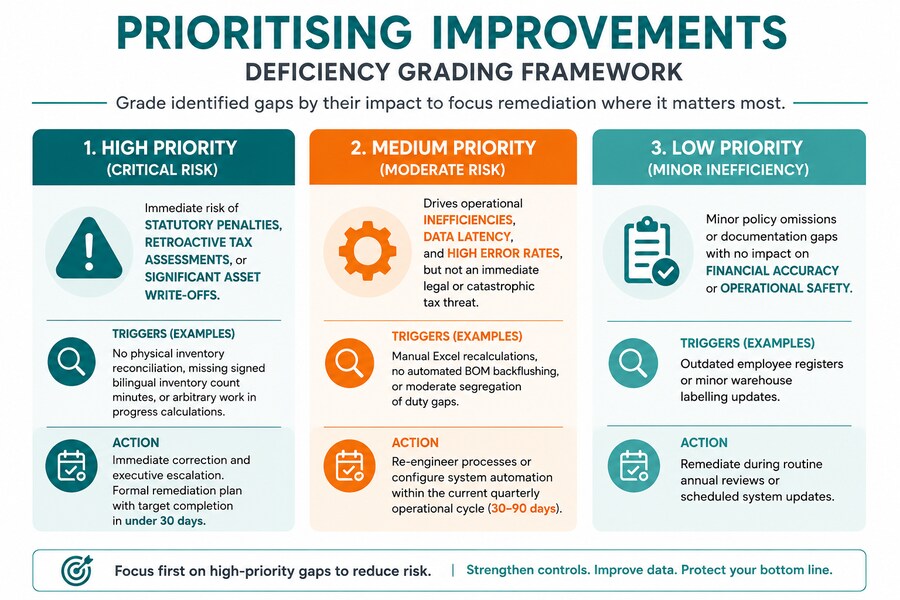
Assessing inventory control gaps
Businesses can reduce inventory-related risks by periodically reviewing their existing control framework. This review should cover how inventory is received, recorded, stored, issued, counted, and reconciled.
Key areas for assessment include:
- Whether inventory responsibilities and approval procedures are clearly defined;
- Whether physical stock is regularly reconciled with accounting records;
- Whether warehouse, production, and accounting systems produce consistent data;
- Whether inventory losses, write-offs, and valuation adjustments are adequately documented; and
- Whether material control weaknesses are identified and addressed in a timely manner.
The objective is not simply to identify accounting errors but to establish whether the business can reliably support its inventory balances and related tax positions.
Key inventory controls for businesses
An effective inventory control framework should generally include regular physical stocktakes, timely reconciliation of discrepancies, clear approval procedures, and consistent documentation of inventory movements.
Businesses should pay particular attention to:
- Stocktaking and reconciliation: Conducting regular physical counts and promptly investigating material discrepancies;
- Cut-off procedures: Ensuring that inventory receipts, deliveries, and sales are recorded in the appropriate accounting period;
- Costing and WIP: Applying consistent methodologies for allocating production costs and valuing work in progress;
- Inventory adjustments: Maintaining documentation for stock losses, write-offs, disposals, and valuation provisions; and
- Data consistency: Reconciling warehouse, purchasing, production, accounting, and sales records.
Takeaway
Inventory management is not solely an operational issue. Weak controls can affect financial reporting, production costing, VAT, CIT, and a business’s ability to substantiate transactions during an audit or tax inspection.
For manufacturers and other inventory-intensive businesses, the most effective approach is to maintain consistent records across warehouse, production, accounting, and tax functions. Regular stocktaking, timely reconciliation, reliable costing methods, and adequate supporting documentation can help reduce compliance risks and provide greater confidence in reported inventory balances.