Other Briefings
PCI and BPI 2025: Measuring Vietnam’s Business Environment and Private Sector Growth
Vietnam’s private sector remains central to the country’s economic growth strategy. Findings from the Provincial Competitiveness Index (PCI 2025) and the Business Performance Index (BPI) show how governance reforms, innovation capacity, and local business ecosystems are shaping competitiveness across Vietnam’s provinces and cities.

Vietnam’s private sector entered 2025 amid a period of significant policy and institutional reform. As the Government continues to position the private sector as a key engine of economic growth, efforts to improve governance, streamline administrative procedures, and strengthen the business environment have accelerated.
The newly updated Provincial Competitiveness Index (PCI 2025) and Business Performance Index (BPI) provide a timely assessment of how these reforms are shaping business conditions across the country, while highlighting the opportunities and challenges that continue to influence private sector development.
See also: Driving Vietnam’s Private Sector Growth: Incentives under Decree 20/2026
A new framework for assessing Vietnam’s business environment
PCI 2025 introduces a significant update to Vietnam’s flagship business environment assessment framework. While maintaining its core objective of measuring provincial economic governance through business experiences, PCI 2025 reflects changes in Vietnam’s development priorities and the evolving needs of the private sector.
Key changes introduced in PCI 2025 include:
- Updated methodology: Obsolete indicators have been removed, while new metrics have been introduced to capture emerging governance and business development challenges.
- Broader assessment scope: While previous PCI editions focused on business environment and governance, PCI 2025 takes a broader view, assessing the entire ecosystem supporting private sector growth.
- Expanded evaluation criteria: The framework now examines factors ranging from market entry conditions, access to resources, workforce development, policy implementation, and fair competition to the strength of legal institutions and government responsiveness.
- Greater focus on private sector outcomes: For the first time, indicators measuring private sector development and innovation have been separated from the traditional PCI framework and incorporated into a complementary Business Performance Index (BPI).
- Introduction of the BPI: The Business Performance Index assesses business outcomes across provinces, including enterprise growth, profitability, innovation capacity, and participation in supply chains, providing a more direct measure of private sector performance.
Together, PCI 2025 and the BPI offer a more comprehensive view of Vietnam’s business environment, allowing policymakers and investors to assess not only the quality of local governance but also the effectiveness of provincial ecosystems in supporting private sector growth and competitiveness.
Governance improvements and remaining challenges
Recent findings from PCI 2025 and BPI indicate Vietnam has made meaningful progress in improving governance and administrative conditions for business.
The strongest performing PCI dimensions were informal costs, compliance costs, and the legal framework, indicating improvements in legal protection, administrative efficiency, and efforts to reduce corruption-related barriers.
However, several weaknesses remain. Business support policies, enabling government, and fair competition received the lowest scores among PCI dimensions. Performance in fair competition and government responsiveness also varies considerably across localities, suggesting that reform progress is uneven nationwide.
In addition, innovation remains a key challenge for the private sector, with only around 3.11 percent of businesses allocating at least 3 percent of their revenue to innovation activities. Therefore, further efforts are needed to strengthen business support, promote fair competition, enhance local governance, and encourage innovation.
PCI 2025: Leading localities in supporting private sector development
Regarding local economic governance and the broader private-sector development ecosystem, PCI 2025 results suggest that the strongest-performing localities are those that deliver consistent results across multiple areas of governance rather than relying on a single competitive advantage.
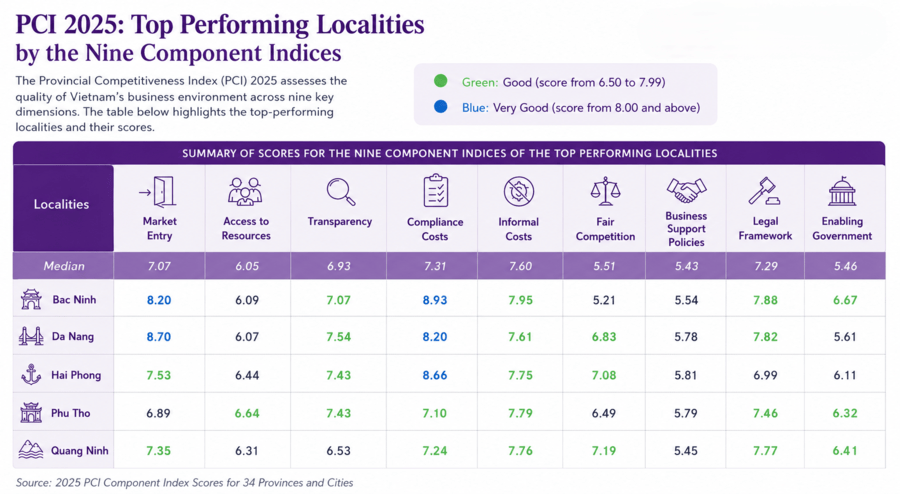
Among Vietnam’s 34 provinces and cities, Bac Ninh, Da Nang, Hai Phong, Phu Tho, and Quang Ninh were the only localities to achieve a “Good” PCI rating in 2025. Despite their different development models, all five ranked among the national top 10 in at least five of the nine PCI component indices.
Several common characteristics emerge among these leading provinces:
- Efficient administration: All five outperformed the national median in key indicators such as market entry and compliance costs, reflecting streamlined administrative procedures and a lower regulatory burden for businesses.
- Stronger governance quality: The provinces consistently scored above the national median in areas including transparency, informal costs, and legal framework, indicating more predictable and business-friendly operating environments.
- Balanced performance across governance dimensions: Rather than excelling in a single area, the top performers combine administrative efficiency, legal reliability, fair competition, and responsive governance to support long-term business growth and investor confidence.
Several provinces also demonstrated notable strengths:
- Bac Ninh led the country in administrative efficiency, recording the highest scores for market entry and compliance costs.
- Hai Phong and Quang Ninh stood out for their strong fair competition scores.
- Da Nang distinguished itself through a combination of efficient administration, transparency, and government responsiveness.
Despite their strong overall performance, all five provinces recorded relatively modest scores for business support policies and access to resources, highlighting areas where further improvements could enhance private-sector development.
BPI: Top provinces for innovation and business performance
Complementing PCI’s assessment of governance quality and business conditions, the BPI measures the actual outcomes achieved by the private sector in each locality, including business growth, profitability, innovation, and supply chain integration.
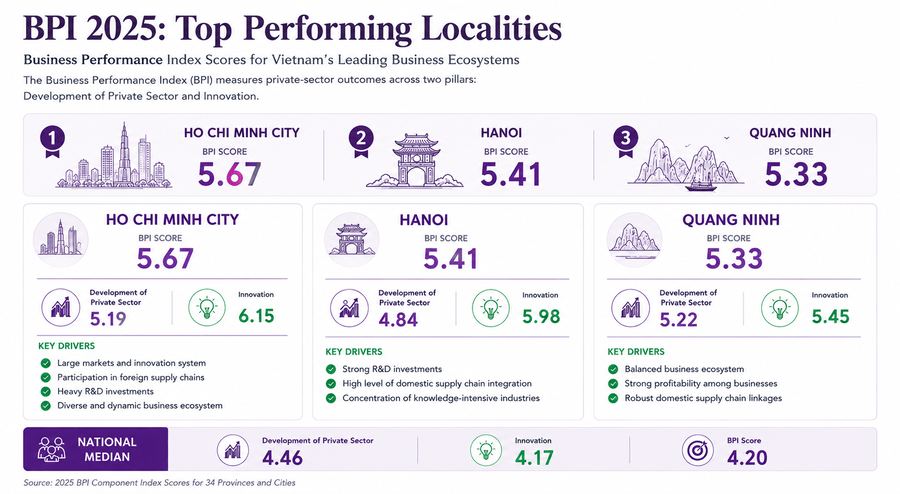
The highest BPI scores in 2025 were recorded by Ho Chi Minh City, Hanoi, and Quang Ninh. While each locality demonstrates a different development model, all three outperform the national median in both private-sector development and innovation, highlighting the importance of market connectivity, innovation capacity, and business ecosystem maturity in driving business performance.
Each of the three localities stands out in its own way:
- Ho Chi Minh City achieved the highest overall BPI score, supported by its large consumer market, strong innovation ecosystem, significant R&D investment, and deep integration into international supply chains.
- Hanoi ranked second, benefiting from high levels of innovation investment and strong domestic supply-chain integration.
- Quang Ninh distinguished itself through balanced private-sector development, strong profitability, and robust domestic supply chain linkages.
Although innovation continues to be a principal differentiator among Vietnam’s most successful business ecosystems, participation in both international and domestic supply chains appears closely associated with improved business outcomes. While Ho Chi Minh City capitalizes on global connectivity, Hanoi and Quang Ninh illustrate that robust domestic networks can equally foster business growth and competitiveness.
The 2026 outlook of Vietnam’s private sector
Looking ahead to 2026, Vietnam’s private sector is expected to benefit from the ongoing implementation of administrative reforms and stronger government support initiatives.
As improvements in governance, regulatory efficiency, and legal protections continue to take place, Vietnam will become an increasingly attractive market for both domestic and international investors seeking long-term growth opportunities.
However, several challenges are likely to persist. Weak market demand and intense competition will continue to pressure businesses, while access to finance remains a significant obstacle, particularly for small and medium-sized enterprises. Businesses that successfully strengthen their innovation and technology capabilities will be better positioned to capture opportunities from Vietnam’s ongoing private sector reforms.
See also: Resolution 79: Repositioning Vietnam’s State-Owned Enterprises



For international investors, Vietnam's different localities offer favorable conditions across almost every sector, particularly as the country shifts toward higher value-chain manufacturing, high-tech industries, and innovation. Taking a closer look at Vietnam's provinces and investment destinations before committing capital can provide a decisive competitive advantage. A tailored market study, dedicated location selection, or business matchmaking can uncover factors that are often hard to assess—such as special incentives, skilled labor availability, and tax breaks.
About Us
Vietnam Briefing is one of five regional publications under the Asia Briefing brand. It is supported by Dezan Shira & Associates, a pan-Asia, multi-disciplinary professional services firm that assists foreign investors throughout Asia, including through offices in Hanoi, Ho Chi Minh City, and Da Nang in Vietnam. Dezan Shira & Associates also maintains offices or has alliance partners assisting foreign investors in China, Hong Kong SAR, Indonesia, Singapore, Malaysia, Mongolia, Dubai (UAE), Japan, South Korea, Nepal, The Philippines, Sri Lanka, Thailand, Italy, Germany, Bangladesh, Australia, United States, and United Kingdom and Ireland.
For a complimentary subscription to Vietnam Briefing’s content products, please click here. For support with establishing a business in Vietnam or for assistance in analyzing and entering markets, please contact the firm at vietnam@dezshira.com or visit us at www.dezshira.com
- Previous Article Vietnam-Sweden Relations: Beyond EVFTA Toward Innovation and Green Growth
- Next Article