Other Briefings
Thai Investment in Vietnam: Key Investors, Growth Sectors, and Market Entry Strategies in 2026
Thailand is Vietnam’s second-largest ASEAN investor, with 805 active projects and US$15.4 billion in registered capital. This guide covers key sectors, leading Thai conglomerates, market entry strategies, and the 2026 investment outlook.
Key Takeaways
- Thailand is Vietnam’s second-largest ASEAN investor, with 805 active projects and US$15.4 billion in registered capital as of April 2026.
- Thai investment has evolved from consumer-focused sectors toward integrated industrial ecosystems spanning manufacturing, petrochemicals, energy, logistics, retail, and financial services.
- Major Thai investors, including SCG, CP Vietnam, Central Retail, ThaiBev, BJC, Amata, Bangkok Bank, KBank, and Krungsri, have used a mix of greenfield investment, mergers and acquisitions (M&A), and strategic partnerships to expand their presence in Vietnam.
- Future investment is expected to focus on high-tech manufacturing, renewable energy, digital transformation, circular-economy projects, and advanced agribusiness.
Following the establishment of official diplomatic relations in 1976, Vietnam and Thailand have developed strategic collaborations across multiple areas, especially in trade and investment. According to Vietnam’s Foreign Investment Agency, as of April 2026, Thailand remains Vietnam’s second-largest investor within ASEAN and ranks eighth among all foreign investors, with 805 active projects and US$15.4 billion in registered capital.
The bilateral relations continue to deepen. The bilateral upgrade to a Comprehensive Strategic Partnership in May 2025, followed by General Secretary To Lam’s state visit to Bangkok in late May 2026, has given Thai investment in Vietnam a new political tailwind.
The nature of that capital has undergone a decisive shift: Thai companies are no longer entering Vietnam solely to sell into its consumer market. Instead, they are constructing integrated industrial ecosystems encompassing manufacturing, energy, logistics, retail, and financial services, thereby positioning Vietnam as a central hub in their regional strategies.
How does growing trade support Thai investment in Vietnam?

Bilateral trade between Vietnam and Thailand reached US$22.1 billion in 2025, nearly 2.5 times the US$9.17 billion recorded in 2013 when the two countries first established their Strategic Partnership. Both sides have set a 2026 trade value target of US$25 billion, and the current trajectory makes that figure credible: two-way trade reached US$8.6 billion in the first four months alone, up 23.9 percent year over year.
The trade structure is also improving. Vietnam’s exports to Thailand rose 37.9 percent in the first four months of 2026, outpacing the 14.9 percent growth in imports from Thailand. The deficit is narrowing, and Vietnamese-manufactured goods, including electronics, digital products, and processed industrial outputs, are gaining ground in the Thai market alongside traditional raw materials.
For Thai investors, this deepening trade relationship reinforces Vietnam’s importance as both a production base and a consumer market. Growing cross-border supply chains, expanding industrial linkages, and improving market access have encouraged Thai companies to commit capital to sectors with long investment horizons, including renewable energy, petrochemicals, manufacturing, logistics, and retail.
Rather than short-term opportunities, these investments reflect confidence in Vietnam’s long-term role within ASEAN production networks and regional economic integration.
From consumer entry to industrial ecosystem: How Thai FDI has evolved
Thai businesses entered Vietnam in an earlier era through sectors directly tied to consumer demand: retail, food and beverages, agriculture, and construction materials. Vietnam’s large population, rapid urbanization, and rising middle class made it an attractive sales destination. Consumer-market fundamentals remain intact, but they no longer define the dominant investment thesis.
The current wave of Thai foreign direct investment (FDI) centers on integrated value-chain investment. Thai conglomerates are building production facilities, logistics networks, financial platforms, and industrial infrastructure directly in Vietnam, treating the country not just as a place to sell, but as a manufacturing and export base within their ASEAN operations.
This shift carries a competitive dimension. A Bangkok Post commentary has noted that Vietnam’s rise as a manufacturing and FDI hub is generating pressure on Thailand’s own economic position in the region. Thai companies are responding by embedding themselves more deeply in Vietnam’s growth story, part competitive hedge, part genuine opportunity.
The bilateral policy framework underpins this transition. Vietnam and Thailand actively promote the “Three Connections” Strategy: connecting enterprises within supply chains, linking infrastructure and logistics systems, including overland routes via Laos and coastal corridors, and aligning sustainable growth strategies across energy, green industry, and the circular economy. This framework gives the investment relationship a structural backbone that outlasts any single administration or business cycle.
Key sectors and leading investors
Petrochemicals and manufacturing
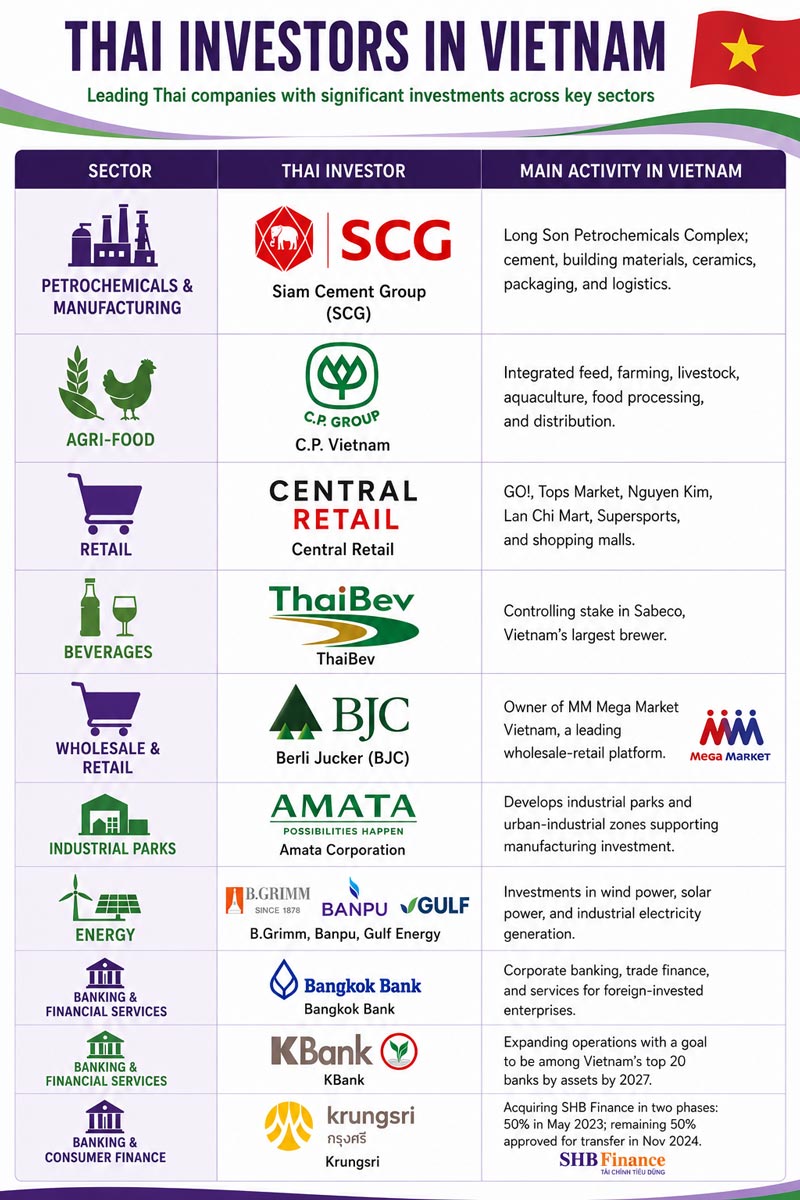
Siam Cement Group (SCG) is the most deeply embedded Thai conglomerate in Vietnam. Its flagship Long Son Petrochemicals Complex in Ho Chi Minh City represents a total investment exceeding US$5 billion, making it one of the largest FDI projects in Vietnam across any sector. SCG is now investing an additional US$500 million to upgrade the complex through an ethane feedstock integration project, improving operational flexibility and supporting lower-carbon production.
In 2025 alone, SCG contributed US$31.5 million to Vietnam’s state budget. Beyond petrochemicals, SCG operates across cement, building materials, ceramics, packaging, and logistics, building a vertically integrated industrial chain rather than a collection of standalone projects.
Agri-food
C.P. Vietnam, part of Charoen Pokphand Foods, operates the “Feed-Farm-Food” integrated model covering animal feed, breeding, livestock, aquaculture, food processing, and distribution. C.P. built this ecosystem entirely within Vietnam, controlling the supply chain from raw inputs to retail-ready products, a model that gives it structural depth few competitors can match.
Retail and beverages
Central Retail entered Vietnam through the 2016 acquisition of Big C from France’s Casino Group and has since expanded into a multi-format network spanning GO!, Tops Market, Nguyen Kim, Lan Chi Mart, Supersports, and shopping mall operations.
ThaiBev, through an affiliated company, acquired a 53.59 percent controlling stake in Sabeco, Vietnam’s largest brewer, in December 2017 for US$4.8 billion. That deal remains Vietnam’s largest-ever privatization transaction and gave ThaiBev immediate control of an established brand with nationwide production and distribution infrastructure.
Berli Jucker (BJC), part of TCC Group, acquired MM Mega Market Vietnam separately, adding a wholesale-retail platform to the conglomerate’s footprint.
Industrial parks and energy
Amata has developed industrial park and urban-industrial zone infrastructure in Vietnam for years, providing manufacturing space and related services that attract both domestic producers and foreign investors.
In energy, B.Grimm, Banpu, and Gulf Energy have invested in wind power, solar power, and industrial electricity generation, directly aligned with Vietnam’s accelerating energy transition and the power-supply demands of its expanding manufacturing base.
Banking and financial services
Bangkok Bank, one of the earliest Thai financial institutions in Vietnam, focuses on corporate banking, trade finance, and services for foreign-invested enterprises.
KBank is pursuing an aggressive growth strategy, targeting a position among Vietnam’s top 20 banks by total assets by 2027. Krungsri is acquiring SHB Finance, a consumer finance subsidiary of Saigon-Hanoi Commercial Joint Stock Bank, in two phases: 50 percent transferred in May 2023, with the remaining 50 percent approved for accelerated transfer in November 2024.
Market entry strategies: greenfield, M&A, and partnership
Greenfield investments for long-term growth
Thai companies have pursued three distinct approaches to building positions in Vietnam, each suited to different sectors and risk appetites.
Greenfield investment requires high capital commitment and long ramp-up periods, but delivers full operational control and first-mover positioning. Amata’s industrial park portfolio and SCG’s broader manufacturing buildout are the clearest examples of this approach in Vietnam. This approach suits investors with patient capital and a clear long-term thesis about Vietnam’s industrial trajectory.
M&A as a market-entry accelerator
Mergers and acquisitions (M&A) have been the faster route for Thai companies seeking scale in consumer-facing sectors. The ThaiBev-Sabeco, Central Retail-Big C, BJC-Metro, and Krungsri-SHB Finance transactions all follow the same logic: acquire existing brands, customer bases, distribution infrastructure, and regulatory licenses rather than building from scratch.
M&A compresses time-to-market and transfers going-concern value. New entrants should note, however, that premium targets in consumer and financial services are becoming scarcer as leading assets are absorbed. Investors arriving now will face higher acquisition multiples or need to look toward less-contested verticals such as energy, logistics, and high-tech manufacturing.
Partnerships as a strategic expansion tool
Technology and operational partnerships represent an emerging third model. SCG’s memorandum of understanding with FPT on digital transformation and smart governance illustrates how leading Thai investors now treat local partnerships as operational assets rather than mere regulatory requirements.
Joint ventures with Vietnamese counterparts also accelerate regulatory navigation, particularly in sectors such as banking, energy, and retail, where foreign ownership thresholds and licensing requirements require local partnership.
Outlook: Deeper integration through 2026 and beyond
Bilateral momentum gains institutional support
Vietnam-Thailand economic cooperation is entering a new phase characterized by stronger institutional coordination and policy follow-through. The Vietnam-Thailand Business Forum, held in Bangkok in May 2026, brought together government representatives and business leaders from both countries, reinforcing commitments under the Enhanced Strategic Partnership framework.
Momentum is also being supported by the 50th anniversary of diplomatic relations in 2026, which has elevated bilateral economic cooperation as a priority for both governments. Rather than relying solely on diplomatic goodwill, both sides are increasingly focused on translating political commitments into concrete trade, investment, and business outcomes.
Where the next wave of Thai investment is headed
The next phase of Thai investment in Vietnam is expected to concentrate on sectors aligned with both countries’ industrial upgrading strategies, including:
- High-tech manufacturing, particularly semiconductors, electronic components, and printed circuit boards (PCBs);
- Renewable energy and energy-transition projects;
- Digital transformation and technology-enabled services;
- Circular economy and sustainable manufacturing initiatives;
- Advanced agribusiness and food processing.
These sectors highlight the complementary nature of the two economies. Vietnam offers:
- Competitive manufacturing costs and scale;
- A young and increasingly skilled workforce;
- Extensive access to global markets through its network of free trade agreements (FTAs).
Thailand contributes:
- Advanced industrial and agricultural technologies;
- Established manufacturing expertise;
- Mature regional logistics and supply-chain capabilities.
This combination creates opportunities for long-term industrial partnerships and co-investment rather than purely capital-driven investment flows.
Supply-chain diversification creates new opportunities
Vietnam’s growing role in global supply-chain diversification is likely to further strengthen Thai investment interest. As multinational companies continue to expand production capacity outside China, Vietnam has emerged as one of ASEAN’s principal manufacturing destinations.
For Thai conglomerates, investing in Vietnam provides exposure to:
- Expanding regional and global supply chains;
- Vietnam’s preferential market access through major FTAs;
- Growing export-oriented manufacturing sectors; and
- Rising domestic consumption and industrial demand.
As bilateral integration deepens, investors may find the greatest opportunities in projects that align with the “Three Connections” framework – linking supply chains, businesses, and localities between the two countries. Companies positioned within these strategic corridors are likely to benefit from stronger policy support, deeper commercial partnerships, and sustained investment momentum through the remainder of the decade.



Setting up a business in Vietnam requires navigating company registration, local approvals, and work permit processes. We help FDI companies by preparing and submitting documentation, coordinating with authorities, and ensuring compliance, so they can start operations smoothly and focus on growth.
About Us
Vietnam Briefing is one of five regional publications under the Asia Briefing brand. It is supported by Dezan Shira & Associates, a pan-Asia, multi-disciplinary professional services firm that assists foreign investors throughout Asia, including through offices in Hanoi, Ho Chi Minh City, and Da Nang in Vietnam. Dezan Shira & Associates also maintains offices or has alliance partners assisting foreign investors in China, Hong Kong SAR, Indonesia, Singapore, Malaysia, Mongolia, Dubai (UAE), Japan, South Korea, Nepal, The Philippines, Sri Lanka, Thailand, Italy, Germany, Bangladesh, Australia, United States, and United Kingdom and Ireland.
For a complimentary subscription to Vietnam Briefing’s content products, please click here. For support with establishing a business in Vietnam or for assistance in analyzing and entering markets, please contact the firm at vietnam@dezshira.com or visit us at www.dezshira.com
- Previous Article Export Manufacturing in Vietnam: Logistics, Incentives, and Setup Considerations
- Next Article Resolution 10-NQ/TW: Vietnam’s New Strategy for High-Quality FDI and Economic Transformation