Other Briefings
Vietnam’s Four New Tax Decrees: Why Businesses Must Treat Compliance as an Integrated Exercise
Vietnam’s tax reforms entered a new phase on 1 July 2026 with the simultaneous entry into force of four implementing decrees covering tax administration, personal income tax (PIT), electronic invoicing, and transfer pricing.
Key takeaways
- Vietnam’s four new tax decrees came into force on 1 July 2026, completing the implementation of the country’s revised tax framework.
- The reforms cover tax administration, PIT, electronic invoicing, and transfer pricing, with interconnected compliance obligations.
- Businesses should align tax, payroll, invoicing, and transfer pricing processes to ensure consistent reporting and reduce compliance risks.
Rather than introducing standalone obligations, the four new decrees form an integrated compliance framework under the Law on Tax Administration 2025 and related tax laws. Businesses should therefore assess their tax governance holistically, as changes in one area, such as tax registration or invoice management, may directly affect compliance in others.
The government issued four decrees on 30 June 2026, all taking effect the following day:
|
Decree |
Primary focus |
Businesses most affected |
|
Tax administration |
All taxpayers |
|
|
Personal income tax |
Employers, payroll teams and individual taxpayers |
|
|
Electronic invoices and electronic documents |
Businesses issuing invoices electronically |
|
|
Transfer pricing and related-party transactions |
Multinational groups and enterprises with related-party transactions |
Although each decree governs a distinct area, they are designed to operate together. Businesses should therefore avoid implementing them in isolation, particularly where finance, payroll, tax and legal functions operate independently.
Decree 252 establishes the compliance foundation
Decree 252 provides the overarching framework for tax administration by standardising tax registration procedures, taxpayer obligations and enforcement mechanisms.
Among the key changes are:

- Harmonised deadlines for tax registration and notification procedures;
- Revised rules governing temporary exit suspension for tax debtors;
- Enhanced taxpayer protections during electronic system failures;
- A new mechanism allowing businesses under invoice enforcement to continue issuing invoices in certain circumstances; and
- Consolidation of five previous tax administration decrees into a single implementing regulation.
For businesses, Decree 252 establishes the administrative framework upon which the other decrees operate. Tax registration records, taxpayer status and compliance history all influence subsequent obligations relating to invoicing, payroll reporting and tax administration.
Decree 253 updates PIT compliance and payroll administration
Decree 253 provides detailed guidance on implementing the revised Personal Income Tax Law.
The decree clarifies several areas affecting employers, including:
- Taxable and non-taxable employment benefits;
- Residency determination;
- Deductible expenses and allowances;
- PIT withholding obligations;
- Tax finalisation procedures; and
- Documentation supporting tax exemptions and deductions.
For employers, payroll compliance cannot be viewed separately from tax administration. Employee registration information, taxpayer identification numbers and withholding declarations all depend on accurate tax registration under Decree 252.
Companies with expatriate employees should also reassess residency determinations and payroll policies to ensure continued compliance under the revised PIT framework.
Decree 254 strengthens Vietnam’s electronic invoicing regime
Decree 254 modernises Vietnam’s electronic invoicing framework by introducing more detailed rules governing electronic invoices and electronic documents.
The decree expands requirements relating to:
- Electronic invoice issuance and authentication;
- Invoice correction and replacement procedures;
- Electronic records and supporting documents;
- Responsibilities of taxpayers and service providers; and
- Data transmission between taxpayers and the tax authority.
The decree also supports the Government’s continued digitalisation of tax administration by strengthening the role of electronic records in tax compliance.
Businesses should review ERP systems, invoicing software and internal controls to ensure electronic invoice workflows remain aligned with the new requirements. Changes to invoice administration may also affect VAT reporting and broader tax compliance processes.
Decree 255 introduces a new transfer pricing framework
Decree 255 replaces Vietnam’s previous transfer pricing regulations with a new framework governing tax administration for related-party transactions.
The decree updates rules on:
- Identifying related-party relationships;
- Transfer pricing documentation;
- Comparability analysis;
- Disclosure requirements;
- Exemptions and documentation thresholds; and
- Tax authority administration of related-party transactions.
For multinational enterprises, transfer pricing compliance increasingly extends beyond preparing annual documentation. Tax authorities now have access to a broader range of taxpayer information collected through tax registration, electronic invoicing and tax administration systems, reinforcing the need for consistency across all tax filings.
See also: Vietnam Consolidates Transfer Pricing Rules under Decree 255/2026
Why businesses should implement all four decrees together
Although each decree regulates a different aspect of taxation, they collectively reshape how businesses manage tax compliance in Vietnam.
The interaction between the four regulations means that:
- Tax registration under Decree 252 supports PIT reporting, invoice administration and transfer pricing filings;
- Electronic invoices under Decree 254 generate transactional data that tax authorities may use when reviewing VAT, CIT and transfer pricing positions;
- PIT compliance under Decree 253 relies on accurate taxpayer registration and payroll reporting; and
- Transfer pricing compliance under Decree 255 increasingly depends on consistent financial, invoicing and tax administration records.
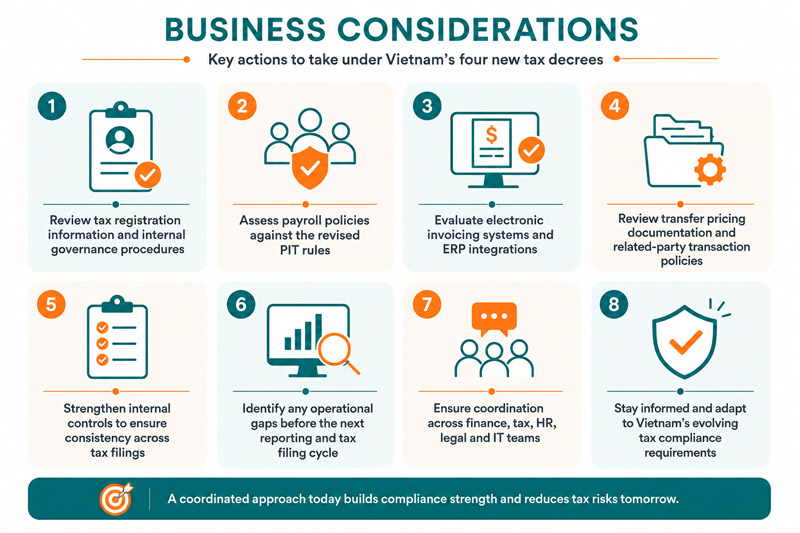
Rather than treating the reforms as four separate compliance exercises, businesses should adopt a coordinated implementation plan involving finance, tax, payroll, HR, legal and IT teams.



Managing tax in Vietnam is critical for FDI companies to stay compliant with local regulations, GST requirements, and global standards such as IFRS, navigate complex filings, and apply correct tax treatments. A well-structured tax process helps to avoid penalties and stay 100% compliant.
About Us
Vietnam Briefing is one of five regional publications under the Asia Briefing brand. It is supported by Dezan Shira & Associates, a pan-Asia, multi-disciplinary professional services firm that assists foreign investors throughout Asia, including through offices in Hanoi, Ho Chi Minh City, and Da Nang in Vietnam. Dezan Shira & Associates also maintains offices or has alliance partners assisting foreign investors in China, Hong Kong SAR, Indonesia, Singapore, Malaysia, Mongolia, Dubai (UAE), Japan, South Korea, Nepal, The Philippines, Sri Lanka, Thailand, Italy, Germany, Bangladesh, Australia, United States, and United Kingdom and Ireland.
For a complimentary subscription to Vietnam Briefing’s content products, please click here. For support with establishing a business in Vietnam or for assistance in analyzing and entering markets, please contact the firm at vietnam@dezshira.com or visit us at www.dezshira.com
- Previous Article Vietnam Revises High-Tech Park Rules: What Investors Need to Know
- Next Article