Key takeaways
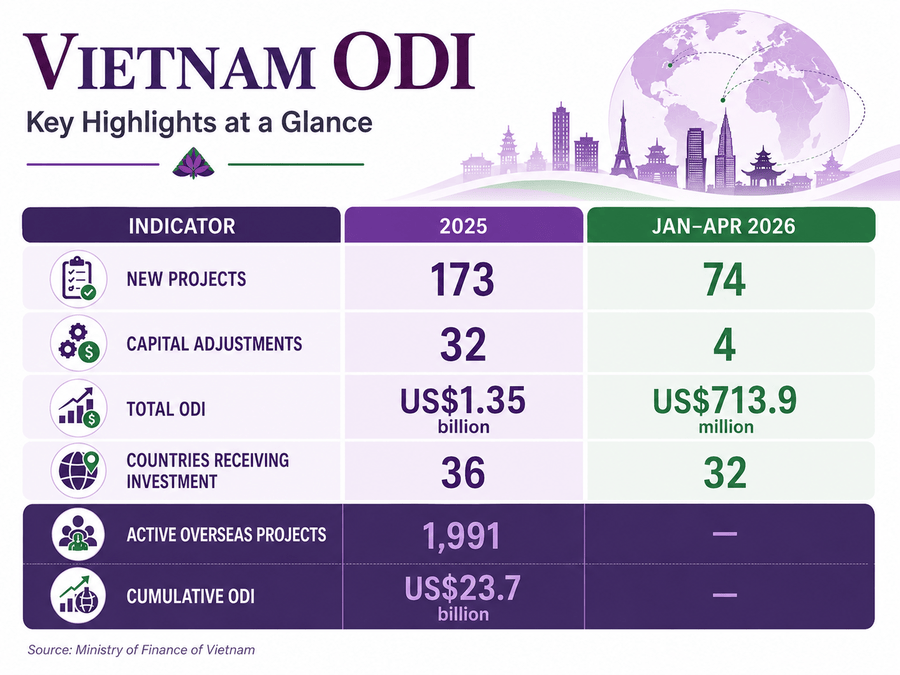
- Vietnam’s outbound investment reached a new milestone in 2025, with total overseas investment rising to US$1.35 billion, before accelerating further to US$713.9 million in the first four months of 2026, up 2.3 times year-on-year.
- Investment destinations are becoming more diversified. While Laos and Cambodia remain major recipients, Vietnamese companies are increasingly targeting strategic financial hubs such as Singapore and Hong Kong, as well as emerging markets including the UAE.
- Singapore has emerged as a preferred platform for regional expansion, offering regulatory certainty, extensive tax treaty coverage, strong financial markets, and regional headquarters advantages that support long-term international growth.
While neighboring markets such as Laos and Cambodia remain important investment destinations, Vietnamese companies are increasingly diversifying into developed financial centers and emerging markets. Singapore has become one of the most attractive destinations due to its stable regulatory environment, extensive tax treaty network, sophisticated financial ecosystem, and role as a regional headquarters location.
For Vietnamese companies planning international expansion, understanding where capital is flowing and why is becoming an important strategic consideration.
Plan Overseas Expansion
Assess target markets, investment structures, tax exposure, and regulatory requirements before expanding beyond Vietnam.Vietnam’s outbound investment continues to accelerate
Vietnamese outbound investment has expanded steadily over the past several years, reflecting the growing maturity of domestic enterprises and their increasing ambitions to build regional and global operations.
By the end of 2025, Vietnamese investors had active investments in 85 countries and territories, representing 1,991 valid overseas investment projects with cumulative registered capital exceeding US$23.7 billion.
In 2025 alone, investors launched 173 new projects and adjusted capital for another 32 projects, bringing total outbound direct investment (ODI) for the year to nearly US$1.35 billion.
The momentum has continued into 2026.
During the first four months of 2026, Vietnamese companies invested US$713.9 million overseas, representing a 2.3-fold increase compared to the same period in 2025. Of this amount, 74 newly licensed projects accounted for US$691.1 million, while four existing projects increased their investment capital by another US$22.8 million.
Sector priorities are shifting toward infrastructure and industrial expansion
Vietnamese overseas investment is also becoming more diversified by sector.
In 2025, newly registered capital was concentrated in:
- Electricity generation and distribution (37.7%)
- Manufacturing (22.3%)
- Wholesale and retail (9.7%)
During the first four months of 2026, investment priorities shifted slightly, with infrastructure-related industries accounting for a larger share of total capital:
- Electricity & utilities (22.9%)
- Construction (21.4%)
- Transportation & logistics (20.9%)
The data suggests Vietnamese companies are increasingly investing in sectors that support long-term regional operations rather than purely resource-based investments.
Investment destinations are becoming more diversified
Historically, Vietnamese outbound investment has been concentrated in neighboring economies where Vietnamese businesses possess established commercial networks and operational familiarity.
At the end of 2025, Laos remained Vietnam’s largest overseas investment destination with cumulative investment exceeding US$6.2 billion, followed by Cambodia at US$2.94 billion and Venezuela with approximately US$1.82 billion.
Laos also attracted the largest share of newly registered capital, accounting for 53.6 percent of total ODI, while the Philippines and Germany ranked second and third, respectively.
However, the first four months of 2026 suggest that geographic diversification is accelerating. Although Laos remained the leading destination, new capital also flowed to Kyrgyzstan, the United Kingdom, and Kazakhstan, reflecting growing investor confidence in a wider range of overseas markets.
Structure Overseas Investment
Get support with jurisdiction selection, investment structuring, entity establishment, and cross-border tax planning.Singapore is emerging as a strategic platform for international expansion
While traditional investment destinations continue to dominate total ODI value, Singapore has emerged as one of the most attractive jurisdictions for Vietnamese companies seeking regional expansion.
Unlike neighboring production-oriented markets, Singapore offers a combination of institutional strengths that support international business growth, including:
- A transparent legal and regulatory framework;
- One of Asia’s leading financial and banking ecosystems;
- Extensive double taxation agreements (DTAs);
- A broad network of free trade agreements (FTAs);
- Strong intellectual property protection; and
- Access to regional headquarters, financing, and capital markets.
These advantages make Singapore attractive not only as a destination for direct investment but also as a platform for managing regional operations across ASEAN and beyond.
The trend is becoming increasingly visible. By the end of 2024, the number of active Vietnamese investment projects in Singapore had increased by 59 percent compared to 2020, while cumulative investment capital had grown by 86 percent over the same period.
For many Vietnamese enterprises, Singapore offers an optimal balance between regulatory certainty, tax efficiency, and international connectivity.
See also: How Singapore’s Double Taxation Agreements Can Reduce Withholding Taxes on Cross-Border Investments
Hong Kong remains relevant, but growth has moderated
Hong Kong has historically served as another important financial gateway for Vietnamese outbound investors.
However, recent investment activity indicates that growth has become relatively modest compared to previous years. While Hong Kong continues to offer sophisticated financial services and capital market access, Vietnamese investors increasingly appear to be evaluating alternative regional financial centers alongside it.
This shift does not necessarily reflect declining competitiveness but rather a broader diversification strategy as Vietnamese companies expand internationally.
UAE is gaining attention as a new gateway
Although current investment volumes remain relatively small, the United Arab Emirates (UAE) is emerging as another market attracting Vietnamese interest.
Its position as a regional financial and logistics hub linking Asia, Europe, and Africa has strengthened its appeal for companies seeking access to new export markets. Combined with ongoing bilateral economic cooperation between Vietnam and the Gulf region, the UAE could become an increasingly important destination for future outbound investment.
Strategic implications for Vietnamese businesses
Vietnam’s ODI data indicates that companies are no longer expanding overseas solely to access natural resources or neighboring consumer markets.
Instead, investment decisions increasingly reflect broader strategic objectives, including:
- Diversifying revenue sources;
- Establishing regional headquarters;
- Strengthening supply chain resilience;
- Supporting cross-border mergers and acquisitions;
- Accessing international capital and financial services; and
- Building global brands.
For businesses pursuing these objectives, selecting the appropriate investment jurisdiction has become just as important as identifying the right commercial opportunity.
Outlook
As Vietnam’s outbound investment footprint continues to expand, businesses are becoming increasingly strategic in selecting investment destinations and structuring overseas operations. Lok Kah Seng, Associate Director – Group Commercial at Ascentium, shares his outlook on the next phase of Vietnam’s ODI and the factors likely to shape investment decisions:
“Vietnam’s outbound investment is expected to remain on an upward trajectory as domestic enterprises continue expanding internationally.
Traditional markets such as Laos and Cambodia will likely remain important due to longstanding commercial relationships, while established financial centers, including Singapore and Hong Kong, alongside emerging gateways such as the UAE, are expected to play increasingly strategic roles.
As investment destinations become more diversified, Vietnamese companies will need to balance market opportunity with regulatory certainty, tax efficiency, and long-term operational flexibility.
Singapore and Hong Kong each offer distinct institutional strengths, from financial ecosystem depth and treaty network coverage to capital market access and proximity to global investors. Both continue to serve as established platforms for Vietnamese enterprises pursuing regional and international growth.
The appropriate choice of jurisdiction will ultimately depend on each company’s strategic objectives, sectoral focus, and target markets. What is clear is that Vietnamese outbound investors are becoming more deliberate and sophisticated in how they structure and locate their international operations.”