The EU-Vietnam Free Trade Agreement (EVFTA) has significantly reshaped economic relations between Vietnam and the European Union (EU), creating new opportunities for trade and investment across a wide range of sectors.
Among EU member states, Sweden has emerged as a particularly important partner. While bilateral trade continues to expand under the EVFTA framework, recent developments suggest that the Vietnam-Sweden relationship is entering a new phase centered on innovation, digital transformation, green technology, and sustainable industrial development.
The shift has been reinforced by the establishment of a strategic partnership in science, technology, and innovation following discussions between Vietnamese Prime Minister Pham Minh Chinh and Swedish Prime Minister Ulf Kristersson in Stockholm in June 2025.
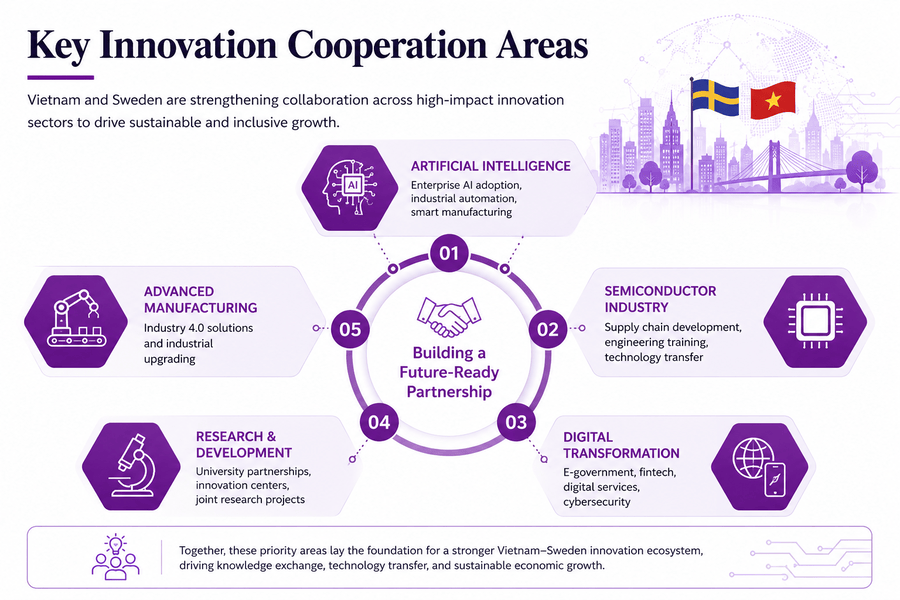
The partnership is expected to deepen collaboration in areas such as artificial intelligence (AI), semiconductors, green transition, nuclear energy, digital transformation, and high-quality workforce development.
Trade Rules and Regulations Between Sweden and Vietnam
EU-Vietnam Free Trade Agreement (EVFTA)
The EVFTA is one of the EU’s most comprehensive trade agreements, eliminating nearly 99 percent of tariffs between Vietnam and EU member states over a phased implementation period.
According to Vietnamese authorities, the agreement is expected to significantly boost Vietnam’s exports to the EU while supporting economic growth through greater market access, investment inflows, and supply chain integration.
For Swedish businesses, the EVFTA has reduced barriers to entering Vietnam’s rapidly expanding consumer and industrial markets, while Vietnamese exporters benefit from improved access to one of Northern Europe’s most advanced economies.
EU-Vietnam Investment Protection Agreement (EVIPA)
Complementing the EVFTA, the EU-Vietnam Investment Protection Agreement (EVIPA) is designed to provide stronger protections for investors from both sides through enhanced dispute resolution mechanisms and investment safeguards.
Once fully ratified by all EU member states, EVIPA is expected to further encourage long-term Swedish investment in Vietnam’s manufacturing, technology, and sustainability sectors.
Vietnam and Sweden expand cooperation beyond trade
In May 2026, Vietnam’s Ministry of Science and Technology and Sweden’s Ministry for Foreign Affairs held a series of high-level meetings in Hanoi to strengthen cooperation in research, innovation, digital transformation, and business connectivity.
During discussions between Vietnamese Deputy Minister of Science and Technology Hoang Minh and Swedish Director-General for Trade Policy Camilla Mellander, both sides emphasized the need to expand cooperation in:
- Innovation ecosystems;
- Startup development;
- Research and development (R&D);
- Digital transformation;
- Technology transfer;
- Business networking and investment facilitation.
The meetings also marked the launch of the first session of the Vietnam-Sweden Joint Committee on Science, Technology, and Innovation, providing a formal mechanism to advance bilateral projects and institutional cooperation.
Vietnam has identified Sweden as one of its leading European partners in innovation, green development, and digital transformation, while Sweden views Vietnam as a strategic gateway to Southeast Asia’s rapidly growing technology and manufacturing ecosystem.
Swedish companies deepen presence in Vietnam
The growing economic relationship is increasingly reflected in the activities of Swedish companies operating in Vietnam. While established brands such as H&M, IKEA, and Tetra Pak have maintained a long-term presence in the market, recent collaborations demonstrate a broader shift toward innovation, sustainability, circular economy solutions, and advanced manufacturing.
Tetra Pak
Swedish food processing and packaging company Tetra Pak continues to deepen its engagement with Vietnam’s food and beverage sector through advanced processing, packaging, and digital manufacturing solutions.
At the Vietnam International Dairy Exhibition 2026, the company introduced integrated Swedish technologies designed to help dairy and beverage producers improve food safety, preserve nutritional value, accelerate product development, and enhance production efficiency. The solutions particularly target the rapidly growing food supplement and nutrition (FSN) segment.
According to Tetra Pak, the global FSN market is projected to reach US$758.9 billion by 2034, growing at an annual rate of 7 percent, while Vietnam’s FSN market is expected to expand by 8.4 percent annually through 2027, up from the previous growth rate of 6.7 percent.
SYRE
Vietnam is also attracting a new generation of Swedish sustainability-focused investors.
SYRE, a textile recycling company backed by the H&M Group and Swedish entrepreneur Harald Mix, is planning its first industrial-scale recycling facility in Vietnam. The project is expected to involve an investment of approximately US$750 million, with construction scheduled to begin in 2027 and commercial operations targeted for 2029.
The facility aims to recycle polyester textile waste into virgin-quality recycled polyester, supporting circular economy objectives and sustainable supply chains. Over the longer term, SYRE has set a target of producing 3 million tonnes of recycled polyester annually, equivalent to roughly 4 percent of global polyester output.
The company selected Vietnam for its first large-scale plant due to the country’s strategic position in global textile supply chains and its strong manufacturing ecosystem.
Others
Vietnam’s importance to Swedish businesses extends beyond new investments. According to Swedish Ambassador Johan Ndisi, global Swedish brands such as H&M, IKEA, Tetra Pak, Ericsson, ABB, and Electrolux have established significant operations and partnerships in the country. More than 70 Swedish companies are currently active in Vietnam across sectors, including manufacturing, energy, telecommunications, healthcare, retail, and infrastructure.
For companies such as H&M and IKEA, Vietnam has evolved from a manufacturing base into a strategic sourcing and supply-chain partner. The country’s growing industrial capabilities, skilled workforce, and integration into global trade networks have made it an increasingly important component of Swedish companies’ regional and global operations.
Two-way trade
According to statistics from Vietnam’s General Department of Customs, bilateral trade between Vietnam and Sweden reached US$1.83 billion in 2025. Of this total, Vietnam’s exports to Sweden amounted to US$1.31 billion, representing a 25.4 percent increase compared to 2024, while imports from Sweden reached US$517 million, up 21.4 percent year-on-year.
Vietnam’s exports to Sweden
Vietnam’s exports to Sweden reached approximately US$1.31 billion during the reporting period, driven primarily by high-value manufactured goods. Telephones and electronic products accounted for nearly 40 percent of total exports, while machinery, textiles, and footwear remained key export categories.
The composition highlights Vietnam’s growing role in global technology and manufacturing supply chains, as well as the complementary nature of trade between the two economies.
See also: Vietnam’s Investment Support Fund for High-Tech Enterprises: Decree 182
|
Vietnam’s Exports to Sweden in 2025 |
||
|
Product |
Value (US$) |
Share (%) |
|
Telephones, mobile phones, and parts thereof |
357,863,540 |
27.3% |
|
Other goods |
169,907,071 |
13.0% |
|
Computers, electronic products, and components |
164,594,593 |
12.6% |
|
Textiles and garments |
161,972,288 |
12.4% |
|
Machinery, equipment, tools, and spare parts |
160,270,343 |
12.2% |
|
Footwear |
87,577,338 |
6.7% |
|
Iron and steel products |
60,865,130 |
4.6% |
|
Fishery products |
34,327,794 |
2.6% |
|
Wood and wooden products |
30,181,887 |
2.3% |
|
Handbags, wallets, suitcases, hats, umbrellas |
28,588,397 |
2.2% |
|
Plastic products |
19,334,609 |
1.5% |
|
Toys, sports equipment, and parts |
15,004,555 |
1.1% |
|
Bamboo, rattan, sedge, and carpet products |
10,340,111 |
0.8% |
|
Textile, garment, leather, and footwear materials |
4,944,366 |
0.4% |
|
Ceramic products |
1,664,580 |
0.1% |
|
Rubber |
532,930 |
0.0% |
|
Other base metals and products thereof |
2,432,743 |
0.2% |
|
Total |
1,310,402,274 |
100.0% |
| Source: Vietnam Customs | ||
Vietnam’s imports from Sweden
Vietnam imported US$516.9 million worth of goods from Sweden during the reporting period, with pharmaceuticals and machinery accounting for nearly 58 percent of total imports.
The import structure underscores Vietnam’s reliance on Sweden for high-tech industrial equipment, healthcare products, and specialized manufacturing inputs, reflecting the growing role of Swedish technology and innovation in supporting Vietnam’s industrial development and modernization efforts.
| Vietnam’s Imports from Sweden in 2025 | ||
|
Product |
Value (US$) |
Share (%) |
|
Pharmaceuticals |
156,703,867 |
30.3% |
|
Machinery, equipment, tools, and spare parts |
141,406,222 |
27.4% |
|
Other goods |
76,415,014 |
14.8% |
|
Paper |
59,818,820 |
11.6% |
|
Chemical products |
21,263,564 |
4.1% |
|
Iron and steel |
19,447,848 |
3.8% |
|
Iron and steel products |
16,315,734 |
3.2% |
|
Plastic products |
7,395,273 |
1.4% |
|
Computers, electronic products, and components |
5,432,772 |
1.1% |
|
Wood and wooden products |
4,858,787 |
0.9% |
|
Other petroleum products |
4,616,935 |
0.9% |
|
Plastics (raw materials) |
3,160,939 |
0.6% |
|
Electrical wires and cables |
32,891 |
0.0% |
|
Iron and steel scrap |
40,402 |
0.0% |
|
Total |
516,909,067 |
100.0% |
| Source: Vietnam Customs | ||
Vietnam-Sweden trade moving forward
While the EVFTA remains the foundation of Vietnam-Sweden economic relations, bilateral cooperation is increasingly expanding beyond conventional trade.
The establishment of a strategic partnership in science, technology, and innovation, combined with growing collaboration in green transition, digital transformation, advanced manufacturing, and circular economy solutions, signals a broader and more sophisticated phase of engagement between the two countries.
See also: Vietnam’s On-Spot Export and Import Regime: Latest 2025 Updates
This article was originally published February 26, 2024. It was last updated June 11, 2026.