Other Briefings
From Outsourcing to Ownership: Using the BOT Model to Build a Software Team in Vietnam
Explore Vietnam’s growing software outsourcing market and how Build-Operate-Transfer (BOT) models help foreign companies establish offshore development centers with lower risk, faster market entry, and scalable ownership options.

Vietnam has become one of Asia’s most competitive software outsourcing destinations. Over the past decade, the country has built a strong reputation for engineering talent, cost efficiency, and reliable delivery capacity. Today, it serves a broad base of international clients ranging from startups to multinational enterprises.
This growth aligns with a wider global shift in how companies build technology teams. Rising labor costs in developed markets, persistent talent shortages, and ongoing digital transformation have pushed more businesses to establish offshore development centers across Asia.
Within this trend, the Build-Operate-Transfer (BOT) model has gained traction as a strategic entry point into Vietnam. The model allows foreign companies to establish a dedicated software development operation in Vietnam with lower upfront risk while preserving a clear path to future ownership.
Vietnam’s software outsourcing market landscape
Vietnam’s software outsourcing sector has expanded rapidly and now plays an important role in the country’s digital economy. The country has evolved from a low-cost coding destination into a full-service software development hub serving global demand across a wide range of technologies.
According to Mordor Intelligence, Vietnam’s IT services market is projected to generate approximately US$2.63 billion in revenue in 2026, with software outsourcing remaining one of its strongest segments.
Vietnam also ranks strongly in global outsourcing competitiveness reports. In Kearney’s Global Services Location Index, Vietnam ranked among the top global destinations for offshore services, supported by financial attractiveness, talent availability, and business environment.
The country’s software outsourcing ecosystem is concentrated in three major hubs:
- Ho Chi Minh City remains the largest commercial center and hosts many international outsourcing firms, startups, and foreign invested technology companies.
- Hanoi offers strong access to engineering talent and benefits from close proximity to government institutions, major universities, and domestic technology groups.
- Da Nang has emerged as a fast-growing outsourcing location, particularly for Japanese and Korean technology firms seeking lower operating costs outside the two largest cities.
Vietnam serves a diverse international client base. Major demand comes from the United States, Japan, South Korea, Singapore, Australia, and Europe. Japanese companies in particular continue to view Vietnam as a preferred partner for dedicated offshore engineering operations.
Service offerings have also become increasingly sophisticated. Vietnamese firms now support:
- Custom software development;
- AI and machine learning solutions;
- Cloud migration and cloud engineering;
- Enterprise software development;
- Fintech solutions;
- Mobile application development;
- Product engineering; and
- Digital transformation consulting.
Structural trends are driving the sector’s expansion. These include the expansion of the digital economy, increased foreign direct investment into Vietnam’s technology sector, and continued demand for distributed engineering teams.
Government policy has also contributed to this momentum. Vietnam’s National Digital Transformation Program aims to accelerate digital infrastructure, expand digital business activity, and position the country as a regional technology hub by 2030.
Why global companies choose Vietnam for software outsourcing
Large talent pool and competitive labor costs
Vietnam combines cost competitiveness with a growing pool of skilled technology professionals. Software developer salaries remain lower than in many developed markets, allowing companies to achieve significant cost savings while maintaining access to qualified talent.
The country is also home to one of Southeast Asia’s largest IT workforces, supported by a steady pipeline of graduates from universities and technical institutions. According to TopDev’s Vietnam IT Market Report, Vietnam has more than 530,000 IT professionals, with tens of thousands of new graduates entering the market each year from universities and technical institutions.
Stable business environment
Vietnam’s broader business environment further strengthens its position as a software outsourcing destination. Political stability, sustained economic growth, improving digital infrastructure, and strong support for foreign investment continue to attract global technology companies.
Workforce stability is another advantage. Compared with several competing outsourcing markets, Vietnam generally experiences lower turnover among software professionals, helping companies maintain team continuity and retain institutional knowledge.
Understanding the Build Operate Transfer model in software outsourcing
The BOT model has become an increasingly popular structure for companies entering Vietnam’s software services sector.
In the IT outsourcing context, BOT refers to a staged approach where a local service provider helps a foreign company establish and run an offshore software development operation before transferring ownership to that company.
The model generally includes three phases.
Build
In this phase, the local partner sets up the operation. This typically includes recruitment, legal setup support, office infrastructure, payroll systems, and operational processes tailored to the client’s requirements.
Operate
Once established, the local partner manages day-to-day operations. The engineering team works exclusively for the client while the BOT provider oversees administration, local compliance, HR support, and operational management.
Transfer
After the operation stabilizes, ownership gradually transfers to the foreign company. This can include employee transition, operational control, infrastructure ownership, and management handover.
BOT vs. traditional outsourcing models
Compared with traditional outsourcing, the BOT model provides greater strategic control by allowing companies to build dedicated engineering teams aligned with their product roadmap, corporate culture, and technical standards.
Compared with staff augmentation, BOT offers a clearer path to ownership and long-term operational independence. This makes it particularly attractive for companies seeking to establish dedicated engineering capabilities in Vietnam while minimizing market entry risks.
Why the BOT model is an effective market entry strategy in Vietnam
Faster market entry
One major advantage of the BOT model is that foreign firms can establish engineering operations in Vietnam without immediately setting up a local legal entity. This enables companies to begin recruitment, team building, and project delivery more quickly than through a traditional market entry approach.
Lower administrative and compliance burdens
During the build and operate phases, the local BOT provider typically manages labor contracts, payroll administration, regulatory compliance, office facilities, and other operational requirements. This allows foreign companies to focus on business objectives while reducing the complexity of entering a new market.
Scalable growth with reduced risk
The BOT model enables companies to expand gradually. Businesses can start with a small engineering team, assess performance and collaboration, and scale operations over time as demand grows. This phased approach helps reduce investment risk while maintaining flexibility.
Access to local talent market expertise
Local BOT partners bring valuable knowledge of Vietnam’s recruitment landscape, including talent availability, salary benchmarks, hiring channels, and employment regulations. Their market expertise can improve recruitment efficiency and help companies navigate local workforce challenges more effectively.
A clear path to ownership and greater control
Unlike traditional outsourcing arrangements, BOT structures are designed to transfer governance and operational control to the client over time. This provides companies with immediate operational support while maintaining a long-term pathway to full ownership of the development center.
Stronger knowledge retention and team continuity
BOT arrangements support the development of dedicated teams focused exclusively on one company’s products, technologies, and business processes. As a result, institutional knowledge accumulates over time, improving continuity and reducing the knowledge-transfer challenges often associated with project-based outsourcing.
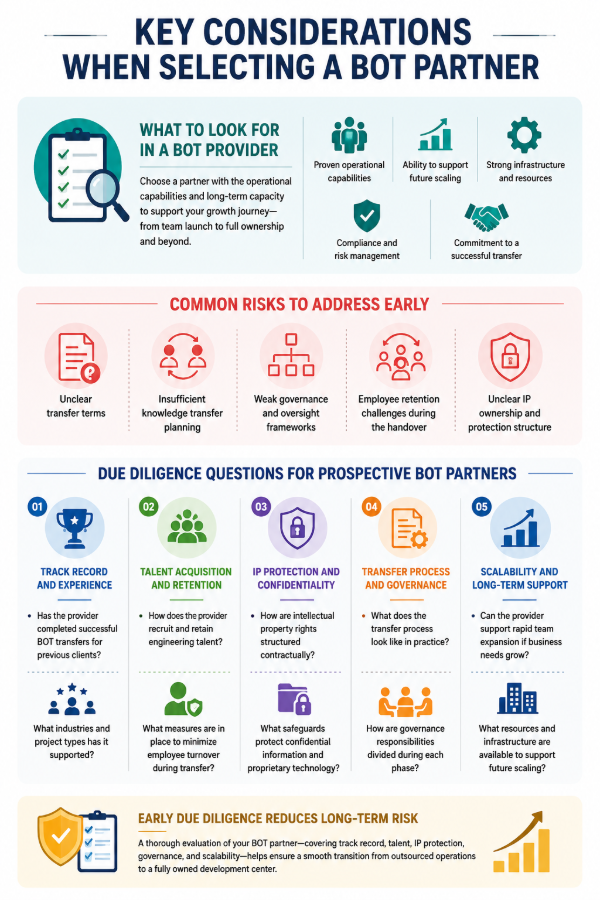
Key considerations when selecting a BOT partner in Vietnam
Choosing the right BOT partner plays a central role in the success of any market entry strategy. Companies should evaluate providers across several key areas:
Proven BOT experience
A provider’s track record should extend beyond team formation to encompass the full BOT lifecycle, including successful transfer execution. Key considerations include:
- Experience managing the build, operate, and transfer phases;
- A history of successful BOT transitions for international clients; and
- Expertise in supporting long-term operational growth.
Recruitment and local compliance capabilities
The ability to attract and retain qualified talent is critical to the success of a BOT arrangement. Companies should assess whether the provider offers:
- Access to software engineers across relevant technologies and seniority levels;
- Established recruitment and talent retention capabilities;
- Knowledge of Vietnamese labor regulations and employment practices;
- Payroll administration and tax compliance expertise; and
- Strong intellectual property protection measures.
Transparency, governance, and cultural fit
Clear operating frameworks and strong working relationships can significantly influence long-term outcomes. Businesses should seek transparency regarding:
- Transfer timelines and milestones;
- Governance and reporting structures;
- Team ownership arrangements; and
- Pricing and cost models.
In addition, cultural compatibility should not be overlooked. Strong communication practices, disciplined project management, and alignment with international business standards can help support effective collaboration throughout the BOT lifecycle.
Bottom line
Vietnam’s software outsourcing sector is moving beyond project-based services toward dedicated offshore capability building. For foreign technology firms, the BOT model provides a flexible and scalable approach to entering the market, combining access to talent, operational efficiency, and a clear path to long-term ownership.
As Vietnam’s digital ecosystem continues to mature, it is increasingly becoming a strategic destination for building engineering capacity in Asia.



Setting up a business in Vietnam requires navigating company registration, local approvals, and work permit processes. We help FDI companies by preparing and submitting documentation, coordinating with authorities, and ensuring compliance, so they can start operations smoothly and focus on growth.
About Us
Vietnam Briefing is one of five regional publications under the Asia Briefing brand. It is supported by Dezan Shira & Associates, a pan-Asia, multi-disciplinary professional services firm that assists foreign investors throughout Asia, including through offices in Hanoi, Ho Chi Minh City, and Da Nang in Vietnam. Dezan Shira & Associates also maintains offices or has alliance partners assisting foreign investors in China, Hong Kong SAR, Indonesia, Singapore, Malaysia, Mongolia, Dubai (UAE), Japan, South Korea, Nepal, The Philippines, Sri Lanka, Thailand, Italy, Germany, Bangladesh, Australia, United States, and United Kingdom and Ireland.
For a complimentary subscription to Vietnam Briefing’s content products, please click here. For support with establishing a business in Vietnam or for assistance in analyzing and entering markets, please contact the firm at vietnam@dezshira.com or visit us at www.dezshira.com
- Previous Article Is Your Business on the List? Vietnam Speeds Up Tax Code Closures for Inactive Firms
- Next Article Thai Nguyen After Merger: Northern Vietnam’s Next Industrial Growth Hub